Youth

Cast: Michael Caine, Harvey Keitel, Rachel Weisz, Paul Dano, Madalina Diana Ghenea, Jane Fonda, Alex Macqueen, Chloe Pirrie, Alex Beckett, Nate Dern, Mark Gessner, Mark Kozelek, Ed Stoppard, Paloma Faith, Sonia Gessner
Writer/Director: Paolo Sorrentino
118 mins
A retired orchestra conductor is on holiday with his daughter, when he receives an invitation from Queen Elizabeth II to perform for Prince Philip's birthday. The script for Paolo Sorrentino’s film is both touching and whimsical, whilst engaging your emotions on several layers - being a prime example of how the written word can be expertly directed to something approaching perfection. “Youth” is full of qualities that almost defy review, as to attempt a dissection or explanation of the film as a whole would take away the beauty. My suggestion is simply to open your heart and mind and let the story sweep you away. The film revolves around Fred Ballinger (Michael Caine) a retired orchestra conductor spending an extended break at a luxurious spa, set amongst the Alps. The rooms are full of famous filmmakers, sports celebrities and the upper echelons of polite society. Everyone is quiet and respectful, offering the sense that any alternative would upset the serenity of the surroundings. Fred's best friend Mick Boyle (Harvey Keitel) is a film director presently honing his latest script whilst musing over the past with Fred. The pair take long strolls to discuss their respective lost loves, regrets and accomplishments. The dialogue is neither superficial nor trite, but rather, rich in subtle wisdom and emotional anecdotes.
Though these two are the central characters, “Youth” is actually about us all. Whether you're young and diving full force into uncharted waters, or nearing the end of your journey and looking at life with melancholy reflection, there is something here to move you. Inevitably the film will be appreciated slightly more by older audiences but it certainly isn’t a nostalgic walk down memory lane. The lacing of eccentric characters who move in and out of the story, adds a fanciful dance to the whimsy, keeping a sufficient balance for the powerful moments to achieve a much greater impact. In addition to outstanding work from both Caine and Keitel, the supporting players Rachel Weisz and Paul Dano are both wonderful in the quiet atmosphere.
There are moments when Sorrentino pulls back the dialogue and allows the soundtrack to conduct the scene. The music (a sublime score by David Lang) actually becomes quite a powerful tool - and the choices used here are as moving as any words could possibly be. Throughout the feature you’ll experience the feeling that at any given moment the characters could awaken from an invigorating sleep and the viewing audience would quickly discover that they'd been voyeurs of the subconscious mind of those on screen.
TRUMBO
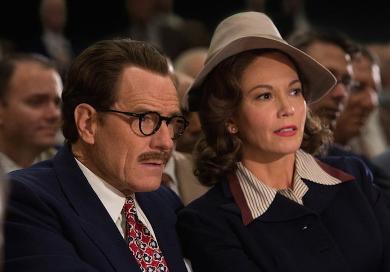
Cast: Bryan Cranston, Diane Lane, Louis CK, John Goodman, Helen Mirren, Elle Fanning, Michael Stuhlbarg, David James Elliott
Director: Jay Roach
124 mins
Trumbo is a film about a screenwriter who was blacklisted during the Communism-scare era of the 1940s, 50s and 60s, but who finally prevailed against the system with sheer determination, hard work and talent. A number of films have been made about the Hollywood blacklist, but this is the one which finally takes us inside that world. Dalton Trumbo (Bryan Cranston), was a member of a prominent group of Hollywood talents called the “Hollywood 10” who in 1947 were targetted by the Congressional House Committee on Un-American Activities for their political views. They refused to testify about Communist Party members and others, based on First Amendment rights (some later refused on Fifth Amendment grounds).
Trumbo and others went to prison for refusing to testify, even though those were not legal sentences, and they lost their jobs, even though that lock-out wasn't legal, either. The case strategy of the Hollywood 10 was based on the expected outcome of their hearings in the Supreme Court, but the make-up of the court changed during the trials, and it no longer favoured their American First Amendment rights. But Trumbo was no ordinary screenwriter, and no ordinary convict either. He fought back the only way he knew, with his typewriter, making a deal with Frank King (John Goodman) of King Brothers Productions to write scripts under assumed names. King loved Trumbo's scripts and before too long he had so much work for him that Trumbo was able to farm out script work to other blacklisted writers who, just like him, needed the money. Eventually, Trumbo would win two Academy Awards for scripts he wrote whilst blacklisted, even though his name did not originally appear in the credits of either film, “Roman Holiday” (1953) and “The Brave One” (1956). His work became so well known that a top star - Kirk Douglas and the director Otto Preminger both sought him out. The blacklist was openly defied and Trumbo's name appeared once again on the silver screen in “Spartacus” (1960) and “Exodus” (1960). He had beaten the system, but it would take decades to get all of his film credits restored.
Trumbo and others were up against extremely powerful forces, including the notorious syndicated columnist Hedda Hopper (Helen Mirren) and John Wayne, four-term president of the powerful Motion Picture Alliance for the Preservation of American Ideals. Hedda Hopper was also a member of the Alliance as indeed was Walt Disney. Ayn Rand wrote a pamphlet for the Alliance, denouncing moral corruption in cinema. Trumbo himself was a rare exception to the blacklist. Most didn't beat the system the way he did, and for many years a great number of those on the blacklist were unable to get jobs in the entertainment industry with some never working again. The film shows the damage done to Trumbo and others who were blacklisted, losing their homes and families as a result.
Some, like Edward G. Robinson (Michael Stuhlbarg) eventually named names to the House Committee on Un-American Activities. Even though he had supported the Hollywood 10, he was shunned by them after his testimony, with bitter divisions developing amongst those on the blacklist about the proper tactics to use. The fear, frustration and stress caused by the blacklist permeates the film, but there is one especially welcome scene of defiance. When a member of Motion Picture Alliance for the Preservation of American Ideals comes to threaten Frank King for using blacklisted talent in his King Brothers flicks, Frank starts smashing up his own office with a baseball bat. Holding the bat against the throat of the man threatening him, he basically tells the man he'll kill him if the Alliance carries out its threats and ruins his business.
Cranston is outstanding in his performance, ably supported by Diane Lane as his wife, and Elle Fanning, who plays his daughter. Other notable turns, in addition to Goodman's, are Louis C.K. in a fine portrayal of his good friend, Arlen Hird. It’s an extremely well-written script by John McNamara) with very able direction from Jay Roach.
