Director: Antoine Fuqua
123 mins
Boxing has long been a cinematic subject for both visceral drama and allegory and as a metaphor for personal and national redemption. We’ve had Jon Voight in “The Champ”, Sylvester Stallone’s merciless series of “Rocky” outings and of course Martin Scorsese’s peerless “Raging Bull” crafting a two-hour epic to mock the very idea of nobility in such a savage activity. Now we have Antoine Fuqua’s “Southpaw”, a film of swollen eyes, lumpy bodies, creaking joints, and bloody mouths, all lingered on with a detail that verges on the perversely affectionate, each battle scar a testament to a vaguely but nonetheless forcefully defined notion of masculinity.
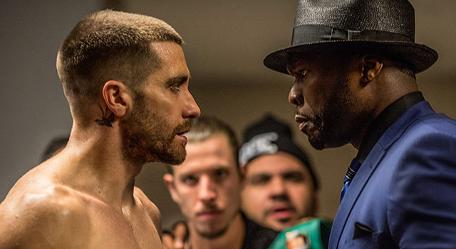
The heightened depictions of violence pile miseries on undisputed world light heavyweight champion Billy Hope (Jake Gyllenhaal) with his craftsmanship of swiftness and intensity. It’s all going swimmingly for the great (white) Hope when suddenly he loses his wife, Maureen (Rachel McAdams), in an explosive altercation with a rival boxer (Miguel Gomez) and his entourage. As sure as round 2 follows the first, he also loses his career, his wealth, his associates/fairweather friends, his palatial home, and as heartbreakingly as the loss of his beloved Maureen, the custody of his young daughter, Leila (Oona Laurence).
Gyllenhaal plays Billy, it has to be said, magnificently, with all the believable tics of a veteran boxer. Raised by the system, our pugilistic protagonist lacks any formal education - resulting in further complications, added to several years’ worth of head injuries manifesting verbally through self-conscious mumbles in conversation. The actor's willingness to take actual punches in lieu of a stunt double pays off handsomely in the authentic reactions of mixed agony and glee when fighters land some real haymakers on Billy, who uses bouts as a means of inviting self-martyring punishment. Forest Whitaker exhibits the weary but honest wisdom of a small-time gym owner named Tick, who trains disadvantaged and neglected kids. The only character with any sense of variation is Leila, though her ostensible complexity is a function of plot convenience, which demands either resentment or affection depending on the scene. Even this child believes her old man’s only true salvation lies in his fighting prowess, and conversely/perversely only forgives him when he pledges to get back to in the ring.
Apart from Gyllenhaal's outstanding performance, another highlight of the film is Mauro Fiore's stunning cinematography, that lends Billy's prematurely aged and arthritic body the countenance of a gargoyle. The pale light of early morning shots show the drains on Gyllenhaal's flesh tones and it is the expressionistic illustration of a tired man (Whittaker) teaching a broken one, the one-eyed man leading the blind, that best articulates a quite brilliant film - dedicated in approach to self-improvement.
Director: Christopher McQuarrie
2hrs 11mins
Mission: Impossible - Rogue Nation, the fifth of the series again features Tom Cruise as impossibly energetic Ethan Hunt, this time with Alec Baldwin who finds himself extolling the virtues of the secret agent: "Hunt is the living manifestation of destiny," he proclaims. Quite an utterance and indeed quite a turn-around in perceptions for Baldwin's CIA Director Hunley, who, for most of the film, systematically denounces, disavows, and tries desperately to disband Hunt's Impossible Missions Force. The team of deep-cover operatives - Simon Pegg as tech whiz but this time a lot less nerdy Benji Dunn, Ving Rhames as cool-dude hacker extraordinaire Luther Stickell, an under-used Jeremy Renner as agent-with-bags-under-his-eyes William Brandt - has been nothing but trouble. All sorts of "wanton acts of mayhem," as Baldwin puts it, have been pinned on the IMF (probably the International Monetary Fund too) but in this case Hunt’s Posse.
But of course, Hunt and his crew are not to blame. No no no. There's a mysterious group called the Syndicate, an "anti-IMF" bent on doing what evil masterminds and their nefarious nuisances are wont to do: rule the world, and transfer billions of dollars of other people's money into a secret bank account while they're at it. The usual drill. It has to be said though that there’s an air of malaise and a sense of punctured enthusiasm in this outing - nowhere as enjoyable as its 2011 predecessor, Mission: Impossible - Ghost Protocol, which was bursting with imagination and verve. Rogue Nation nonetheless still goes through the standard procedures of moving Hunt and co. around the globe (Minsk! London! Washington! Havana! Paris! Vienna! Casablanca!) from one outlandish action set piece to the next.
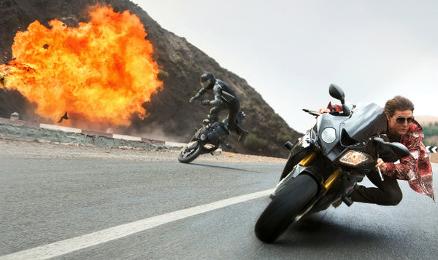
By now you’ll have seen Cruise clutching the side of a military cargo plane as it takes off, hoping Benji can open the thing’s door via his laptop (don’t even begin to ask how this is done – the clue’s in the title) before Hunt's ears pop. Also Cruise dives into 70,000 gallons of pressurised water, hoping he can hold his breath for three minutes while he switches a data card gizmo around. Cruise races a BMW motorbike along Moroccan roadways, hoping he won’t skid out while leaning into the turns at 120 m.p.h. (As is par for the course for our wee action man – he is not wearing a helmet, either.)
The film runs for two hours-plus and there’s just a lot more of everything – in fact there’s just too much. There's a world of difference between velocity and momentum, and while the chases, shootouts and fights rarely flag, my interest did, and yours may well too. Christopher McQuarrie, the Oscar-winning screenwriter of The Usual Suspects, has worked with Cruise three times previously - he scripted the Nazi drama Valkyrie and the sci-fi outing Edge of Tomorrow, and directed Cruise in Jack Reacher. Here though in Rogue Nation, McQuarrie's attention to the intricacies of the plot and the choreography of the action get out of control – and it ends up creating a yawn-like chasm through the whole picture. He needs to lighten up and use humour occasionally, that’s the lesson Brad Bird picked up in Ghost Protocol, which contributed hugely to its success. There are a few plus points though. McQuarrie uses Swedish actress Rebecca Ferguson as British espionage ace Ilsa Faust. It takes a while to figure out where Ilsa's allegiances lie but she and Hunt get to jump around from the roof of the Vienna Opera House and roar through the Atlas Mountains together and she has a humdinger of a leg-whipping headlock.
