Eddie The Eagle
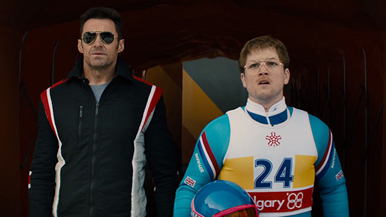
Cast: Taron Egerton, Hugh Jackman,
Keith Allen, Jo Hartley, Mark Benton, Tim McInnerny
Director: Dexter Fletcher
105 minutes
A happy, uplifting and heartwarming tale of unlikely sporting triumph, Eddie the Eagle offers up a lightweight but hugely enjoyable yarn about the power of determination. Despite its conventions, only the concrete-hearted could claim not to be charmed by the tale of real-life British ski jumper Michael “Eddie” Edwards, marvellously portrayed by Taron Egerton. As a youngster, perennial optimist Eddie announces to anyone who will listen, but mainly his bemused and bewildered mum (Jo Hartley) and realist builder dad (Keith Allen), that he is determined to become an Olympian - this despite having lower limb problems with corrective leg braces and distinctive beer-bottle-lensed pseudo-aviator spectacles. Setting his sights on the Winter Olympics, he manages some moderate success as a downhill skier – but the stuffy public school oiks (especially via a hilarious performance - and toupee - from Tim McInnerney) running the British Olympic team, rudely turn up their collective noses at him. However, perpetually ambitious Eddie won’t be put off, and inspired by the knowledge that the UK hasn't fielded a ski jumper since the 1920s, he reckons he is in with more than a shout if he attempts to qualify for the Games. Eddie’s primary motivation isn’t winning – but participating, and this point is reiterated by the quotation from Olympics founder Pierre de Coubertin: “the most important thing in the Olympic Games is not winning, but taking part.” However, Eddie finally discovers that his real challenge is to take himself seriously, thus enabling everyone else to adopt a similar viewpoint towards him.
As the story develops, Eddie wins almost everyone's hearts with his honesty and goofy charm, this despite being devoid of any natural talent and training, as he virtually throws himself down increasingly higher ski jumps. The first-class directing by the increasingly impressive Dexter Fletcher, and screenplay by Sean Macaulay and Simon Kelton, embellishes Edwards’ real life saga by creating a washed-up American former ski jumper/now drunk, Bronson Peary (Hugh Jackman) who shows up in Germany to train him. However, this blatant lack of detailed accuracy doesn’t in any way diminish the film, as Jackman provides his character with a form of outcast status allowing full rein to the dark horse qualities which make eventual success taste so much better. The manipulation of the story details demonstrates the filmmakers' skills, as they’ve hit a bullseye with this - a film of real warmth - featuring a loveable underdog who fulfills his own moderate ambition.
EYE IN THE SKY
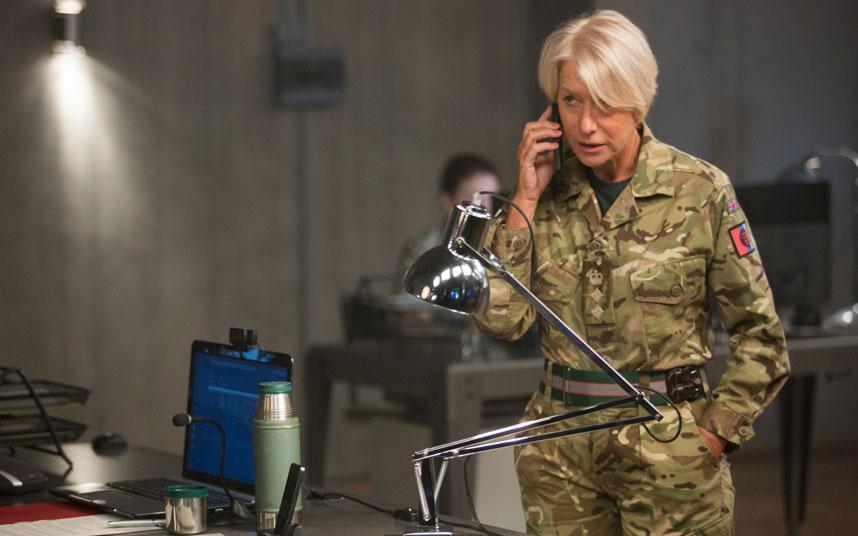
Cast: Alan Rickman, Helen Mirren, Aaron Paul, Barkhad Abdi
Director: Gavin Hood
102 mins.
Reviewing a film, and by its very nature being critical of the decisions made by or indeed the work of other people, is always done from a position of comparative security. Reviews should be made and received with the understanding that taking an objective viewpoint from outside a particular situation and passing judgement on it, is a completely different exercise than actually being in the midst of that situation, having to make complex and difficult decisions with high stakes behind them, bearing responsibility for outcomes that can actually affect any number of people. This is certainly applicable to the relationship between film reviewer and filmmaker – and it bears consideration of such a comparison being one of the ideas running throughout Eye In The Sky. The film focusses on a decision surrounding a drone strike. A hugely debatable issue which generates a substantial array of mixed opinions, but this is a story which puts us in the rooms, with the people, who are in the position to make these types of life-or-death decisions. Within the excellent screenplay by Guy Hibbert was the decision to make it an ensemble piece, a depiction of the fact that each decision to deploy a drone strike is a protracted, tense and frustratingly uncertain series of choices and viewpoints, made by a considerable number of different people at different levels of legal, military, and government status. The narrative follows a British-led operation spearheaded by Colonel Powell (Helen Mirren) which is intended to conclude with the capture of a British-born suspected terrorist in Nairobi. When surveillance reveals a multiple suicide attack is imminent, Powell calls for a ‘hellfire strike’ on the terrorist group’s headquarters, but the process to authorise such a strike proves intensely complicated, exponentially more so when a young girl enters into the collateral damage zone.
The resulting section's tension builds, as a breathtakingly suspenseful mix emerges of morality play and comedy of errors, as on one hand, there’s American drone operator Steve Watts (Aaron Paul) who expresses heart-wrenching anguish over his imminent moral quandary and UK Foreign Secretary James Willett, (Iain Glen) who receives a bathroom briefing, being reluctantly forced into the middle of this dilemma whilst being seated on a lavatory, suffering from the nasty effects of food poisoning. Then we have the USA equivalent, playing table tennis in China and baffled into mild irritation at the interruption by the British hesitation to fire missiles. This sequence offers some dark/light relief in what is otherwise an extremely intense story. The one constant is the ticking time bomb thread providing some dynamic cross-cutting sequences which play well within the broad scope of the situation. Barkhad Abdi provides multiple high-tech surveillance for those watching on screens, as endless bureaucrats take turns, offering, at times, puerile arguments for and against a strike, each attempting to rationalise their arguments from different perspectives and principles, but mainly squirming at the prospect of actually making a decision. The now sadly late and undeniably great Alan Rickman gives a solid performance as the military general advising in favour of the strike as the prevarications build with the tension. There is outstanding collaborative work throughout, highlighted by carefully juxtaposed close-up shots emphasising the internal struggles of each character's involvement, as we are offered a series of distinct perspectives to consider when making judgements on undertakings of this scope and magnitude.
