LONE SURVIVOR
Cast:
Mark Wahlberg, Ben Foster, Emile Hirsch, Taylor Kitsch, Eric Bana
Director: Peter Berg
121 minutes
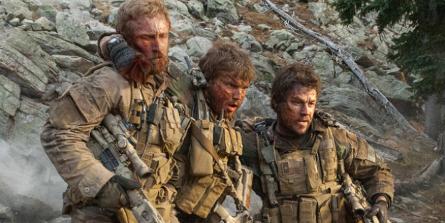
A rock, tree, or branch will never seem as perfectly harmless to you again after enduring “Lone Survivor.” With its depiction of warfare in Afghanistan moved to the unlikely setting of green fields, trees and jagged cliffs, the most horrific moments of director Peter Berg’s drama come from tumbling bodies down a mountainside—and their eventual landing upon each other. Forget that the surrounding Taliban forces are blasting out gunfire upon four injured American soldiers out on a reconnaissance mission; nature is their bigger enemy, and the extent of its cruelty is explored to the fullest over the course of this film’s brutally graphic two hours.Sandwiched between lengthy documentary snapshots of American Navy SEALs—a montage from boot camp to graduation over the opening titles, then an In Memoriam for 19 U.S. soldiers during the end sequence accompanied on the soundtrack by a poor cover version of Bowie’s ‘Heroes’ (presumably when asked for his original version, the TWD politely told the producers to 'go away')—the film is primarily based on Marcus Luttrell’s 2009 non-fiction book “Lone Survivor.”
We see four soldiers, including the then 29-year-old Texan Luttrell (played by Mark Wahlberg), Lt. Michael Murphy (Taylor Kitsch), Danny P. Dietz (an underused Emile Hirsch), and Technician Matthew Axelson (Ben Foster), exposed to the rough terrain and the relentless pursuit by nameless (albeit all but one) Taliban elements. However it seems that Berg can’t wait to immerse these people into battle with the minimum of delay via a maximum of broad clichés and shortcuts. Foster gazes at a picture of his wife as he instant-messages her on his computer, Lt. Commander Kristensen (Eric Bana) makes fun of the new recruit (Alexander Ludwig), while Hirsch jokingly describes to Wahlberg and Kitsch his significant other’s ideas for interior decorating. However accurate the background detail may be - and with the constantly booming score by Explosions In The Sky and Steve Jablonsky, subtlety sneaks out the door early on.
As the soldiers idle on the Afghanistan mountains at the start of their mission, a group of goat herders stumble upon the operation. Suddenly ‘the band of brothers’ is faced with the choice of killing these unarmed civilians in cold blood, or freeing them, clearly too thick to be in possession of the knowledge that they’ll skeedaddle down to grass them up to the Taliban immediately afterwards.
The ensuing discussion in this sequence is tense, with no easy outcome. Here, Wahlberg steps in, doing his usual impression of a tree masquerading as an actor with his soul-less eyes and his total lack of craft attempting to capture the impossible conflict that he and his team must overcome. Together, all four cast members help draw a line across the narrative—separating when we were watching a depiction of names, dates, and locations, and a hellish, immersive situation with no happy ending in prospect.
Once the massive Taliban forces eventually spot Luttrell and his team, the film transfers into a vicious, sustained blood, guts and gore-fest. It is as times so visceral and agonising that you may feel inclined to look away from the screen every few minutes, even if it's just to check the level of popcorn in your cardboard bucket. A succinct death for any of our main characters would be a blessing – but instead - they are ripped to shreds by bullets, impaled on tree branches, and bludgeoned on rocks repeatedly over 45 minutes before a bloody conclusion finally arrives.
It has to be said however that the special prosthetic effects are consistently excellent, however squirmy the achievement. Alas, we never really gain a sense of just how long the entire skirmish lasts; it could be one day or three, until a title card appears to properly tell us otherwise. We also get unnecessary detail on the Taliban enemy—only witnessed so that a late-stage threat of a beheading can evoke a gruesome response.
Presenting Taliban head honcho Shah as an eternally scowling military leader whose main trait is that he has no earlobes, Berg is content to let a propagandistic edge seep into what is already an uncomfortably over-patriotic film. In turn, this tips the narrative over into black-and-white portrayals that cheapen it significantly.
Berg attempts to balance the situation later on by focusing on the sympathetic conduct of the native Pashtun people, but by then because of its hugely immersive central battle, that element can only be tolerated as long as you expect “Lone Survivor” not to provoke questions outside of bravery and sacrifice.
THE ARMSTRONG LIE
Directed by Alex Gibney
122 minutes
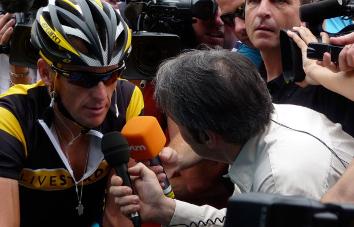
If you’ve yet to encounter and engage over a period of time with a pathological liar, that description would mean very little to most people. Anyone prone to pseudologia fantastica is a psychopath who is both charming and credible - but who twists facts and events into such a convoluted miasma that anyone uninformed has no alternative but belief. Pathological liars are also narcissists who care only for themselves, and will go to extraordinary lengths to preserve the false image they have created, whilst having no concern for the damage they do to others, both financial and psychological. This in essence is the saga of Lance Armstrong, who is presented in this excellent and riveting documentary as one of the most notorious mythomaniacs of the 21st Century (so far).Produced and directed by Alex Gibney, the eventual feature has changed considerably from Gibney’s initial conception. In 2008 he commenced on making a documentary about Lance Armstrong’s life story, which was a compelling prospect - concentrating as it did on his effort to come back after his 2005 retirement and win an eighth Tour de France in the 2009 Tour. Despite a life-threatening illness with testicular cancer in the 1990s, Armstrong went on to win the Tour de France an unprecedented seven consecutive times. He founded and fronted a much-lauded charitable organisation devoted to fighting cancer and raised over $300 million dollars in the process.
Using ten cameras to shoot the Tour, Gibney ended up with a huge 200 hours of film that he condensed into the feature he thought he wanted to make, and was just about ready to go, when 2011 happened. Gibney watched Tyler Hamilton detail Armstrong’s “doping” on the US tv programme “60 Minutes,” and realised that the film he had made would no longer work. More revelations occurred and suddenly Gibney’s film wasn’t the feel-good piece he wanted to make, but a documentary about Armstrong’s lie.
Gibney has interviews with most of those involved, including Michele Ferrari, Armstrong’s doctor and coach who helped him with the drug-taking, Betsy Andreu, who testified that she witnessed Armstrong admit to doping in a hospital room (and whom Armstrong successfully sued), and David Walsh, a sportswriter who was the first to expose systemic doping in cycling. Gibney interwove the film he shot in 2009, including lots of interviews with Armstrong, with interviews he shot after Armstrong finally came clean, even after he appeared with Oprah for his grand ‘mea culpa’ special. In fact one interview with Armstrong took place only hours after the Oprah interview.
This is a fascinating film. Any documentary that lasts over two hours would normally feel far too long, but this is excellent and doesn’t drag for a single second. It’s also beautifully shot and edited. Even towards the conclusion, when you know the dreadful things Armstrong did to good people who only wanted the truth to come out, you can’t help but accept just how charming he is. Clearly that charm assisted him to an almost imeasurable degree in achieving such notoriety in the pantheon of evil liars. You really have to see this film however to fully appreciate the incredible story.
Gibney spends a lot of time on interviews with Armstrong and his former colleagues and teammates, which lets his charisma, either first- or second-hand, do its work. We do get to see some of his ruthless, nasty side, and the fact that Armstrong did illegally ‘enhance’ his performance in cycling doesn't make him particularly monstrous - literally everyone seems to have done it - compared to the exact way he denied it, but Gibney’s film seems to spend a great deal of time acting like EPO and blood transfusions constitute the largest part of Armstrong's villainy.
On the other hand, the doctor who aided Armstrong with this, Michele Ferrari, becomes one of the most intriguing and oddly sympathetic figures in the film; his dedication to improving athletic performance has a purity that it is admirable in its way. And for all that, everything in those scenes has a new meaning due to what has happened since as the material from the 2009 Tour still presents itself as the basis of a great film. The event itself is amazing - brutal competition surrounded by utter chaos in often-beautiful locations.
Also, the cancer/recovery material, whether it be Armstrong's account of what he went through to visiting children in the hospital, is still highly effective - and maybe that's how it should be. As much as Gibney was right about no longer being able to make the inspirational film that he originally intended, he can’t quite find the right spot between those extremes of clean and doped, but the tug of war between them is just fascinating.
