SPOTLIGHT
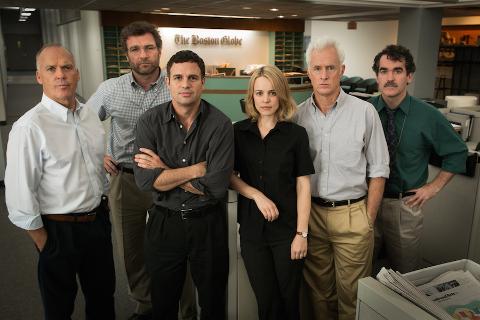
Cast: Michael Keaton, Mark Ruffalo, Rachel McAdams, Liev Schreiber
Director: Tom McCarthy
128 mins
Tom McCarthy’s Spotlight is a rip-off - in the context of ripping off the labyrinthine layers of a cover-up that protected, in many people’s eyes, a cherished institution (the Roman Catholic Church) at the expense of innocent children, and as such it resonates strongly with others like myself, who are constantly aghast at the endlessly corruptive influence of unmonitored power.
Spotlight exhibits no pleasure in exposing its truths, no celebration in removing the sticky red-tape that had hidden some extremely difficult topics. Nor does it execute its tasks in a showy, tabloid-minded or headline-grabbing way. Set in 2001, the efficient, clinical but empathetic true story follows a small team of Boston Globe reporters, led by the even-tempered and respected Walter ‘Robby’ Robinson (Michael Keaton), as they investigate claims that Boston’s Catholic diocese buried countless claims of sexual abuse filed against parish priests. Robinson’s specialised team of relentless reporters – operating under the name Spotlight, and consisting of outstanding character actors Mark Ruffalo, Rachel McAdams and Brian d’Arcy James – unearth a cover-up, but they’re hardly prepared to process how far up the chain of command the scandal goes, or how far the plague of deception and apathy actually spreads.
The entire cast is excellent throughout. One of the joys of Spotlight is that everyone understands the concept of under-acting – and in so doing, comprehends with every fibre of their being that there’s no reason to steal the focus away from the inherent power of the material - and every performance is crucial to the success of the film. McAdams and Ruffalo are diligent and precise as vigilant beat reporters chasing down countless leads. There are interviews, phone calls, newsroom conversations and heart-racing scenes about fighting bureaucracy to get sealed court documents open for public record – and all are enthralling.
Michael Keaton and John Slattery, meanwhile, lend that necessary veteran stoicism and presence as seasoned editors who know when a story is ready, but that it could be in danger of being picked apart because it’s too thin. The film also should be praised for being so accurate in portraying the ebbs and flows that come with being in a newsroom, particularly during the development of a potential landmark story. Liev Schreiber exudes such control in the vital role of Marty Baron – a newcomer to the Boston Globe whose distance from the Boston community and its generations-spanning associations with the Catholic Church - making him the only person capable of initiating an investigation that will go all the way to Cardinal Bernard Francis Law, the Archbishop of Boston.
Spotlight is a tense, crackling, meticulous telling of a contemporary scandal in a major American city. But there’s no triumph in its accomplishment, no vindications in its finale. The result invokes such an immense sadness over the realisation of just how many people looked the other way, when these horrific crimes were being perpetrated against innocent children, and for how long the vile and despicable practice was actually going on – and more horrifically – most likely still does.
ANOMALISA

The protagonist is Englishman Michael Stone (beautifully voiced by David Thewlis), who is a best-selling author and productivity expert. Michael gives speaking engagements, with his modest fame boosted by a successful self-help book he wrote a few years earlier. In an amusing opening sequence he flies in to Cincinnati for his next public appearance and it’s quite clear he’s depressed - not because he’s in Cincinnati – but due to a collapse of confidence in himself and his family life. The film shows the sheer drudgery of being on the road, the crushing banality of the hotel rooms, the endlessly inane small talk from all angles and the blank, uniform cod-friendliness of the hotel employees. Michael is unbearably melancholy and cursed to the point of being utterly underwhelmed by his very existence. He is set to give his bog-standard motivational speech the next day at a conference, but meantime, he has t0 fill the empty and lonely hours prior to the event. He calls a woman he knew long ago, he looks for a toy for his young son – and finally he meets Lisa (voiced by Jennifer Jason Leigh) who has travelled with a female friend from Akron to see him speak at the conference. Lisa is painfully insecure, making self-deprecating jokes about her own lack of sophistication - but Michael feels himself falling for her. Kaufman and Johnson show both a sense of humour and a generosity to all the characters. No one Michael encounters in Anomalisa is scorned, and if anything, the characters are all connected by the writer’s bemused empathy for the ways that we all manage to come up with to keep going, even if it’s by repeating the same tedious pleasantries to each other. As is often the case in Kaufman’s work, Anomalisa juxtaposes the queasiness around the minutiae of cliche/jargon-speak with the vulnerability and promise of new love. Michael’s fondness for Lisa develops over the evening, and because we’re familiar with Kaufman’s style, the anticipation is there for the almost inevitable twist of the knife or unexpected revelation, to occur. The final quarter of the film does sadly unravel out of control and lose its way slightly, but as a whole it’s an unusual and worthwhile piece with some delightfully funny moments.
