THE INVISIBLE WOMAN

Cast: Ralph Fiennes, Felicity Jones, Kristen Scott Thomas, Rebecca Scanlan
Director: Ralph Fiennes
111 mins
Ralph Fiennes’ second directorial outing offers up a saga of the love affair Charles Dickens (Fiennes) had with Nelly Ternan (played by Felicity Jones). Nelly was a great deal younger than the author, and having met when she appeared in a small theatre production, their relationship delicately developed through a series of awkward, gradual social encounters. The actual story is a very slight situation, and it has to be questioned whether it merited such a grand, opulent production as this.
The film opens some years after Dickens’ death, as Nelly, who is now married to a teacher, is observing her husband’s students rehearsing their production of a Dickens play “The Frozen Deep”. It’s often said that (voice-over) narration in a film is a cheap, easy and unimaginative device to outline matters for the viewer – personally I find expositional dialogue an even more offensive culprit – and disappointingly, the latter is what we have here. Through the use of this thin method, we learn that everyone with knowledge of Nelly and Charles’ relationship was under the impression that it was merely platonic (apparently Dickens took the secret of their affair to his grave). So flashback is on the cards as we reverse towards the beginning of their relationship, thus learning its true nature by rifling through Nelly’s memories.
By turns charismatic and gregarious – Fiennes' performance as Dickens holds us by his easy charm and authenticity. When we first encounter him Dickens is 45 years old and an eminently celebrated author and public face. When he first meets the 18-year-old Nelly she is accompanied by her three sisters and their mother Frances (Kristen Scott Thomas), all of whom are actresses. Dickens almost immediately feels drawn towards Nelly, who is both intimidated by Dickens’ comparatively advanced age but thrilled enough by his stature to go weak at the knees.
Dickens is married to a larger-built woman named Catherine (the brilliant Joanna Scanlan), who is mother to his ten children. Dickens is supposedly by this time unfulfilled and suffocated to the point of disgust by his marriage and home life – so he casts aside his poor wife in exchange for a young, beautiful mistress, resulting in inevitable heartbreak and drama.
Dickens publicly achieves this by using the medium of a letter to the editor of the Times in which he announces their separation, and off he trots with the beautiful Nelly. Oddly, every character involved seems to act with abject apathy towards this situation – to such a degree that it spills over from the screen with the result that you too may well (as I did) feel little if any empathy towards the lovers.
A
highlight scene from the film however comes from Scanlan as Catherine, who, when fuelled by raw human emotion, is a welcome jolt that just about redeems
this sauntering, lifeless slog of a film. Her reaction to the aforementioned
Times letter is crushing, and a quiet conversation she shares with Nelly, in
which she clears the air with the utmost class and dignity, is unforgettable.
Fiennes is excellent too, and Dickens’ work simply drips off his tongue as he recites it aloud to a receptive audience of admirers. The main problem comes from his scenes with Jones. There is no clear indication nor demonstration of why he loves this young girl to such a degree that he’d leave behind his family and possibly his personal reputation for her. It’s a crucial error, as this relationship forms the primary focus of the film. On screen little if anything emanates from them in terms of passion, romance, longing or chemistry. This is a vacuous and empty togetherness which consequently makes the film as a whole feel emotionally anaemic.
Fiennes is excellent too, and Dickens’ work simply drips off his tongue as he recites it aloud to a receptive audience of admirers. The main problem comes from his scenes with Jones. There is no clear indication nor demonstration of why he loves this young girl to such a degree that he’d leave behind his family and possibly his personal reputation for her. It’s a crucial error, as this relationship forms the primary focus of the film. On screen little if anything emanates from them in terms of passion, romance, longing or chemistry. This is a vacuous and empty togetherness which consequently makes the film as a whole feel emotionally anaemic.
THE LEGO MOVIE
Voice
Cast: Will Arnett, Elizabeth Banks, Will Ferrell, Morgan Freeman, Jonah Hill,
Liam Neeson, Anthony Daniels, Channing Tatum
Directors: Phil Lord, Christopher Miller
100 mins
Directors: Phil Lord, Christopher Miller
100 mins
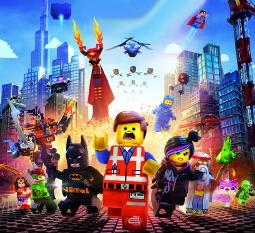
To paraphrase one of this film’s voiceover actors’ (Liam Neeson) ‘Taken’ catchphrase, both Chris Miller and Phil Lord certainly have a very special set of skills at their disposal. They've taken a quite ridiculous premise yet again with this, “The Lego Movie”, following "Cloudy With A Chance Of Meatballs" – and made a really entertaining feature you wouldn’t have put money on as being anything better than hopeless. Here we have a toy, a narrative-free artefact, which has been transformed into a film that’s enormously creative, hugely imaginative, deftly ironic and unutterably daft. It’s an extremely clever and engaging work and has more than enough delights within to entertain all ages.
With a brilliant mix of real Lego use, stop-motion and computer-generated graphics - a collaboration of like-minded wildly eccentric geniuses have come up with a dazzling array of people, buildings and vehicles all from those previously annoying chunks of plastic with inter-insertable tops and bases you thought had been consigned to old-school stuff you’d occasionally see at car boot sales. You may well wonder once you’ve seen this film if there are now hundreds of deranged nutters lying in a psychological trauma ward following their work on such insane brilliance! There is a story too, believe it or not and the script never takes itself too seriously, but that's not to say the entire film is a joke. The film has a hyper—paced sense of its own ridiculousness and there are popular culture references all over the place, many of which are US-based so they may well be over the heads of non-American film fans. Former Devo main-man Mark Mothersbaugh has come up with a brilliant score - and the grotesquely catchy "Everything Is Awesome" will create a mindworm in your head, so beware!
The whole project is sublimely smart, very cleverly put together, impeccably paced and executed–and you can just tell the voice-over cast had a ball doing their work. It’s 100 minutes of constant enjoyment.
STALINGRAD
Cast:
Pyotr Fyodorov, Thomas Kretschmann, Sergey Bondarchuk, Maria Smolnikova, Yana
Studilina,
(Subtitled: Russian, German dialogue)
Screenplay: Ilya Tilkin and Sergey Snezhkin
(based on "Life and Fate" by Vasiliy Grossman)
Director: Fyodor Bondarchuk
131 mins
(Subtitled: Russian, German dialogue)
Screenplay: Ilya Tilkin and Sergey Snezhkin
(based on "Life and Fate" by Vasiliy Grossman)
Director: Fyodor Bondarchuk
131 mins

Stalingrad’s vicious
battle during the Second World War was a devastating encounter for both Russian
and German troops and has been tackled in previous cinematic outings. This time
out - using a greyish, almost monochrome filming technique, highlighted only by
spurting blood, casualties alight with flames, randomly vicious explosions and
highly realistic plane crashes – but in an unimaginative and ultimately
pointless 3-D format, writers Snezhkin and Tilkin focus on a dedicated area to
expound the story.
Bizarrely and confusingly, the film opens and closes with scenes from the aftermath of a contemporary Japanese earthquake and subsequent tsunami, as a rescuer decides via a transmitter to trapped women survivors below the rubble, that it would be appropriate for him to describe the torment endured by his mother when taken care of by five Russians during the aforementioned encounter. The intention is clear - to hopefully dignify and humanise the individuals caught up in a conflict manufactured by politicians. However this backstory is riddled with caricatures – including the hectoring from a sadistic Nazi colonel barking pantomime orders and worst of all, a Russian equivalent who rapes a beautiful captive German blonde lady – prior to them falling in love - with one another. None of this is intended to be lighthearted of course, but the unfolding tale, weak as it is, fails dramatically in comparison to the staggeringly effective special effects.
Music is by the sublime Angelo Badalamenti, but the feeling evoked is that he too was directed by helmer Fyodor Bondarchuk to ensure sufficient sentiment is achieved during the slow-motion demise sequences as those engaged within both sides’ military meet their dramatic doom. In summation, Stalingrad, whilst undeniably an impressive technical achievement, is disappointingly diminished by a underdeveloped narrative structure.
Bizarrely and confusingly, the film opens and closes with scenes from the aftermath of a contemporary Japanese earthquake and subsequent tsunami, as a rescuer decides via a transmitter to trapped women survivors below the rubble, that it would be appropriate for him to describe the torment endured by his mother when taken care of by five Russians during the aforementioned encounter. The intention is clear - to hopefully dignify and humanise the individuals caught up in a conflict manufactured by politicians. However this backstory is riddled with caricatures – including the hectoring from a sadistic Nazi colonel barking pantomime orders and worst of all, a Russian equivalent who rapes a beautiful captive German blonde lady – prior to them falling in love - with one another. None of this is intended to be lighthearted of course, but the unfolding tale, weak as it is, fails dramatically in comparison to the staggeringly effective special effects.
Music is by the sublime Angelo Badalamenti, but the feeling evoked is that he too was directed by helmer Fyodor Bondarchuk to ensure sufficient sentiment is achieved during the slow-motion demise sequences as those engaged within both sides’ military meet their dramatic doom. In summation, Stalingrad, whilst undeniably an impressive technical achievement, is disappointingly diminished by a underdeveloped narrative structure.
