CLOUD ATLAS
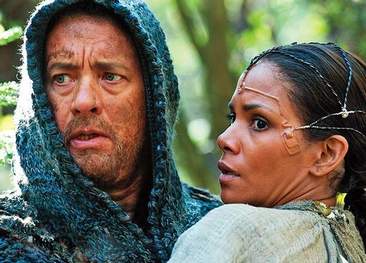
Cast: Tom Hanks, Halle Berry, Hugh Grant, Jim Broadbent, Hugo Weaving, Susan Sarandon
Directors: Lana Wachowski, Andy Wachowski and Tom Tykwer
Running time: 172 mins
It's difficult to ascertain quite where to begin with this film - as most likely the three directors did, but that's what you get with something as ambitious as Cloud Atlas, which aspires to be a daring and satisfying experience. The inscrutable novel which is its source - has resulted in a visual feast both neural and visual. With its grand themes and colossal structure, it may overwhelm many, but there are undeniable rewards in experiencing and reflecting upon it.Even the structure is an ambitious undertaking, but we have David Mitchell to thank for that. Like his 2004 novel, Cloud Atlas takes us through different moments in time, six stories to be precise, each about a struggle to do what is right in the face of adversity, a common theme but never told quite like this. Mitchell's novel tells each complete story, but the filmmakers here choose to bounce between settings with little more than a quick cut, taking us from the Pacific Islands in 1850 to Belgium in the 1930s to San Francisco in 1973 to modern times in the United Kingdom, including tantalisingly tiny touches of Glasgow and Edinburgh amongst them, then onto Korea in a post-apocalyptic, distant future where tribes fight for survival. The characters we meet in these settings and their stories unfold quickly, as Andy & Lana Wachowski and Tom Tykwer try to keep the film's momentum continuously on the go. At first, Cloud Atlas overpowers the viewer like a deluge, and your mind may need to go into overdrive to keep up with who or where or what we're seeing. The uninitiated might throw their hands up in frustration when a hi-tech hovercraft appears, throwing what's previously been a period piece into the stylishly techno-heavy world of tomorrow.
What’s really missing though
is a much-needed foothold to let you sink into the overall story. The writers
and directors don't let the film's pace or structure get away from them,
choosing to focus on two or three of the stories at a time and cutting between
them for large sections of the film. As you experience each story, both the
underlying narrative and main theme of the thing struggle to make themselves
known. Each of the stories could well work on their own, but fitting at times
irrationally into the grand scope of what could only be referred to as the
design of the world, is incredibly haphazard to say the least, as bits of
information learned in one has little if any relevance to the events shown in
another, and every action by every character obviously ends up having a purpose, but
we’re left baffled as to precisely what that might be.
If this description of the film seems opaque, it's because the themes Mitchell set down in his novel, and which the filmmakers have pulled out for this film are explained (or the attempt to clarify them) is thrust on the screen through visual examples. Could someone please tell me for example, why a letter written centuries ago can help spark a revolution centuries from now? The ambitious nature of the film married with the way it attempts to handle the depiction of the characters is really where Cloud Atlas seriously loses its focus. Jumping between scenarios comes with its own share of tonal shifts scattered throughout, and you may be in a serious drama about slave traders one minute and a slapstick comedy about a Englishman trying to escape a nursing home with some elderly Scottish folk the next and ending up in a pub brawl with rugby fans shortly afterwards. Nearly every actor in the film plays multiple roles, some switching age, race, or even gender between parts. Seeing Tom Hanks as a Cockney (or is he meant to be Irish?) gangster then suddenly witnessing him lead a post-apocalyptic tribe of survivors does keep the engrossment (and credibility) potential of much of Cloud Atlas at arm's length.
Each actor takes absolute charge with each of their roles, however, with most of them quite literally disappearing in front of our eyes under heavy makeup and surely some CG facial enhancements. Nearly every performer has a part in each story, though many of them will be difficult to point out. Having said that, though, everyone in Cloud Atlas does a good job within the chameleon aspect of their multiple roles. Whether it's Hanks as a quirky doctor with strange teeth, Halle Berry as a journalist trying to uncover a conspiracy, Jim Broadbent as a cantankerous classical composer one mintute and a brutal Captain Birdseye the next, or Hugo Weaving as an enigmatic creature named Old Georgie who lives in the forests of the post-apocalyptic world, every actor gives every role their full attention. In doing so, the viewer tries hard to do exactly the same thing.
Special mention though to Hugh Grant who ejects his stereotype rom-com persona with wicked abandon, and in one characterisation, his onscreen embodiment is beyond reproach as he portrays a tribal rapist. Cloud Atlas is an experience that brings an audacity and visual extravagance to an times visually beautiful and audacious story about love and the effects such works of art have for future generations, and at the very least it shows bravery from the Wachowskis and Tom Tykwer for making it in the first place.
If this description of the film seems opaque, it's because the themes Mitchell set down in his novel, and which the filmmakers have pulled out for this film are explained (or the attempt to clarify them) is thrust on the screen through visual examples. Could someone please tell me for example, why a letter written centuries ago can help spark a revolution centuries from now? The ambitious nature of the film married with the way it attempts to handle the depiction of the characters is really where Cloud Atlas seriously loses its focus. Jumping between scenarios comes with its own share of tonal shifts scattered throughout, and you may be in a serious drama about slave traders one minute and a slapstick comedy about a Englishman trying to escape a nursing home with some elderly Scottish folk the next and ending up in a pub brawl with rugby fans shortly afterwards. Nearly every actor in the film plays multiple roles, some switching age, race, or even gender between parts. Seeing Tom Hanks as a Cockney (or is he meant to be Irish?) gangster then suddenly witnessing him lead a post-apocalyptic tribe of survivors does keep the engrossment (and credibility) potential of much of Cloud Atlas at arm's length.
Each actor takes absolute charge with each of their roles, however, with most of them quite literally disappearing in front of our eyes under heavy makeup and surely some CG facial enhancements. Nearly every performer has a part in each story, though many of them will be difficult to point out. Having said that, though, everyone in Cloud Atlas does a good job within the chameleon aspect of their multiple roles. Whether it's Hanks as a quirky doctor with strange teeth, Halle Berry as a journalist trying to uncover a conspiracy, Jim Broadbent as a cantankerous classical composer one mintute and a brutal Captain Birdseye the next, or Hugo Weaving as an enigmatic creature named Old Georgie who lives in the forests of the post-apocalyptic world, every actor gives every role their full attention. In doing so, the viewer tries hard to do exactly the same thing.
Special mention though to Hugh Grant who ejects his stereotype rom-com persona with wicked abandon, and in one characterisation, his onscreen embodiment is beyond reproach as he portrays a tribal rapist. Cloud Atlas is an experience that brings an audacity and visual extravagance to an times visually beautiful and audacious story about love and the effects such works of art have for future generations, and at the very least it shows bravery from the Wachowskis and Tom Tykwer for making it in the first place.
