The Hobbit:
The Desolation of Smaug
The Desolation of Smaug
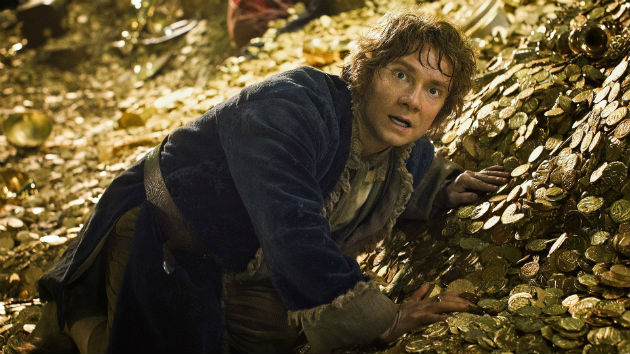
Cast: Martin
Freeman, Ian McKellen, Richard Armitage,
Benedict Cumberbatch, Ken Stott, Stephen Fry, Orlando Bloom
Director: Peter Jackson
162 mins
Benedict Cumberbatch, Ken Stott, Stephen Fry, Orlando Bloom
Director: Peter Jackson
162 mins
The Hobbit: An Unexpected Journey did exactly what it needed to do, which was in re-setting the stage for another set of films, similar works with obvious echoes, but very much their own pieces of the puzzle. This is a lengthy journey, so there was bound to be a considerable amount of baggage. For many, the first Hobbit film felt superfluous, and talk of the expansion of what was quite a lean novel was dismissed at best as folly or at worst merely an attempt at Ring-fencing further not insubstantial income generated from the cash-cow, by helmer Peter Jackson and company.
For those disposed to
either notion the fifth film of Tolkien tales will do little to disabuse you of
those notions. For The Hobbit: The Desolation of Smaug is, at first glance -
just more of the same. We've got additional traipsing dwarves, more action
sequences, more sombre intoning by wizards, and many, many more shots of the
seemingly extraterrestrial vistas of New Zealand. For anyone blind to the
Jacksonian quirks that some find tedious - if you don't like The Desolation of
Smaug - you probably didn't like the Lord of the Rings films very much, either.
For even more so than the previous outing, this chapter feels very much like an
expansion on the world that the original trilogy helped create. The Tolkienian
landscape is a rich one with many places to explore, and many will refuse to
begrudge this extraordinary group taking more time to delve further into the
nooks and crannies of what is undeniably a rich narrative.
While the last film
opened with a prologue similar to The Fellowship of the Ring, this one opens
with a setting that equally reminds very much of Aragorn's introduction to the
saga. This brief prologue, along with other elements later in the film, provide
direct cues to the greater whole. For some, this may feel derivative, but as
anyone who has ever delved into Tolkien's world, these ripples-through-time
practically define his work. It's exactly these connections, through rich
genealogies and throwaway lines of inter-connectivity, that hint at the vast
constellation of characters and histories that Tolkien revelled in. This
is not to say that the film requires one to have read the source material, for
this film diverges more sharply from the source material than any of the others
in the saga. One needlessly controversial element is the fabrication of a
character, Tauriel, a representative of the Sylvain elves and one who plays a
critical role throughout the film. Capably played by Evangeline Lilly, she represents
one aspect of the way that Jackson and his writers have wrestled the sparse
narrative of The Hobbit into something approaching the complexity provided
by Tolkien's The Lord of the Rings books. These changes illustrate
definitively what sets an exceptional adaptation apart from a mediocre one: a
careful balance between the devotion to the source material and the creative
freedom to make these very much their own works in a different medium. These
films are good not just because of Tolkien's stories, they're great despite
elements of Tolkien's prose that if simply transcribed into script form would
have made the screen versions both pedantic and convoluted. Thus, we
have Legolas running around a world that purists may point out preceded his
very creation at the hand of Tolkien, we've got Radagast and Azog, and other
elements that were merely hinted at previously. Once again, it's to the credit
of all that none of this feels superfluous or tacked on, but instead does what
any prequel should do - provide a build-up for what's to come, while very much
existing on its own terms and telling its own story.
This is the film
where some of the more iconic elements of the source book are presented on
screen - the barrel ride, the visit to Lake-town, the encounters with Beorn,
and the battle of wits with a giant dragon (Smaug himself). All of these
elements are ripe for cinematic exploration, and Jackson doesn't disappoint.
From the flume-ride soggy enjoyment of the barrel chase to the mine-shaft
mayhem in the former kingdom of Erebor, much of the film plays as a theme-park
ride, as action-packed as any Indiana Jones film, with some terrific visual
moments which are the equal of any wham-bam adventure. There are also some
delicious moments of darkness. Over the years there have been dozens of
dragons onscreen, but the long-awaited arrival of Smaug - performed in a
particularly effective, sneering basso- profondo voce by Benedict Cumberbatch
(in one of two outings here for his mellifluous tones) - lives up to even
heightened expectations. The animation is extraordinary, and while it won't
quite get the plaudits that the revolutionary Gollum/Sméagol work did, it's
still mindboggling to have witnessed the technological advances leading to this
latest incarnation of a big onscreen beastie. The cast continues to
please - Martin Freeman in particular is given more to work with as his
character becomes more complicated.
There will be plenty more for the likes of
Richard Armitage to do in the next instalment, but he still provides Thorin
with appropriate levels of majestic gravitas. Yet it's Ken Stott's
pitch-perfect Balin that again impresses, his contribution easy to overlook,
yet perhaps the closest to rivalling the ever-astonishing Ian McKellen in terms
of exhibiting both grace and intensity when required. The sequence with the
spiders however, while dispatched relatively quickly, still feels a bit too
much like other scenes we've seen several times before. This is a film that's
a better balance between setting a tone and delivering exposition, one where
characters are allowed to develop while ginormous action sequences
unfold. Quite simply, The Desolation of Smaug has elements the equal to
any part of the previous outings. In time, the division between the Hobbit
films and the LOTR trilogy will be seen as a mere inconvenience of chronology,
as the separation is actually far less than even in the original books.
These
works remain the pinnacle of this type of cinematic epic fantasies, and it is
this blend of both comfortable familiarity and outright wonder at the spectacle
that makes this film work as well as it does.
THE SECRET LIFE OF WALTER MITTY
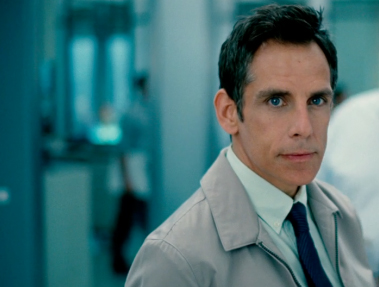
Cast: Ben Stiller,
Kristen Wiig, Sean Penn
Director: Ben Stiller
114 mins
Director: Ben Stiller
114 mins
Ben Stiller’s The Secret Life of Walter Mitty tells the tale of an ordinary person given to adventurous daydreams far grander than real life – or so the publicity for the film would have us believe. This is Stiller’s fifth feature as a director and although it is unabashedly nice, crowd-pleasing, and earnest, its globe-spanning scale is perhaps too daunting a task for Stiller’s modest formal ambitions. However, taken purely as a pleasant unfussy release, on that level there’s really not much to take issue with, especially because Stiller’s presence - his choices as a director are always in permanent harmony with his character’s emotional state.
The film’s plot though is surprisingly flimsy, resting as it does on what ultimately amounts to one man’s worldwide search for Sean Penn. Adapted from James Thurber’s classic 1939 short story (which was first turned into a film starring Danny Kaye, in 1947), the screenplay here though is consistently clunky in its balancing of real-world solitude and fantasy-realm illusions; that the feature’s fantasy sequences, are so broad and arbitrary (why, for example did they do an irrelevant Curious Case of Benjamin Button joke, moderately amusing as it is?) depletes their resonance all the more. It’s hard to invest in the film’s central romance when, right after the two characters share a serious, adult conversation, daydream-prone Walter Mitty (Stiller) is suddenly imagining them living out the circumstances of F. Scott Fitzgerald’s age-distorting narrative.
What complicates this is that Stiller is clearly more at home when depicting Walter’s corporate angst. He seems to relish the act of filming the strict, geometrical architecture of the Life magazine offices, the walls of which are all cloaked in steel blues and greys. When Adam Scott walks in, hideously threatening beard in tow, as a managing director bent on changing Life into an online enterprise, Stiller lingers lovingly on the roll of film his Walter receives from fabled freelance photographer Sean O’Connell (Penn).
In a sense, then, Stiller has
rendered Walter Mitty’s story contemporary, by fashioning a rather blunt (though
hardly unwelcome) allegory for the increasing evaporation of celluloid. The
hazards of down-sizing, meanwhile, position the film within a recession-plagued
environment, with Scott and his menacing posse of corporate hounds looking to
sack as many disposable employees as possible.
Walter, with sixteen years of Life employment under his belt, begins to fear for his job when he can’t locate the O’Connell photograph that’s supposed to grace the cover of the magazine’s final print edition. Described as “the quintessence of life,” the photograph is mysteriously missing from the reel O’Connell mailed to Walter (bizarrely the two have never met in person - but Walter is the only Life worker O’Connell entrusts with his pictures).
Walter, with sixteen years of Life employment under his belt, begins to fear for his job when he can’t locate the O’Connell photograph that’s supposed to grace the cover of the magazine’s final print edition. Described as “the quintessence of life,” the photograph is mysteriously missing from the reel O’Connell mailed to Walter (bizarrely the two have never met in person - but Walter is the only Life worker O’Connell entrusts with his pictures).
Walter’s mission, then,
becomes a sort of adventure-mystery, with him using the roll’s odd selection of workable
photographs - one is a close-up of a thumb, another hints at the name of a boat
- to attempt to locate the famously remote O’Connell. Walter’s journey suddenly
takes him to Greenland and eventually Iceland. Comprising the film’s middle
section, these sequences are basically just an extended travelogue, complete
with small, odd, offhand scenes (like one altercation with a drunk Greenland
pilot, played by Ólafur Darri Ólafsson) and conventionally life-affirming
montages set to the music of Arcade Fire and David Bowie.
Much of the information accumulated during this section of the film comes off as superfluous and not necessarily crucial to the story. Because Stiller defines his character’s situation so nicely in the film’s opening scene - in which Walter goes to great lengths to try to “send a wink” to an online dating site profile of a co-worker (Kristen Wiig) whom he fancies something rotten - most of the additional background information we get of Walter (in his former employment at Papa John’s and KFC fast-food outlets and having an ongoing affinity with skateboarding) only serves to make the character’s persona more confusing. Stiller’s Walter is so efficiently conceived on a visual level - the short-sleeve dress shirts, the too-long trousers, the Norman Wisdom physical movement as he strolls - that we come to understand him almost immediately on an intuitive level - so the abundance of eccentric character traits isn't really needed.
In addition to Wiig, who is, as always, wonderfully natural – although this time in a fairly basic role, Stiller is surrounded by the likes of Kathryn Hahn, as Walter’s quirky, performance-artist sister; Shirley MacLaine, as Walter’s mother; and Patton Oswalt, as a dating-site consultant from whom Walter seeks help. That these minor characters are mostly forgettable is another sign of the strength of Stiller’s character.
As written, they all seem thin and even
boring when compared to Walter, which is saying something, since he’s the one
who’s supposed to be going through a mid-life crisis. It’s entirely possible
that your opinion of The Secret Life of Walter Mitty will hinge on whether or
not you like what's on Neg 25 - the picture that eventually appears on the final print issue of Life
magazine.
