The Snows Of Kilimanjaro
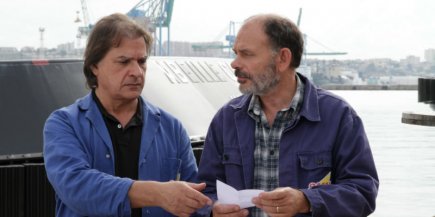
Cast: Ariane
Ascaride, Jean-Pierre Darroussin, Gerard Meylan, Maryline Canto, Gregoire
Leprince-Ringuet, Anais Demoustier, Adrien Jolivet, Robinson Stevenin, Karole
Rocher, Julie-Marie Parmentier, Pierre Niney.
Directed by Robert Guédiguian
Running time: 147 mins
Directed by Robert Guédiguian
Running time: 147 mins
Robert Guédiguian’s film isn’t another take on Hemingway’s story of the same name, but a contemporary interpretation of basic human decency.
Following his redundancy from work, working-class couple, Michel (Jean-Pierre Darroussin) and his wife Marie-Claire (Ariane Ascaride), are victims of a brutal robbery in their home that ends up bringing out the best in them.
Guédigian’s view of humanity shows as much unbridled sentiment as that of writer Victor Hugo, whose poem How Good Are the Poor inspired the film. Despite that however, his balanced approach to all the roles is wonderful, and the cast, including Jean-Pierre Darroussin and Ariane Ascaride as the couple in question, is uniformly excellent.
Filmed in Marseille, this old-fashioned but highly likeable tale focuses on the balance between the poor and the wealthy with a distinctly socialist rallying cry as it follows one-time union rep ( Darroussin) and his wife (Ascaride) as they deal with being robbed by a former co-worker.
The happy couple begin to question their relationship to their less well-off neighbours even while affirming the core beliefs on which they built their lives. All is resolved in a feel-good ending that is immensely satisfying and uplifting.
On The Road
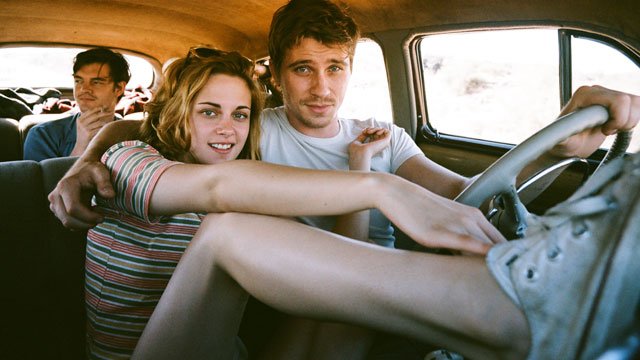
Cast: Garrett Hedlund, Sam Riley, Kirsten Dunst, Kristen Stewart
Director: Walter Salles Jnr.
Running time: 142 mins.
When I read Jack Kerouac's
1957 autobiographical novel “On The Road” many years ago, the tome that
allegedly defined the Beat Generation, I felt even then that such a rambling
stream of consciousness array of self indulgence would have real trouble translating
into a film, were it ever mooted. And so it seems, as here we
have the long-awaited cinema version, by director Walter Salles and
screenwriter Jose Rivera as they attempt to convey Kerouac’s story and
characters. I have to admit they’ve done a reasonable job with the material at
hand – however - it just doesn't fully capture the vicissitudes of Kerouac's
writing as the intangible elements simply aren’t fluid enough to build a
coherent narrative.
The tale kicks off in 1947 with aspirational scribbler Sal Paradise (Sam Riley), hooking up with his future buddy Dean Moriarty (Garrett Hedlund) through a mutual pal. Dean is a carefree, unreliable, hedonist and over the subsequent years, they and assorted other friends along the way, embark on a series of impromptu road trips across the USA. Dope, sex and petty theft are major components of the journeys with Dean being the centre of all attention.
Sal takes a back seat not only to Dean but to Marylou, portrayed here with shocking sexual freedom by a typically moany-faced Kristen Stewart. The film also offers slots to a host of vivid characters who are however saddled with little to stretch them: Viggo Mortensen and Amy Adams as a pair of Louisiana drug addicts; Kirsten Dunst as Dean's second wife; Steve Buscemi as a homosexual who propositions Dean; Terrence Howard as a jazz-loving New York friend and Elisabeth Moss as Ed Dunkel's fed-up wife.
It’s a relatively well shot film and moderately faithful to the book’s ramble about boys and girls in America; it makes life on the margins look like a lot of sweaty, casual sex fun until it suddenly isn’t. As the Kerouac surrogate Sal Paradise, Sam Riley is adequately weak and wishy-washy, but Garrett Hedlun’s Dean Moriarty isn’t the required force of nature, just a poncey poseur covered in road dust.
The tale kicks off in 1947 with aspirational scribbler Sal Paradise (Sam Riley), hooking up with his future buddy Dean Moriarty (Garrett Hedlund) through a mutual pal. Dean is a carefree, unreliable, hedonist and over the subsequent years, they and assorted other friends along the way, embark on a series of impromptu road trips across the USA. Dope, sex and petty theft are major components of the journeys with Dean being the centre of all attention.
Sal takes a back seat not only to Dean but to Marylou, portrayed here with shocking sexual freedom by a typically moany-faced Kristen Stewart. The film also offers slots to a host of vivid characters who are however saddled with little to stretch them: Viggo Mortensen and Amy Adams as a pair of Louisiana drug addicts; Kirsten Dunst as Dean's second wife; Steve Buscemi as a homosexual who propositions Dean; Terrence Howard as a jazz-loving New York friend and Elisabeth Moss as Ed Dunkel's fed-up wife.
It’s a relatively well shot film and moderately faithful to the book’s ramble about boys and girls in America; it makes life on the margins look like a lot of sweaty, casual sex fun until it suddenly isn’t. As the Kerouac surrogate Sal Paradise, Sam Riley is adequately weak and wishy-washy, but Garrett Hedlun’s Dean Moriarty isn’t the required force of nature, just a poncey poseur covered in road dust.
