TYRANNOSAUR

Writer/Director: Paddy Considine
Cast: Peter Mullan, Olivia Colman, Eddie Marsan
Running Time: 72 Minutes
Tyrannosaur opens with a
drunken Peter Mullan kicking his dog to death, then carrying the pet down the street to bury it in his front
lawn.
It’s a jolting, horrific scene that may elicit a gasp of shock, but it’s a perfect setup for the rest of the film. Tyrannosaur dishes out some heavy brutality and bloodletting, as well as a couple of rock solid performances from its leads. Like its main character, it is simultaneously repulsive and intriguing. Joseph (Peter Mullan) is an alcoholic and could use some anger management classes. When he stumbles into a charity shop after a breakdown in a pub has reduced him to tears, Hannah (Olivia Colman) prays for him and begins to melt away the chilly ice surrounding his frozen heart.
However, he still feels that urge to fight and tear apart when backed into a corner. That’s one of the brilliant elements of Paddy Considine’s already award-winning debut as writer/director Tyrannosaur.
We don’t get a life-changing prayer from Hannah as Joseph struggles with his violent tendencies long after he knows he needs to stop. Neither of these characters are saints, but watching how both Joseph and Hannah handle situations that develop around them is consistently enjoyable, dark as their circumstances are.
For a film as bleak as this one, the gravity of the major conflict has to be really powerful, though, and Tyrannosaur slightly loses its footing here.
The big issue is with Eddie Marsan, who appears miscast and out of place. Several scenes require him to really terrify the audience, but apart from one scene in Hannah's shop, most of the time he just falls flat. A particularly pivotal scene that is further illuminated later in the film is meant to utterly disgust and upset the audience, but Marsan seems only half-committed to it and the scene suffers as a result.
Ultimately however,
Tyrannosaur is an extremely powerful film and highly recommended. It’s not for everyone, and not all of it works, but there’s a terrific story here and two really fantastic performances from Mullan and Colman that genuinely deserve to be seen.
It’s a jolting, horrific scene that may elicit a gasp of shock, but it’s a perfect setup for the rest of the film. Tyrannosaur dishes out some heavy brutality and bloodletting, as well as a couple of rock solid performances from its leads. Like its main character, it is simultaneously repulsive and intriguing. Joseph (Peter Mullan) is an alcoholic and could use some anger management classes. When he stumbles into a charity shop after a breakdown in a pub has reduced him to tears, Hannah (Olivia Colman) prays for him and begins to melt away the chilly ice surrounding his frozen heart.
However, he still feels that urge to fight and tear apart when backed into a corner. That’s one of the brilliant elements of Paddy Considine’s already award-winning debut as writer/director Tyrannosaur.
We don’t get a life-changing prayer from Hannah as Joseph struggles with his violent tendencies long after he knows he needs to stop. Neither of these characters are saints, but watching how both Joseph and Hannah handle situations that develop around them is consistently enjoyable, dark as their circumstances are.
For a film as bleak as this one, the gravity of the major conflict has to be really powerful, though, and Tyrannosaur slightly loses its footing here.
The big issue is with Eddie Marsan, who appears miscast and out of place. Several scenes require him to really terrify the audience, but apart from one scene in Hannah's shop, most of the time he just falls flat. A particularly pivotal scene that is further illuminated later in the film is meant to utterly disgust and upset the audience, but Marsan seems only half-committed to it and the scene suffers as a result.
Ultimately however,
Tyrannosaur is an extremely powerful film and highly recommended. It’s not for everyone, and not all of it works, but there’s a terrific story here and two really fantastic performances from Mullan and Colman that genuinely deserve to be seen.
Margin Call
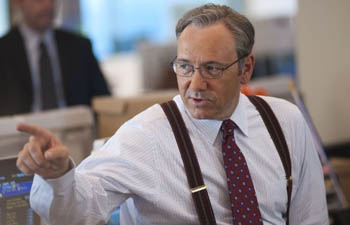
Cast: Kevin Spacey, Zachary Quinto, Paul Bettany, Jeremy Irons, Penn Badgley, Simon Baker, Demi Moore, Stanley Tucci Writer-director: J.C. ChandorRunning time: 107 mins
By having it take place almost entirely within the walls of a New York investment firm, and by having the characters speak nearly indecipherable financial lingo, writer/director J.C. Chandor does something rather interesting: he completely immerses the viewing audience in the panic and confusion of the period. To make us understand what’s actually being said is not the point. As the film begins, the firm, which is unnamed but is said to be loosely based on Lehman Brothers, has just seen 80% of its employees laid off. One of the casualties is Eric Dale (Stanley Tucci), the company’s senior risk analyst; his opening scene, in which he’s 'let go' by a team that fires people for a living, is eerily reminiscent of “Up in the Air,” and about as equally timely. Just before he leaves, he hands a USB drive to a young analyst named Peter Sullivan (Zachary Quinto) – who, for now at least, is still an employee – and instructs him to analyse the data and see if he can finish what was started, and also - to be careful.
Later that night, when many of the employees are out at a bar, Peter plugs in the drive, takes one look at his computer screen, and is immediately disturbed by what he finds. He calls a fellow analyst, Seth (Penn Badgley), who then contacts their supervisor, Will (Paul Bettany), who in turn contacts his boss, Sam (Kevin Spacey). They come back to the office. They too are shocked.
What exactly is on that computer screen? We don’t physically see the data, but we do hear a lot of complicated fiscal jargon attempting to make sense of it. It essentially boils down to this: their firm, as well as the entire market, is heading for disaster. The rest of the film depicts an emergency meeting at the office, one that will last the entire night. Other employees, including the easily mocked Jared Cohen (Simon Baker) and a senior executive named Sarah Robertson (Demi Moore), analyse the data as completed by Peter – and of course, they come to the same inescapable conclusions. The early morning hours will see the arrival of the firm’s CEO via helicopter. This is John Tuld (Jeremy Irons), who likes to speak in condescending simple terms and insists on those around him doing the same. This includes Peter, who was literally a rocket scientist at one point in his life.
All throughout, most of the characters are defined by intriguing personality quirks. Seth, for example, enjoys speculating on the salaries of his superiors. He doesn’t always wait for the right moment to start talking, either. Will, who alternates between smoking and anxiously chewing on pieces of nicotine gum, doesn’t seem to care how off-putting his cynicism has made him. Funny, how you can grow so weary of the system and yet remain so comfortable in the lifestyle it has afforded you. In one scene on the firm’s rooftop – after briefly leaning over the railing and noting that it’s not about the fear of falling, but about the possibility that you’ll actually jump – he explains to Seth and Peter how easily a $2 million salary can be whittled down to just over $100,000. That figure, I presume, is the wealthy man’s version of the poverty line.
All the characters are nicely developed, but not in any usual way. We’re not made to sympathise with them. I would bet, though, that most of them are not, properly speaking, even human beings. They’re motivated not by public service or even by emotions, but by an instinctual need to keep their company afloat. Irons’ character takes a disturbingly Darwinian approach to the problem: The firm will sell off their holdings before the buyers realise they have no value. It’s not about loyalty to customers; it’s simply about survival. The really sad thing is not that he proposes such an idea, but that everyone is resigned to it happening. A scene late in the film, a conversation between Tucci and Moore, is shockingly matter of fact in this regard.
There are only two instances in which emotions get the better of the characters. One involves Seth in a bathroom. The other involves Sam, who is genuinely saddened by his dog’s cancer diagnosis. Thematically, this reaches beyond the notion that even soulless corporate drones have the capacity for selflessness; the dog symbolises the scarceness, frailty, and even the death of innocence. The final shot, which carries this idea even further, is tragic in more ways than one.
“Margin Call” is nothing less than an American tragedy, especially for this very day and age, when the greed and corruption of Wall Street are foremost on everyone’s minds. It will be interesting to revisit this film when and if the world is brought back on track. Will future audiences appreciate that it was made at a time when the economy was in shambles, jobs were hard to land, and all reasonable attempts at financial reform were fought against?
