Behind The Candelabra
Cast: Michael
Douglas, Matt Damon, Ron Lowe, Dan Aykroyd, Scott Bakula,
Debbie Reynolds
Director: Steven Soderbergh
118 mins.
Director: Steven Soderbergh
118 mins.
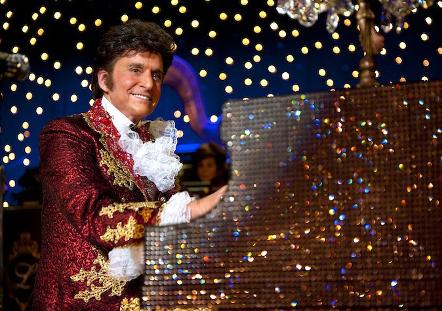
Behind the Candelabra invites us to laugh at - and not always with - the grinning, gaudy Vegas spectacle that is/was Liberace. But Michael Douglas' performance is also deep, dignified, sympathetic and brilliant, an act of impeccable replication that reveals the essence of a man defined by his fame as surely as he is encased in his spangled tuxedo. The wonder of Steven Soderbergh's hugely entertaining film is that it beautifully walks the line between hilarious kitsch and character study.
The story follows Scott Thorson, Liberace's boy-toy and live-in love interest during the late 1970's and wonderfully played by Matt Damon with complete conviction and consumate ease. Taken by his friend Bob (Scott Bakula) to see one of Liberace's flamboyant Vegas shows, Scott is surprised at how the mainstream, middle-aged crowd embraces something so outrageously camp. "Oh, they have no idea he's gay," Bob says, introducing one of the major themes in Richard LaGravanese's deft and skillful screenplay: the response of Liberace's straight audience was part naivete, part willful blindness, a reaction that existed in a particular moment in time. Based on the real Scott Thorson's memoir, the story is seen through Scott's point of view, and Damon creates a young man raised in foster homes, flattered by the attention and the lavishness of his new friend's glamorous life, willing to sell himself into an arrangement with an older man. Damon - still a hugely underrated actor because he so powerfully underplays -- makes Scott's youth his excuse for some odd choices. Damon is superb, but the film belongs completely to Douglas.
He has the voice down to a tee. The nasal drawl that turns Scott's name into two syllables: 'Sco-ott'. But Liberace never seems like a predator; he's benign and, as he so often says himself, generous. He is also his own fictional construction; it's a great moment when we see him without his pompadoured wig, a sign of his trust in Scott, a scene this smart film leads us to gradually. Also, he is ludicrously self-absorbed. The most astonishing sequence, which apparently, actually took place, begins when he asks his doctor (Rob Lowe) to reconfigure Scott's face to exactly resemble a portrait of the young Liberace. Yet Douglas' empathy for the character makes even that seem like a child's innocent Christmas wish rather than an act of enormous creepiness.
Much of the film take place in Liberace's homes which are lavish and ostentatious - the ultimate in excess. Also, there are many extravagant recreations of his Las Vegas shows with Douglas' fingers, heavy gold rings poking out of large ruffled cuffs, seeming to fly across the piano keys in speeded-up variations on musical standards. Scott appears on stage in a chauffeur's uniform driving the car that carries Liberace and his $300,000 crystal-lined fur cape. However, all that fun leads Scott to drugs and an inevitable breakup, and a reconciliation scene with Liberace on his deathbed, still capable of endless denial. He was a devoted Catholic who felt God exempted him from the homosexuality-is-a-sin rule, a man who loved men yet successfully sued a tabloid for suggesting he was gay. Soderbergh's production is mesmerising - the piano-playing seems authentic and the prosthetics are indiscernible, although we know they must be there. Douglas has Liberace's nose, Damon's face is Scott's before and after the re-design, Rob Lowe's eyes have been turned into cosmetically-altered slits and Debbie Reynolds is unrecognisable as Liberace's mother. And the performances, especially of Michael Douglas are magnificent.
This is a wonderful film that stakes a claim to be up there on the zenith of both Soderbergh's and Douglas' careers.
