
The credits above really should include the train, as in this film, based upon Paula Hawkins' book (which featured a London-based setting), the public transport vehicle is like a leading character and is paramount to the story. Rachel Watson (Emily Blunt) is 'The Girl' (actually a woman) in the film, directed by Tate Taylor, who manages not to stray too far other than location, in the adaptation by Erin Cressida Wilson. Both succeed in punctuating Hawkins' free-flowing techniques which has the protagonist Rachel Hunter thinking aloud as she embarks on numerous t0-and-fro journeys, merely to view the latest scene at one particular house en route. The ensuing saga unfolds from the perspectives of three unreliable women whose lives are connected by a murder. Unfortunately The Girl on the Train generates little tension or empathy for the characters and offers only a few pale pink herrings. However, for those not familiar with the book’s plot, the film may work as a moderately entertaining, competently produced domestic noir. It’s the kind of rare mainstream picture that’s welcome for its adult themes and female-driven storyline and most ticket buyers will probably enjoy it, even as they dissect its flaws.
Back to Rachel. She is an alcoholic thirty-something divorcee who continues to commute even though she’s lost her job in the city. Sipping gin from a water bottle and staring blearily out the window, she passes the house where she used to live with Tom (Justin Theroux). He has now remarried, his latest spouse being Anna (Rebecca Ferguson), a blonde property agent with whom he had an affair whilst still betrothed to Rachel. They live in apparent bliss with their new baby, and bitter Rachel can’t stop looking. Several doors down, we have yet another seemingly perfect couple: the beautiful Megan (Haley Bennett) and the handsome Scott (Luke Evans). This pair spends an unreasonable amount of time cuddling outdoors and facing the railway line, as Rachel whizzes by, stalking from a travelling distance whilst informing us via a voiceover that they’re ‘the embodiment of true love’. However – when one day she happens to see Megan kissing another man, followed by Megan’s mysterious disappearance, presumed murdered, Rachel simply can’t help herself from becoming involved. Her own alcoholic blackouts - and her tendency to turn up and terrorise her ex, mean that she is also a suspect. The tough female detective on the case (Allison Janney) certainly thinks so, but what about the man Megan was kissing (Edgar Ramirez), who turns out to be her therapist?
Danish cinematographer Charlotte Bruus Christensen creates a stylish and shadowy study and the mood is sustained by a sombre instrumental score from composer Danny Elfman. Blunt manages to give her sad and messy character some humanity through smudged mascara and puffy lips, but the mechanical screenplay by Erin Cressida Wilson doesn’t give her – or the others – all that much room to develop. Personally I felt it difficult not to compare The Girl on the Train with David Fincher's Gone Girl. Where Fincher’s film unspooled its mystery as a multi-layered and deliciously acidic parable of modern marriage, this feels like a thin enigma with no real insight to offer beyond its solving.
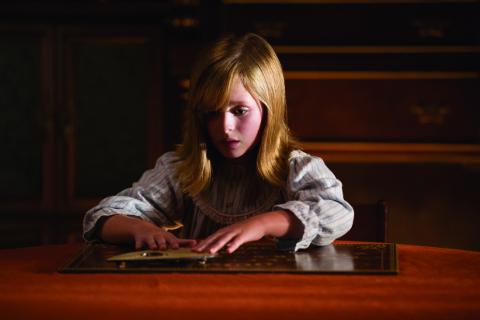
Cast: Elizabeth Reaser, Annalise Basso, Lulu Wilson, Henry Thomas, Parker Mack
Director: Mike Flanagan
99mins
2014's "Ouija" was inspired by the board ‘game’ — and appeared to be aimed primarily at young teenage girls having a sleepover with friends. Here, with the prequel to that, writer-director Mike Flanagan seems to have been given free reign to do as he pleases. "Ouija: Original of Evil" is a considerable improvement over its predecessor, with several thrills, spills and chills despite the somewhat predictable familiarity of the narrative. Mum to two girls, and recently widowed Alice Zander (Elizabeth Reaser) is struggling with life in general – and runs a fortune-telling business within her home. However, her abilities as a medium are a complete scam, as she and her daughters, 15-year-old Paulina (Annalise Basso) and 9-year-old Doris (Lulu Wilson) help her to rig these bogus seances as an assistance to the grieving process for the bereaved clients’ over their now-departed loved ones. Alice later decides to introduce a Ouija board into the proceedings and what initially appears to be a conduit to communicating with their late father and husband suddenly takes a far more sinister turn as a malevolent entity begins to possess the younger daughter Doris.
"Ouija: Origin of Evil" is a mature, character-focused horror flick that thankfully avoids reliance on soundtrack musical stingers. Director Flanagan is a confident filmmaker as he creates bold and moody visual compositions, and succeeds in building a real sense of unease while never losing sight of his protagonists' reality and struggles. In so doing, he ensures that his story remains rivetting in spite of its conventions, and with his adept intuition and firm control of mise en scène, he has single-handedly given his film a spectral vision.
