The Imitation Game
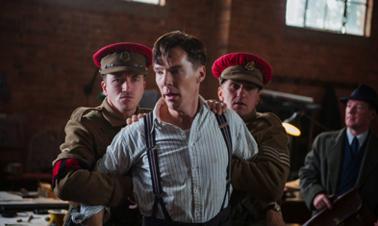
Cast: Benedict
Cumberbatch, Keira Knightley, Matthew Goode, Rory Kinnear, Charles Dance,
Mark Strong
Director: Morten Tyldum
113 mins
Mark Strong
Director: Morten Tyldum
113 mins
This is very much a film to admire. The Imitation Game doesn’t have a high level of rousing relatability for its protagonist, as Alan Turing is quite a prickly individual, so Benedict Cumberbatch deserves full credit for making him such an enigmatic and interesting character. However, despite the mathematician’s off-putting abrasiveness, making Turing hard to like is clearly the point, for much of the film focusses on his struggle to relate to his peers and co-workers. It takes a long time to come around to Alan, but The Imitation Game appeals in the end and finds just the right time to make Alan’s plight a worthy one as the film finds the greater text within this landmark tale. Cumberbatch is manically awkward as Turing—abrupt, curt, and egocentric—but his chameleon-like turn channels Turing’s ability to melt into the crowd as he pretends to be like everyone around him so as to avoid being signalled out for being a geek, a recluse, and, ultimately, a homosexual.
This latter aspect of Turing’s personality becomes a central thread of the film as The Imitation Game weaves from past to present as Turing becomes the centre of an investigation that inadvertently threatens to expose his sexual orientation, which was still a criminal offence in 1950s Britain. The film is admittedly prim with its dramatisation of Turing’s sexuality, for it offers little about his personal life (if he even had one) aside from a budding fling in school with a classmate who introduced him to both love and code cracking. Graham Moore’s smart script thus uses Turing’s ability to mirror the habits of others and pass himself off as part of the crowd as a double for Turing’s own efforts to recreate the human mind in the self-computing machines he develops for the British Secret Service. This layered and dexterous film slowly pulls the audience into Turing’s mind by playing his psychology off his work and vice versa.
Turing’s breakthrough work makes The Imitation Game accessible despite his tetchy character. Turing leads a team of brilliant minds to crack the Nazis’ codes and help Britain win the war, so this talky and academic film relies heavily on the strength of its robust ensemble to keep the drama engaging. The sturdy cast capably meets the task however, and makes a film about numbers as thrilling as one could be. Cumberbatch finds an equal in Keira Knightley as Joan, who provides an unlikely ally for Alan as he struggles to win the respect of his colleagues. The film playfully introduces Joan during an interview process in which Turing submits candidates to crack a puzzle, and Joan outshines the time set by Alan himself. Joan, like Alan, needs to play the imitation game for men to accept that a woman may perform the same work as a man, and The Imitation Game lets the plight of the mathematicians against Nazi Germany symbolise a fight for all outsiders. It does this by celebrating the outsiders and people like Turing who benefit the world from their different ways of thinking.
Norwegian director Morten Tyldum delivers an intricately crafted film that is as elaborate and brainy as one of Turing’s machines. Handsome production values, especially the cinematography by Óscar Faura along with subtle editing keeps the action lively with the film’s effective leaps through time, and the production has the pulse of a thriller thanks to the masterful score by Alexandre Desplat, who accentuates the enigma of Turing’s persona with an entrancing score. There can be no denying that this is a smart and solidly made film.
Interstellar

Cast: Matthew
McConaughey, Anne Hathaway, John Lithgow, Michael Caine, Jessica Chastain, Mackenzie Pryce
Director: Christopher Nolan
166 mins
Director: Christopher Nolan
166 mins
While spectacle-films are abound these days, with blockbuster sequels and rehashes each trying to one-up each other, we are seldom treated to something that is new and truly special. With imagination, ambition and heart Christopher Nolan's Interstellar positions itself to be just that. In the near future, humanity finds itself on the brink of extinction as Earth’s crops begin to die out. Cooper, a former pilot, lives with his two children and father-on-law on a farm. Almost by accident, he stumbles on co-ordinates that lead him to a group of people intending to save the human race. They ask him to man a flight through a mysterious wormhole, in search of a new, inhabitable world. Without knowing how long the journey will take, or if he'll even make it back alive, Cooper faces a difficult choice - a chance to save humanity, or stay with his family.
At nearly three hours and with some high-minded meditations about what it means to be human, Interstellar is not merely ambitious, it's dangerously close to being both hugely self-indulgent and from suffocating under its own sense of self-importance. What's more, with ample parallels to Kubrick's 2001, it makes no attempt to hide its lofty aspirations. Yet, beyond the self-seriousness and boldness of the film's vision, there also lies a big heart. In fact, it's the first time that Nolan's work has really struck an emotional chord, and the ring of that endeavour reverberates throughout the whole film. However – despite this, Interstellar is not 2001. Though it takes its cue from the sci-fi classic, Nolan's film shies away from allowing room for interpretation. It doesn't pose big questions so much as nestling its answers within a nexus of inevitable conclusions within the admittedly tight confines of its exceptionally tidy script. Instead, it's a story about a father who left his daughter behind. The epic space journey to save humanity is certainly rivetting, but as the grand backdrop to an emotional story about the possibly unbridgeable chasm between two characters, it becomes breathtaking.
Continuing the much publicised ‘McConaissance’, leading man Matthew McConaughey delivers rusty musings about the importance of discovery with his standard, gravely Texan cadence that isn't always easy to decipher (much like his rants in the sublime tv serial True Detective), but his performance as the everyday dreamer who is foisted with the fate of humanity on his shoulders is the centrepiece of the film's emotional ballast. The consternation and uncertainty written all over his face as he leaves his family before his journey is nothing short of heartbreaking. Maintaining Nolan's uncertain run with female characters is Anne Hathaway's problematic scientist, whose emotional vulnerability poses significant obstacles during the space voyage. Far better, and the other half of the story's emotional core, is Cooper's daughter, played by the impressive Mackenzie Pryce as a young girl and then a terrific Jessica Chastain as an adult. In addition, John Lithgow and Michael Caine (his sixth time with Nolan on the trot) both play imposing patriarchs while Topher Grace seems an odd casting choice in a minor role and a major star cameo (I won’t give it away in the cast list prior to this review) at the halfway point is potentially disruptive.
Much like Gravity, Interstellar is a technical marvel that pushes the boundaries of the medium. With stunning visuals, thrilling set pieces and some of best sound design on screen, it's a spectacle that screams to be seen on the biggest possible screen – certainly not on a piffling smartphone, perish the thought. Though Nolan's long-standing cinematographer Wally Pfister was off filming his debut Transcendence, Hoyte Van Hoytema stepped in to provide lucid photography, comfortably oscillating between rich and intimate on earth, and stark and awe-inspiring in space. Plus Richard King's immersive sound work, which goes from dense, claustrophobic rattles to eerie, almost silences, Hans Zimmer provides what might go down as one of his greatest scores, though it owes much to the Strauss compositions that are now forever associated with 2001. As a conflagration of art and commerce, Interstellar should be celebrated as a blockbuster that strives for originality, despite being more than a little overreaching at times. Admittedly, few filmmakers would be provided this kind of a budget, but Nolan, keenly aware of what is required of a film of this size in today's film market place, delivers the goods with a work that is both breathlessly expansive and enormously affecting.
The Drop

Cast: Tom Hardy,
Noomi Rapace, James Gandolfini
Director: Michaël Roskam
106 mins
Director: Michaël Roskam
106 mins
On a nightly basis, money laundering is a major recurrence, with cash changing hands across the criminal underworld. Deals are struck, goods are purchased, and bets are won and lost. At the end of the night, the cash has to end up somewhere, its last stop on the way to the big boss who will take the most off the top. This place is known as a drop bar, and in Brooklyn, the location changes day to day, the designated spot chosen at random. This is to keep the heat off any one specific bar and keep anyone foolish enough from getting the wrong idea about getting their hands on all that dough.
A robbery at one of those bars is one of the exciting incidents in The Drop, written by Dennis Lehane and directed by Michaël Roskam. The location in question is a rundown watering hole named Cousin Marv's. It's been several years since Marv (James Gandolfini, in his final role) owned the joint. Though he still runs it, Marv lost the bar to Chechen gangsters who aren't too pleased with giving up $5,000 to a couple of chancers in masks. Marv and his bartender (and actual cousin) Bob (Tom Hardy) are technically on the hook for the missing money, and maybe even suspected in its disappearance. Both the bad guys and a nosey cop aren't too sure their hands are clean.
Around the same time, Bob finds a wounded pit bull pup abandoned in a dustbin. The owner of said dustbin, but not the canine inhabitant, Nadia, lets him into her house to clean up the dog. They become friends, and she helps Bob figure out to how look after his new pet. He's a man of very few words and it would seem even less experience taking care of anyone but himself. This new addition to his life comes with hidden consequences, however; the creep who left the dog is Nadia's ex, a bad article who may also be responsible for the disappearance of one of Marv's old customers.
All of these things may be connected. Or they may just be coincidence. As The Drop unfolds, we mostly follow Bob as he observes his surroundings and tries to puzzle out what's behind all these scrapes and schemes. Like everything and everyone else in Lehane's script, Bob is not all that he seems. He is more capable than his downbeat demeanor might suggest. Hardy buries himself completely in the role, giving Bob a physical gravity but masking his inner workings behind a stoic facade. The actor maybe goes a little too De Niro at times, that furrowed brow and frown coupled with a penchant to repeat things as if 'it's ridiculous the other person didn't hear them the first time' has a definite familiarity. Yet, it also works to keep the whole situation slightly off kilter. Not knowing what Bob is thinking means we regularly don't know what to think, either.
The Drop's most defining characteristic though, is tension, which is constant, using the camera as an intruder or a distraction. Long before we see Eric, for instance, we are privy to his vantage point, watching from just out of frame and focus. Elsewhere, the script lays hints to something that Marv or the detective knows and that Bob doesn't, giving us a leg up.
The film has the bittersweet element of being the last work of James Gandolfini – who has a remarkable presence on screen, and his work here is excellent. While arguably just a variation on Tony Soprano or the hit man he played in Killing Them Softly, Marv is more of an everyman, an older gentleman bitter about his life not turning out the way he'd hoped. The man Eric was supposed to have killed was nicknamed Glory Days, and though it's an obvious metaphor, there is something very real about Marv and his customers reminiscing in his absence. The best of times are behind Marv, and Gandolfini makes that both pitiable and tragic.
To go into much more detail about The Drop would be to give too much away. This is not a film with artificial spoilers, but rather a knotty crime drama with genuine twists and turns based on character behaviour and the natural development of their respective situations. Those familiar with Lehane's style will recognise some of his technique, but the storytelling and direction avoids drawing attention to the revelations, instead letting them happen as they may, which should keep even the most jaded genre fan guessing all the way up to the end.
