The Hateful Eight
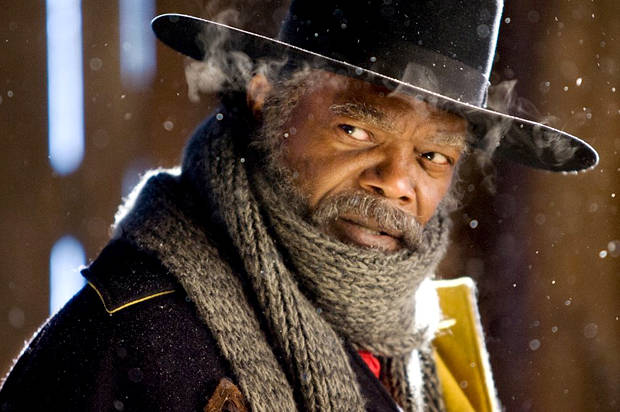
Cast: Samuel L. Jackson, Kurt Russell, Jennifer Jason Leigh, Walton Goggins, Demian Bichir, Tim Roth, Michael Madsen, Bruce Dern, Channing Tatum, James Parks, Dana Gourrier, Zoe Bell, Lee Horsley, Gene Jones, Keith Jefferson, Craig Stark and Belinda Owino
Writer/Director: Quentin Tarantino
Running time: Varies
Quentin Tarantino’s ongoing affection for cinema-past is so huge that he seems unable to prevent himself from hacking into endless plagiarism (or ‘homage’ as his followers would have us believe). So much so, that here, on his eighth interminable vanity project, he attempts to revive the experience from the fifties to the seventies—where big productions were given special treatment, usually in extra-widescreen format (ie Panavision 70mm) complete with overtures and intermissions. “The Hateful Eight,” continues his overblown conceit. With the protracted musical introductions and intermission, the film in some formats runs to something approximating three hours, and although it will be shown in the aforementioned form in which it was shot, only in a small number of venues in major cinemas for a short run, the digital transfer that most venues will screen, is luminous, showing off the outstanding technical contributions. And therein lies the tale.
Tarantino somehow, miraculously/mysteriously, whether through the power of persuasion, dishing out substantial wads of cash, or his clear affinity with the invisible new clobber of the Emperor, consistently succeeds in luring the finest cinematic technical talent around, not to mention the esteemed Ennio Morricone for the soundtrack. This is all well and good – but it just about manages to superficially disguise, albeit to everyone without a trained eye, the lamentable lack of discernible original creative talent from the writer/director – one Quentin Tarantino. I touched on this very fact in an earlier review, for ‘Django Unchained’, which I also felt deserved very few of the accolades it garnered – “he so needs a skilled, assertive creative partner to keep his obsessive excesses in check”. Robert Richardson’s gorgeous cinematography, Yohei Taneda’s excellent production design, Richard L. Johnson and Ben Edelberg’s first-class art direction, Courtney Hoffman’s terrific costume design and Rosemary Brandenburg’s ace set decoration—are all utilised to their respectively best advantage. But the film just isn’t worth all their effort.
In parts it’s odious – rife with gratuitous violence, racism and misogyny - it is certainly nowhere near being the classic that some of the headline reviews would have you believe. The film is, in essence, a weak western potboiler with a pulp-novel pulse, amusing in parts but tediously overlong, with no juicy characters, ridiculously poor dialogue and inane plot twists, and it does of course provide the ludicrously excessive and totally expected bloodbath at the climax. After Ennio Morricone’s introductory music which has a moody, sombre hook, the film starts with, it has to be said, a beautifully-composed scene of a stagecoach, initially merely a dot in the distance, trudging its way through the dazzlingly white snow-covered Wyoming landscape toward us, but unfortunately the pace of this promising opening develops into an ongoing, lacklustre, strung-out tempo in all that is to follow. Inside the coach are only two passengers: bounty hunter John Ruth, (‘The Hangman’) for his habit of bringing his quarry in alive for execution – played by Kurt Russell), and his prisoner Daisy Domergue (a barely recognisable Jennifer Jason Leigh), a murderess, whom he’s taking to Red Rock to end her days by execution. Along the way they pick up two additional individuals. One is Major Marquis Warren (Samuel L. Jackson), a former Union officer now also a bounty hunter, and the other - Chris Mannix (Walton Goggins) a former member of a Confederate renegade band, now the recently-appointed sheriff of Red Rock.
Reaching Minnie’s Haberdashery, the crew finds the place in the hands of a Mexican named Bob (Demian Bircher). Inside this wooden refuge are former Confederate General Sandy Smothers (Bruce Dern), there to visit the grave of his son; sinister cowboy Joe Gage (Michael Madsen), who claims he is off to visit his mother, and erudite Englishman Oswaldo Mowbray (Tim Roth), who presents himself as the Red Rock hangman. What follows from this point isn’t the expansive outdoor vista experience which the film’s epic proportions might suggest. Instead, and bafflingly we are subjected to a laborious verbal marathon in the claustrophobic cabin, as the various characters chatter about their pasts, sometimes accompanied by flashbacks (one, involving Warren and Smithers’ son, is particularly offensive and deeply unsettling). Most of the dialogue is in era-inconsistent expletive-laden typical Tarantino cogitation - and, as in the aforementioned “Django,” his obsessional use of multiple occurrences of the word ‘nigger’. It isn’t too long, despite the use of ‘Chapters’ (another Tarantino affectation) before the extreme carnage sets in—along with revelations, some delivered through narration from Tarantino himself, who reverses direction to show what actually happened before the coach arrived at Minnie’s and events since then from a different perspective - replete with the inevitable flashbacks, of course. This use of that function deepens suspicion that Tarantino cannot settle on a coherent narrative and is constantly adding to the original outline – which must surely prove infuriating to the technical team.
None of this will of course matter one jot to Tarantino aficionados, who will be content with his typically over-the-top genre imitations, amplified in this instance by the technical vitality. They’ll also doubtlessly enjoy the work of a cast with ironic credentials and a penchant for seizing on the peppery dialogue. Jackson luxuriates in the incongruously elevated esoterics of the script, as does the hammy, grinning Roth who, along with the more reticent Madsen, was also part of the ensemble of “Reservoir Dogs” and, like him, seems to relish being back in the director’s orbit. Newcomers Leigh and Goggins mug ferociously throughout, while both Russell and Bichir, buried under a mass of facial hair and scarves, grumble their way through the picture. Dern, looking convincingly frail, barely moves at all from his chair until his climactic moment with Jackson, and Tatum does well, albeit briefly, as Daisy’s brother.
In essence the entire piece is bloated and appears to have been over-extended to a ridiculous degree to meet the expectations of the format—with far, far too much repetitive dialogue and too many prolonged but extraneous sequences. You may well find yourself suffering from brain fatigue and saddle sores from endurance of this over-rated brat’s latest marathon. With the possible exception of 'Pulp Fiction' and 'Jackie Brown', whilst his technical teams' prowess has certainly excelled beyond the brief, his personal input has dismally failed to fulfill the hype. Let's hope he sticks to his earlier promise of ten films then he's out - as at this rate, for me at least, he's little more than a predictable, nerdy washed-up charlatan - and you can quote me on that.
ROOM
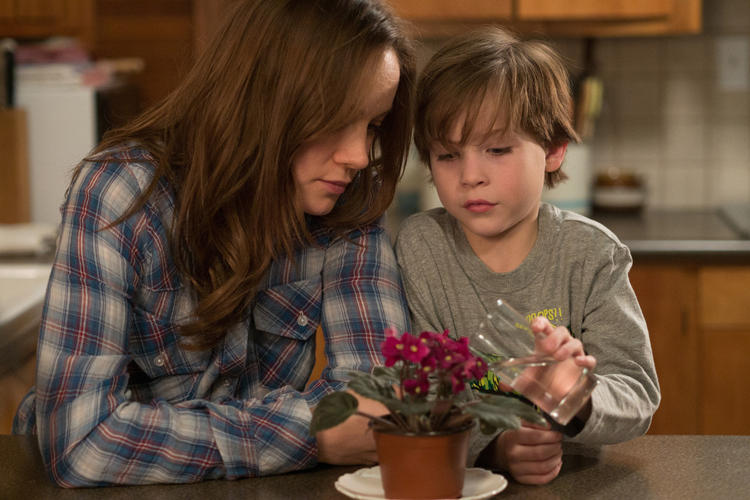
Cast: Brie Larson, Jacob Tremblay, Joan Allen, Sean Bridges, Tom McCamus
Director: Lenny Abrahamson
118 mins
"Room" is so very different from the usual imprisonment and escape story, because it is told from the viewpoint of a five-year-old boy (and narrated by him). Presenting the world from a child's perspective is not at all an easy thing to achieve, but done properly, as it is here, it opens up a whole new way of looking at the world.
This is a story of a teenage girl (beautifully played by Brie Larson) who has been kidnapped, raped and held as a sexual slave in a 10-foot by 10-foot shed with only a single skylight in the high unreachable ceiling to let in light. She has been held captive for seven years, but five years ago, she gave birth to a son, Jack (a quite astonishingly accomplished performance by young Jacob Tremblay) who means everything possible to her. Somehow through enormous emotional sacrifice and astonishing self-control, she has managed to insulate Jack from the horrors of her existence by keeping him separated from their captor, whom she has named Old Nick (Sean Bridgers) and by creating rich and colourful fantasies about the nature of the universe. To Jack, this small room is everything. He has no inclination whatever that anything exists outside their prison, so he is happy in the room, which is referred to not as “a room” or “the room,” but simply “Room” - his entire universe. His mother keeps it that way as long as she can. Old Nick, who comes to Room often to deliver supplies and to have sex with Jack's mother, is gradually becoming more curious about Jack, despite her attempts to keep them apart. Finally, she decides it is time for another escape attempt.
Years before, she had tried to ambush Old Nick when he came in via the coded entry and exit heavy steel door, but failed, and was injured in the process. This time, she has a fresh plan and attempts to convey that Jack has a fake illness, in the hope that Old Nick will take Jack to a hospital, where he can slip a note to doctors about his mother's imprisonment. Sadly the ruse fails, however it opens her mind to an even more elaborate and desperate escape idea. In this, the result is, that Jack is a real hero and in the process, he finally gets to see the world as it really is, huge, bright and at times to him, quite terrifying, filled with so many people. Reunited with his mother, whose name is Joy Newsome (a name Jack in his quite natural distress, fails to recall when asked by the police) the two move to Jack's grandmother's house, where Joy grew up.
Jack's grandmother, Nancy Newsome (Joan Allen) struggles to adapt to her daughter's mental state, whilst Jack is completely overwhelmed with the enormous adjustments required in trying to deal with the much larger world and all these people. Jack becomes withdrawn and clings to his mother, who in turn is dealing with anger, sorrow and depression following the harrowing seven years she’s had ripped out of her life. Despite dreaming of freedom for so long, regrettably her precious liberation doesn't instantly translate into happiness. She is also dealing with the fact that her mother has divorced and re-married during her captivity. Her father, Robert (William H. Macy) has moved to a distant city and he can't even bear to look at his own grandchild, the product of rape and abuse. The only person in the house who seems calm about this new situation is Joy's stepfather, Leo (Tom McCamus) due to his not having been burdened with the huge trauma which the others have gone through. Leo doesn't force anything, nor does he confront anyone nor demand anything. He wisely and patiently lets the others come to him in their own time, and then he connects with them. There is a delightful scene between Leo and Jack over breakfast which demonstrates Leo's welcoming sense and aura of calm, patience, and people skills which Jack immediately warms to.
Half the film takes place in Room, with the remainder tackling the difficult post-traumatic healing process. It is about Joy, Jack and Nancy (Jack's grandmother) all trying to adjust to their new reality, which also gives the audience a welcome opportunity to heal from the trauma endured by Joy and Jack in this film. The horror of kidnapping, rape and imprisonment is lessened for the audience because we experience the story through Jack's eyes, and he never fully realises the full extent of the shocking experience his mother endured throughout during her captivity. The cinematography and production design capture both the claustrophobia of “Room” and the expansiveness of Jack's imaginary universe. A small camera and an ingenious expandable Room set were reportedly used to film in the cramped space. The performances of Brie Larson and Jacob Tremblay are utterly outstanding. The story, based on the novel, “Room,” by Emma Donoghue (who also wrote the screenplay) is loosely based on actual events.
This is a wonderfully compelling film, expertly directed by Lenny Abrahamson - who does a superb job in reminding us how the world is viewed through the eyes of a child.
