Venus In Fur
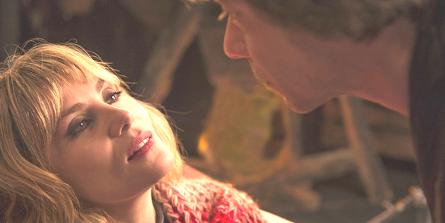
Cast: Mathieu Amalric, Emmanuelle Seigner
Director: Roman Polanski
96 mins
Polanski seems to revel in claustrophobic set pieces with conversational subversiveness – and here we have a very dark labyrinthian sequence of mind games laced with humour. Venus In Fur opens with a desperate theatre director, Thomas (Mathieu Amalric) pacing the stage whilst he moans with suppressed rage on the phone, following an arduous day of auditions from timewasting idiots.
He’d been hoping to cast the lead in his new play, Venus In Fur, an adaptation of an infamous novel by Leopold von Sacher-Masoch which was credited with creating the term masochism. The play is a labour of love for Thomas, fuming that no one seems able to grasp the lofty intention of such a highly-sexualised period piece. Just as he is about to leave the theatre and head home, in rushes an actress - Vanda (Emmanuelle Seigner), whose name also happens to share that of the titular Venus of the play. Vanda’s initially dumb blonde persona, as she grumbles excuses for her lack of punctuality, eventually succeeds in charming an initially unconvinced Thomas to allow her to audition, despite her late arrival.
However, Thomas’ over-zealous enthusiasm for his own work apparently blinds him to the fact that this Vanda is not all that she appears to be, revealing a convenient number of perfectly prepared props from her own personal supply of goods. She begins by offering a slack reading from her complete copy of the script (which also arouses Thomas’ ire - being astonished at how she has managed to obtain a full transcript). This is followed by director and actress slipping in and out of character as they squabble about the true nature of the play. Events become more personal as we learn of Thomas’ obsession with the material - which may well run deeper than initially perceived. Vanda actually has the entire play memorised, and before long, the differentials become blurred regarding who is actually the director and who is the actress.
Taken from the 2010 stage play by David Ives, this play-within-a play is adapted from Von Sacher-Masoch’s notorious novel which uses this structure within its own narrative, examining the innate misogyny and exploitation within gender politics, whilst blending seamlessly with the male dominated world of the theatre – as it skewers perceptions of masculine and feminine, director and actress.
Amalric is tremendous here – superbly portraying Thomas with a bewildering complexity, at turns fragile and assertive, but basically a look alike/stand-in for Polanski. This situation is further complicated by the presence of Seigner who is Polanski’s real life wife. Polanski helms the proceedings as a latter-day Sacher-Masoch, unravelling the fantasy as he depicts a protagonist being mercilessly manipulated by the fantastic embodiment of a hopelessly alluring femme fatale.
To Alexandre Desplat’s wonderfully appropriate score, the film opens with a drifting shot over the posters for a recently-ended musical version of Stagecoach, before eventually settling on Amalric prior to his downward spiral where he spars wonderfully with a sublime performance from Seigner. She is someone too often stuck in the shadow of her infamous husband’s career but here, her portrayal of Vanda is a joy, as she almost devours Amalric alive, radiating with a turn of monstrous glee, her feline eyes peering from those prominent cheekbones. She offers an agile ease sidling through the material’s dynamics at the same time disguising just what it is she’s really up to.
Fading Gigolo
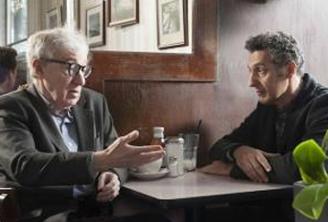
Cast: Woody Allen John Turturro,
Sharon Stone, Vanessa Paradis,
Liev Schreiber
Writer/Director: John Turturro
98 mins
Sofia Vergara and Sharon Stone are intrigued by the prospect of a ménage a trios - and when that happens – who ya gonna call? Fioravante! The protagonist (John Turturro) is a part-time florist who is struggling financially – and when his chum Murray (Woody Allen) suggests a new career sideline for him as a male prostitute, with Murray as his pimp/agent – following some thought, he takes up the offer.
The premise may not at first glance appear to be a close friend of reality, but if you can look beyond that, you’ll find "Fading Gigolo" to be enormously enjoyable.
Murray Schwartz (Woody) is the owner of a book shop that has fallen victim to the age of digital reading – and he’s decided the time has arrived to reluctantly close down the business. His good friend Fioravante (Turturro) suffers equally from financial pressure. Following an appointment with his dermatologist, Dr. Parker (Stone), Murray informs his chum Fioravante of an unusual request issued by Parker. She has asked Murray if he is aware of any man who might be interested in offering himself as part of a threesome sexual liaison with friend Selima (Vergara) and herself. Fioravante looks on blankly until Murray reveals that he has suggested to the doctor that he - Fioravante – could well be interested and that a lucrative payment is on the table.
Following an understated response, he reluctantly agrees to give it a try. Murray, as the newly self-designated pimp, will of course get a piece of the action – but purely in cash terms, whilst suggesting that as a pimp he should re-monicker himself as Bongo. Taking to it like a duck to water, Fioravante enters this new career path with a disarming suaveness as he successfully completes several encounters much to the pleasure of an array of grateful new clients.
However, a more serious appointment emerges when Murray/Bongo obtains a new client for his protégé. This is Avigal (Vanessa Paradis), a Hasidic woman whose husband has died, leaving her in sufferance from abject loneliness. A relationship of sorts forms between Fioravante and Avigal, although Dovi (Liev Schreiber) who is a member of the local Hasidic police force, has a huge crush on Avigal and becomes suspicious of Avigal's clandestine meetings.
Although the script was written by John Turturro, every line from Murray is - I’d bet my life on it - from Woody Allen, who is a delight throughout. The whole piece adds up to a slight but nevertheless entertaining experience, despite the credibility of it being nothing short of nonsense.
The memory of this film will undoubtedly fade, but not before it leaves the imprint of a smile on your face.
