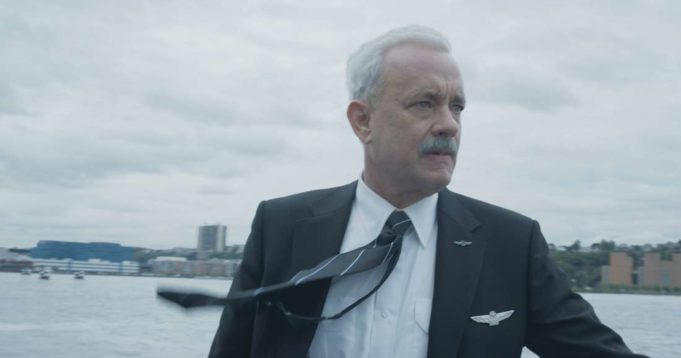
Cast: Tom Hanks, Aaron Eckhart, Laura Linney
Producer/Director: Clint Eastwood
96 mins
Clint Eastwood’s film re-enacts in almost forensic detail how, in January 2009, US Airways Captain Chesley "Sully" Sullenberger and his co-pilot Jeff Skiles, successfully executed the water-landing of Flight 1549 on the Hudson River, after both of their plane’s A320 engines were incapacitated following the digestion of a flock of geese shortly following take-off. Despite the enormous dangers of such an unorthodox landing and the freezing temperature of the River Hudson, all 155 passengers and crew managed to survive the crash - a testament to Sully’s 40 years of experience in the air. However, to manufacture some meat from the bones of a good story and as, in feature-film word, no decent deed goes unpunished, Sully (Tom Hanks) and Skiles (Aaron Eckhart) are immediately whisked away to an hotel to explain the decision to ditch in the river instead of diverting to a landing strip at a nearby airport, just across the Hudson in New Jersey. Since the film is based on actual history I can’t really apologise for a spoiler in this review – especially if you paid any attention to the news at the time, but for those of you now reading this, but to whom this tale passed you by, the film dramatises the ensuing investigation. Calling Sully’s landing improbable barely does his feat justice, but the airline’s insurance company ignored Sully’s skill and heroics and focussed instead on whether or not he followed the correct procedures. Hanks is measured and calculated, despite his character’s occasional forays into PTSD-inspired hallucinations of the plane inexorably dive-bombing a la 9/11 into the Manhattan skyline, and the lead easily portrays the cool, logical conviction of a veteran pilot. Eckhart plays his own role with zingy backchat and sarcasm.
Unfortunately, even an actor of Laura Linney’s calibre gets fed some duff lines, and Eastwood’s apparently regular penchant for shooting as few takes as possible doesn’t help her. Hanks gets away with it because Sully’s semi-detached personality allows for it, but regrettably, just now and then the dialogue has trouble climbing above exposition. Worse, the whole thing does get stuck when it tries to make the audience care about the passengers – boring types such as a trio of losers rushing off on a golfing holiday and charging on to the flight at the last possible second, and just who the hell is ever chuffed to find themselves trapped in window seat next to a baby? Eastwood merely creates very basic sketches of a handful of passengers, so you care very little if at all, when the pre-aquatic descent becomes more tense and perilous. However when Sully and Skiles give their testimonies, the real-time events (played out as an unbroken flashback from take-off to crash) are truly harrowing. Hearing the flight attendants chant, “Heads down! Stay down!!” as the plane thunders on to the river is terrifying – and watching the various rescue services swing into action is thoroughly satisfying, as is Sully’s final vindication. The film is enjoyable, and Eastwood is nothing if not highly competent at telling a story.
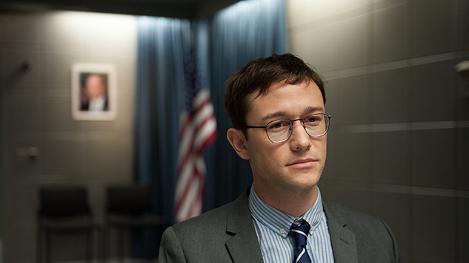
Cast: Joseph Gordon-Levitt, Shailene Woodley, Rhys Ifans, Timothy Olyphant, Zachary Quinto, Nicolas Cage
Director: Oliver Stone
138 mins
Oliver Stone’s Snowden, synthesises all of the maverick director’s best qualities into one ruthlessly efficient 138-minute feature. Stone has always been a director more than comfortable when operating within a wide variety of styles and genres, and here we have a few. It’s a thriller, a love story, a political provocation and an ensemble drama, in which none of the elements detracts from the others. The film’s ultimate power, however, derives from the director’s return to the theme of heroism in a manner that expands upon and deepens his previous work. Many of Stone’s best films examine profoundly flawed men who are nevertheless capable of greatness, in the process exploring how heroes and icons can either transcend or fall short of our—and indeed their own—expectations. He’s a director keenly aware of the power of mythology and who is equally aware of the need to deconstruct or answer them. In Snowden, there’s no need to mythologise. Stone is dealing with recent history which has already been distorted and put at the service of a multitude of agendas many times over. Instead, he adopts a more realistic and relatively straightforward approach. The film displays Stone’s constant probing for new modes of cinematic storytelling and in recounting Edward Snowden’s journey from idealistic soldier through government employee to fugitive NSA whistleblower, we have here a technique that is both objective and subjective, alternating between clear, concise journalistic detail and stylised imagery that places the viewer in Snowden’s consciousness.
There are constant shifts in perspective, not only between outside and inside Snowden, but between the points of view of a variety of supporting characters. Actors like Timothy Olyphant, Zachary Quinto and Nicolas Cage - and above all a quite brilliant performance from Rhys Ifans, shine in parts which exhibit texture far beyond what would seem possible with such a limited amount of running time. Time and again the cast employs an economy of gesture and dialogue that enables them to suggest entire histories in a few lines and images. Scott Eastwood is also impressive as one of Snowden’s superiors, bringing the scope and depth one usually finds in leading roles to a character who only appears on screen in a few scenes.
However, without question, this is Joseph Gordon-Levitt’s picture - and he fully encapsulates the real Edward Snowden’s physical and vocal attributes with flawless technical skill. His performance goes far beyond mimicry to present a character in a constant state of moral anguish—something that might not seem so unusual, aside from the fact that Gordon-Levitt is playing someone who can’t talk to anyone about what he’s going through. The film isn’t just about the American government’s secrets, but about the secrets Snowden himself is forced to keep from everyone around him, for their safety as well as his own. Without the benefit of explicit dialogue, Gordon-Levitt conveys, with total force and clarity, exactly what he’s going through at every stage of his disillusionment, and Stone’s composition and editing showcase the actor’s work with purity. Finally, some forty years on, Stone has managed to distill his style to provide maximum impact using minimal means. It’s a bleak but brilliant feature which could easily be construed as a chilling horror film about the surveillance state under which we all live.
