HORNS
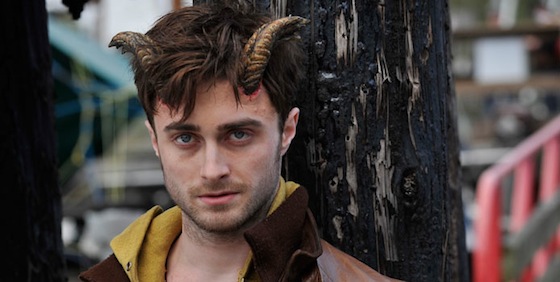
Cast: Daniel Radcliffe, Heather Graham, Kathleen Quinlan, James Remar, Juno Temple, David Morse
Directed by Alexandre Aja
123 mins
Directed by Alexandre Aja
123 mins
Are you Horny?” asks Juno Temple of Daniel Radcliffe, as a verbal bookend in this odd yet sincere adaptation of Joe Hill’s novel, ‘Horns’. Two lovers, Iggy and Merrin lie intertwined from a higher perspective across a spreaded blanket on the edge of the forest, in their own little garden of eden. They kiss, while the camera looks downwards, only to have it then quickly drill down into the ground to look up from a subterranean Hades, for a taste of the unfolding tale that some-time after their playful kiss, Merrin has been murdered and Iggy is prime suspect. To maintain the Bowie/Iggy connection for pop trivia fans, for no other apparent reason, a vinyl copy of David Bowie’s “Heroes” plays on a turntable, only before it is physically impeded to slow down the rpm. The town mourns the loss of Merrin, its very own Laura Palmer, a delightfully perfect girl struck down in her youth.
This kind of crime ellicits the worst kind of weirdness in small towns. The Twin Peaks vibe remains prevalent as Heather Graham, in a sprightly cameo, is even seen serving coffee and pie at the local diner. Iggy can’t seem to convince anyone of his innocence, not his parents, not his future father-in-law and least of all the relentless local news media. However, all of this intensifies when he starts to sprout horns from either temple. Is he becoming the devil, the manifesation of which the whole town is projecting upon him with their accusatory stares?
Director Alexandre Aja muddles the screen with his jarring lack of focus on what is truly important – the love story between Iggy and Merrin. He seems unable to cease the urge to cut away for lengthy flashbacks, revenge story theatricality and procedural sleuthing. These all work well enough in long-form TV, but every element feels sloppy, rushed, and undeveloped. The film goes mad with Iggy’s horns which distribute in him an oddly confusing super-power of sorts which brings out the worst kind of pettiness in people. A woman ludicrously gorges on doughnuts, and inhibitions and propriety rush to dive out the window. A doctor drops all levels of professionalism to have sex with his nurse in full view of a patient, and the media batter lumps out of one another over a possible scoop. When this power makes his family and friends confess and misbehave, it becomes almost unbearably tragic. Separate scenes with Iggy’s mum and dad, played by Kathleen Quinlan and James Remar, see both parents reject their son in disturbing circumstances. Merrin’s father, a small but pivotal role handled well by the always reliable David Morse, plays out with dark poignancy (“She was my favourite thing about you.”) Clear influences are obvious from a Stephen King novel – unsurprisingly, considering the source material author Joe Hill is the horror writer’s son.
Daniel Radcliffe though, it has to be said, is nothing short of a revelation in this. Finally and comprehensively shedding and shredding any last trace of his Potter alter-ego – he absolutely shines and his American accent is note/tone and nuance perfect - as the confused, lovesick protagonist who may or may not be losing his mind but alas, too often the film doesn’t seem to want to be as serious as he is, in treating the material with respect. Just when you can sink your teeth in to some real drama, all is utterly dropped for computer generated hboring snakes and silly revenge plotting.
Shift gears again to all sorts of cute sight gags. Pitchforks, including Eve’s Diner (with its apple logo) and a Jazz bar that looks like Hell’s favourite nightclub or something out of a Tex Avery cartoon. The most egregious sin however, is how it equates two homosexual policeman with evil. All the aforesaid could be forgiven however if things didn’t culminate in a ridiculously over the top CGI finale. The resolution is far too concerned with the film’s mishandled love triangle and not concerned enough with, as the film puts it, making the Devil the hero. Juno Temple plays a corpse for most of the film so her input lacks any real depth, further weakening the credibility of the love story.
Jimi: All By My Side
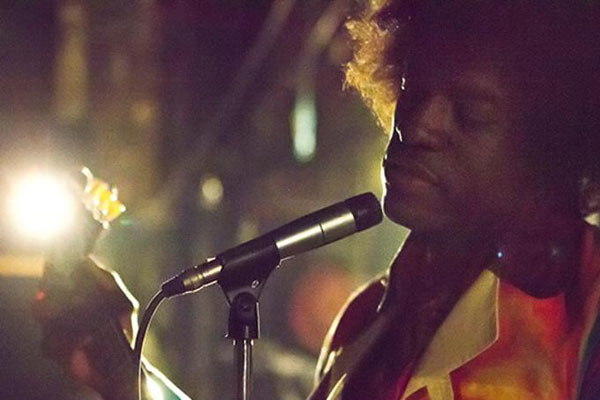
Cast: André Benjamin, Imogen Poots, Hayley Atwell, Ruth Negga,
Andrew Buckley, Oliver Bennett
Directed by John Ridley
118 mins
Directed by John Ridley
118 mins
If you settle down with your bag of munchies in the cinema seat hoping to bear witness to a standard Jimi Hendrix biopic, from the 1960s music legend’s meteoric rise to guitar-hero status, with vignettes of his life through his formative years and tragically climaxing with his demise – you’ll find something else entirely here.
Writer/director John Ridley (the Oscar-winning screenwriter of 12 Years a Slave) does something else entirely, and it’s to everyone’s benefit. Jimi: All Is by My Side is an evocative, probing, enlightening, and impressionistic look at the lesser-known period of Hendrix’s life: the pivotal time from 1966-67 during which the musician discovered his style and voice. Not unlike Hendrix, who turned his left-handed guitar-playing into one of his greatest technical assets, Ridley turns the biggest barrier to the making of this film into its chief engine for ingenuity. Disappointingly prevented by Hendrix’s estate from using any of his songs, Ridley locks into a compelling way to tell this story that has no need for music rights to the Hendrix classics. By placing the focus on the period from 1966-67, when Hendrix went from playing as a sideman still known as Jimmy James to becoming the star attraction known as Jimi Hendrix, Ridley’s film mostly takes place before Hendrix’s first album, Are You Experienced, comes out. Jimi plays a lot in the film, and some of his guitar runs can sound like precursors of later chord progressions, but when it comes to complete melodies, the filmmakers use songs written by others, like Chip Taylor’s “Wild Thing” or Howlin’ Wolf’s “Killing Floor,” which sends Eric Clapton scurrying from the stage while the unknown Hendrix jams with Cream.
The real miracle of the film however, is the performance of André Benjamin (one half of Outkast) as Hendrix. Although older than the character he’s playing, Benjamin manages to capture Hendrix’s fey demeanor and confident swagger. The other electrifying aspect is the feature’s portrait of groupies as complex women – handmaidens to greatness and true music scouts.
The film opens with Hendrix’s initial discovery by Linda Keith (Poots), a top London fashion model and the girlfriend of Keith Richards, while he’s playing backup at New York’s Cheetah club and Richards is occupied with the Rolling Stones’ 1966 American tour. It is she who instills in him a desire to strike out on his own, change his processed hair into an Afro, gives him his first go at acid/LSD and a white guitar belonging to her boyfriend. She also introduces him to Chas Chandler (Buckley), who becomes Hendrix’s manager (and who is usually cited as the one who discovered Hendrix). Hendrix’s tendency to float from girlfriend to girlfriend is well-demonstrated, as is a less-than-flattering tendency toward physical abuse.
Topping things off is Glenn Freemantle’s terrific sound design in which the whole bohemian scene is a sonic sensation in which snatches of music, conversations, and even silence vie in a pastiche that creates as good a sense of that moment in time – and Hendrix’s myriad influences – as any you’re likely to come across.
