NYMPHOMANIAC
Volumes I and II
Volumes I and II

Cast: Charlotte Gainsbourg, Stacy Martin, Stellan Skarsgard, Shia LaBeouf, Jamie Bell, Uman Thurman
Director: Lars Von Trier
Volume 1: 118 mins
Volume 2: 123 mins
Director: Lars Von Trier
Volume 1: 118 mins
Volume 2: 123 mins
The "nymphomaniac" of the title isn't really the central character of Danish director Lars von Trier's latest film, played at two different stages of their lives by Stacy Martin and Charlotte Gainsbourg. Conversely the real title-holder is von Trier himself, as he indulges in a form of aesthetic autobiography, offering provocative references as to how his career has been perceived and received.
As with his previous work Melancholia there’s a real sense of a chillingly subdued feel to the proceedings, indicating a director so totally at the helm in more ways than one. In Nymphomaniac, the structure of Joe's (Ms. Gainsbourg) sexual education is much less about sex, desire or lust than it is about emotion and life itself – almost as though she felt herself to be without any real qualities, whilst immersed in guilt and despair.
Offering her tales of woe to the sympathetic ear of Seligman (Stellan Skarsgård) she attempts to portray her upbringing as of being a nefarious individual, via the intrinsically and in some cases forensically detailed outlining of her sexually coming-of-age recollections. In doing so, is she is really voicing the director's own confession as a master manipulator for his own commercial gains? Throughout his cinematic career perhaps LVT has maliciously substituted art for sex - and in the process expecting cinemagoers to take note of the unmitigated fact that very little if any of the sex depicted on screen is graphic or even titillating. In so doing maybe the result is offering us more of just how ambitious and touchy Mr. von Trier is, as he attempts to create self-justification for being the foremost agent provocateur in contemporary cinema.
On offer should you wish to partake/indulge, is just under four hours of screen time for ‘Volume I and Volume II’ of Nymphomaniac - and whether these dual cuts are or aren’t what LVT originally planned by he himself (all will be revealed on DVD/Blu-ray release day), the whole collective piece is clearly his work, all the way down to the demanding, nakedly confessional tone of the performances.
Gainsbourg, Skarsgård and Willem Dafoe show up from his regular troupe – as well as an array of familiar faces and in some cases less familiar ‘downstairs areas’ of such as Shia Laboef, Jamie Bell, Uma Thurman (who turns in a brilliant performance as a distraught wife) and Christian Slater (plus some quite wonderful work from Stacy Martin) who all pop up along the way, mid-and-beyond a cornucopia of carnal knowledge. You may well feel you’re being manipulated yet again, what with the content - not to mention the multi-version situation of the films themselves - however I personally sense LVT is being a great deal more sincere and genuine than in most of his previous work.
Quoted in the film's narration is the line "we are all waiting for permission to die.” Undeniable though that may be - we encounter many elements here of loneliness, despair and sexual motivation - and all are used as a mixed means to an end or indeed towards survival.
STARRED UP
Cast: Jack O'Connell, Ben Mendelsohn, Rupert Friend, David Ajala, Peter Fernadino
Director: David Mackenzie
100 mins
David
Mackenzie’s 'Starred Up' (prison slang for a young offender who
is moved to an adult prison due to their excessive violent
behaviour) is the story of a young man who has that 'accolade' bestowed upon him with the resultant action of him being redirected into a big boys’ prison - where it just so happens his errant dad
is banged up too.
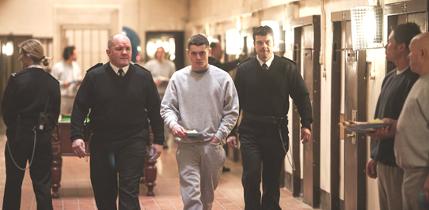
The film is shot through with authenticity – in the story and location – and is sprinkled with characters who maintain an ominous sense of palpable unease, bringing chilling unpredictability to each and every scene. These exceptionally flawed individuals could explode at any time but are also capable of utilising vast degrees of cunning, logic and an occasional ability to see beyond the next violent outburst to gain a grasp on what kind of future can be achieved within this desolate, unforgiving environment. The narrative maintains a strong forward momentum, and concurrently an ebb and flow in the status of the characters with the respective overall emotion where any possible shame or contrition for their recidivist endeavours is disguised by being utilised.
This method of developing shame awareness enables some of the convicted community to become more expert in confrontation, so they learn how to match the power of the person they are confronting instead of having to hide (giving power away) and attack (overpowering). Because power may be matched, an adversary is given a choice: either choose to stop shaming, or choose to take it up to the next level. If the shamer chooses to stop shaming, there is no loss of face, since he is not being forced into his decision by being overpowered; he is making a choice. Everyone wins because the primary reward is facilitated; social bonds are being nurtured and repaired. When an incarcerated individual makes an intervention to match power successfully, he shares power, therefore becoming a leader in their own right capable of delivering the primary reward.
The central focus here is with 19 year-old Eric, who has just been “starred up” to the adult prison. Portrayed with mesmerisingly credible conviction (pardon the pun) in a superb leading performance by Jack O'Connell, he may have been a teenager while in a young offenders’ institution, but there’s no time for anything resembling coming of age here. He’s given his own cell due to his high-risk category of potential self-harm vulnerability – but he wastes no time at all in creating a makeshift knife from his toothbrush and shaving razor. His demeanour, expression and body language all show he is hyper-alert and won’t wait for trouble to come to him – he’ll beat it, literally, to the punch. In his wing of this sprawling facility, just a floor above him, is his father Neville. Though he initially comes across as less physically intimidating, he has tangible clout in his own section of the jail. He knows guards, has wider access to amenities and has his own team of fellow-cons. The initial conversation between dad and son in the yard is less family reunion and more about bravado - but Neville has a clear message for his boy – be very, very careful about whom you decide to get on the wrong side of in this place. Adhering to the prison pecking order is vital – and in turn paternal Neville sycophantically offers regular reports to his own in-house ‘daddy’ - a bespectacled n’er-do-well creep who rules the entire wing from his cell complete with his own creature comforts.
Following an almost inevitable early violent incident, Eric is spotted by a volunteer counsellor who runs a regular anger management group meeting for especially hot-headed inmates. This interaction is an impressive section, offering no platitudes nor easy answers, but with a little natural progress, respect - albeit reluctantly - is earned between participants. Eric detects possible benefits here, but his inherent rage issues emerge and he in turn struggles to keep his distance from his father, who interferes with the session and causes the knock-on effect which ends with Eric’s removal.
Unfortunately a cliched warden character appears, who is devoid of any subtlety or complexity - as brutal retribution is delivered upon Eric. This disappointing hiccup apart, Starred Up is superb in its depiction not just of the brutality, lack of hope and diminishing dignity of life within incarceration, but in showing the many ways that men desperately crave respect from however it may be sourced - considering the extremities of behaviour required to achieve this most fundamental of desires.
The film is shot through with authenticity – in the story and location – and is sprinkled with characters who maintain an ominous sense of palpable unease, bringing chilling unpredictability to each and every scene. These exceptionally flawed individuals could explode at any time but are also capable of utilising vast degrees of cunning, logic and an occasional ability to see beyond the next violent outburst to gain a grasp on what kind of future can be achieved within this desolate, unforgiving environment. The narrative maintains a strong forward momentum, and concurrently an ebb and flow in the status of the characters with the respective overall emotion where any possible shame or contrition for their recidivist endeavours is disguised by being utilised.
This method of developing shame awareness enables some of the convicted community to become more expert in confrontation, so they learn how to match the power of the person they are confronting instead of having to hide (giving power away) and attack (overpowering). Because power may be matched, an adversary is given a choice: either choose to stop shaming, or choose to take it up to the next level. If the shamer chooses to stop shaming, there is no loss of face, since he is not being forced into his decision by being overpowered; he is making a choice. Everyone wins because the primary reward is facilitated; social bonds are being nurtured and repaired. When an incarcerated individual makes an intervention to match power successfully, he shares power, therefore becoming a leader in their own right capable of delivering the primary reward.
The central focus here is with 19 year-old Eric, who has just been “starred up” to the adult prison. Portrayed with mesmerisingly credible conviction (pardon the pun) in a superb leading performance by Jack O'Connell, he may have been a teenager while in a young offenders’ institution, but there’s no time for anything resembling coming of age here. He’s given his own cell due to his high-risk category of potential self-harm vulnerability – but he wastes no time at all in creating a makeshift knife from his toothbrush and shaving razor. His demeanour, expression and body language all show he is hyper-alert and won’t wait for trouble to come to him – he’ll beat it, literally, to the punch. In his wing of this sprawling facility, just a floor above him, is his father Neville. Though he initially comes across as less physically intimidating, he has tangible clout in his own section of the jail. He knows guards, has wider access to amenities and has his own team of fellow-cons. The initial conversation between dad and son in the yard is less family reunion and more about bravado - but Neville has a clear message for his boy – be very, very careful about whom you decide to get on the wrong side of in this place. Adhering to the prison pecking order is vital – and in turn paternal Neville sycophantically offers regular reports to his own in-house ‘daddy’ - a bespectacled n’er-do-well creep who rules the entire wing from his cell complete with his own creature comforts.
Following an almost inevitable early violent incident, Eric is spotted by a volunteer counsellor who runs a regular anger management group meeting for especially hot-headed inmates. This interaction is an impressive section, offering no platitudes nor easy answers, but with a little natural progress, respect - albeit reluctantly - is earned between participants. Eric detects possible benefits here, but his inherent rage issues emerge and he in turn struggles to keep his distance from his father, who interferes with the session and causes the knock-on effect which ends with Eric’s removal.
Unfortunately a cliched warden character appears, who is devoid of any subtlety or complexity - as brutal retribution is delivered upon Eric. This disappointing hiccup apart, Starred Up is superb in its depiction not just of the brutality, lack of hope and diminishing dignity of life within incarceration, but in showing the many ways that men desperately crave respect from however it may be sourced - considering the extremities of behaviour required to achieve this most fundamental of desires.
