Mr. Turner
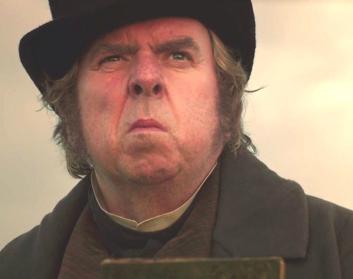
Cast: Timothy Spall, Dorothy Atkinson, Marion Bailey, Karl
Johnson, Lesley Manville
Writer/Director: Mike Leigh
Writer/Director: Mike Leigh
149 mins
Mike Leigh’s peerless film “Mr Turner” clearly shows the exquisite care taken in terms of location, light and colour in some sublime scenes that mirror the sketches, oils and watercolours of Turner, which embrace all the emotion, passion and poetry which are normally beyond traditional camera capabilities. The film isn’t strictly a biopic but it is based on research into characters and the requisite period without being at all in the format of a documentary – and the 149 minutes are too well done to have this perceived as a mere labour of love. JMW Turner, quite wonderfully portrayed by (Leigh regular) Timothy Spall, is magisterially unaware of social niceties and paternal obligations, nor of women’s (or anyone’s) rights, and in fact he seems to have severed all human ties except those towards his ex-barber father or “Daddy” as he quaintly calls him - William, Sr. (Paul Jesson). The story, however, is not concerned with genius against humanity or humility. Beyond tears at his Daddy’s bedside after agreement with the dying man on what a witch his mother had been, there is no background or insight into what made the man. Irascible grunts and snorts are the sole odd endearing trait of this highly successful middle-aged painter who is at once the terror and darling of the Royal Academy. Defended by a pompous young John Ruskin (Joshua McGuire), he ignores the political, royal and social waters that swirl around him and his work. Unexpected acts do appear from him, like the refusal of £100,000 for his entire body of work ie 19,000 pieces - so that, instead, it can be bequeathed gratis to the nation, or his gruff generosity with a whiney indolent Benjamin Robert Haydon, (Martin Savage) who in reality was actually more successful than this film portrait indicates.
As an artist, Turner had already made the transition from romantic landscapes to the vortices of colour, vision and interpretation that anticipated twentieth century theory and practice. As a man, obsessed with his work and experimenting with the perception and effect of light and space, he became divorced from other people and was particularly appalling in relationships with defenceless women. One brief exception was all-business natural philosopher Scottish (or ‘Scotch’ as she describes herself) scientist Mary Somerville (another Leigh regular, the always wonderful Lesley Manville), herself concerned with prismatic division and projection of light. Turner unsettling in his procurement of young prostitute Eliza (Kate O’Flynn) for sketching, and cold and detested by Sarah Danby (Ruth Sheen), mother of their two daughters who also detest him. He is repulsive in near daily contact with adoring, self-effacing, feeble and skin-diseased housekeeper Hannah Danby (Dorothy Atkinson), a niece of Sarah’s whom he uses from time to time for sexual gratification that is nothing short of rape.It is a mystery how any woman would be attracted to such a sloppy lout as this self-styled “gargoyle.”
When taking a sabbatical to Margate, he registers as Mr. Mallard at a guest house run by Sophia Booth (Marion Bailey) and her ex-slave ship’s carpenter husband (Karl Johnson). Mr. Booth may perhaps have inspired the unmentioned 1840 oil, The Slave Ship (Slavers Throwing Overboard the Dead and Dying, Typhoon Coming On) and in any case conveniently dies, leaving the garrulous widow to become a blessing to the painter’s later years. Careless to the point of fatality with regard to his health (he lived to the age of 76) and to the point of having himself lashed to a mast to observe first-hand a snowstorm at sea, the driven man seems to reach relatively calm waters with this caring ego-bolstering woman, while equally besotted Hannah is left out in the cold. Also, for the first time ever in a Mike Leigh film, the genial acting and dialogue meet their match with the quite breathtaking cinematography, effectively evoking the misty suns and pinkish hues of Turner’s paintings – making a formidable case for the intricate similarities between painting and cinema.
