LEVIATHAN
Directed by Lucien Castaing-Taylor, Verena Paravel
Running Time: 87 min.
Running Time: 87 min.
Lucien Castaing-Taylor and Verena Paravel climbed aboard a New England fishing boat to film Leviathan, which is almost wordless throughout its seemingly endless 87 minutes. The film has no narrative, no interviews, no structure, no entertainment and no information value whatsoever. All I can offer you is a plea to give this bilge the widest berth you find yourself capable of, it doesn't even fathom the idea of being a wind-up, it is so facile.
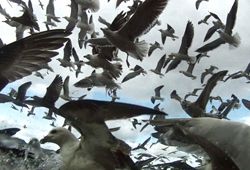
For the entire running time, the masochistic filmgoer will be subjected to a miserable array of images featuring jaw-dropping raw footage of nets, fish, pulleys, overweight slobbish crew members and relentless images of the sea and the attendant gulls. The footage captured by Castaing-Taylor and Paravel is free of traditional restriction of movement, allowing the duo to indulge themselves with shots displaying the tedium of the fishing process. The whole thing is nothing more than an exercise in patience-stretching.
A peek at the filmmakers' resumes sheds some light on the film's ‘unique’ style. Both Castaing-Taylor and Paravel apparently work in Harvard University's Sensory Ethnography Lab. If you can be bothered (yawn) to open a new page whilst reading this, and peruse on Harvard's website, you’ll see that this requires "innovative combinations of aesthetics and ethnography that deploy original media practices to explore the bodily praxis and affective fabric of human and animal existence." (The things I do in the name of film research).
The raison d’etre of Leviathan is presumably to bring us the reality, as banal as it undoubtedly may be, of the world of sea-fishing. Late in the film, we are treated to a ten minute langorous shot of one of the ship's crew sitting in a disgusting galley, watching an unseen television set, and hearing advice from it on ‘colon flow’. In another scene the camera focuses on an empty beer can among the haul, twitching in the wind – then, wait for this one - the camera sits on the deck, observing fish heads sliding back and forth, while a bird struggles to climb over a barrier to get at some free food.
I am baffled, when there are so many wonderfully creative, innovative filmmakers out there, struggling to the point of frustration in their constantly failed attempts to raise sufficient finance to green-light their projects, when utter tosh like this, mysteriously and bafflingly, sails into commercial release.
The only positive thing to come out of this abhorrent abomination will be that if you’ve endured it, by some unhappy accident, you can thereafter rest easy, safe in the knowledge that you finally have endured what will be the very worst motion picture experience of your life.
TEENAGE

Cast: Ben Whishaw, Alden Ehrenreich, Malik Peters
Director: Matt Wolf
Running Time: 80 min.
Matt Wolf’s Teenage combines archive
materials with some newly shot footage, to trace the contemporary development
of the adolescent. The narration however is at times slightly passionless, as part of the reason to tell the story this way is apparently to
bring the anthropological intent of the text to life with images and
sound.
Four token narrators provide the voiceover: (Malone as the
“White American”, Ben Whishaw as the “Brit”, Julia Hammer as the “German” and
Jessie Usher as the “African American”). Director: Matt Wolf
Running Time: 80 min.
However, even these aren’t nearly
enough to take on such a diverse, challenging and wide topic as the development
of the teenage experience.
Narrowly focused on the origins of “teenagers,” the perspective
shifts from the American flapper through the “Bright Young Things” in the UK to the
Hitler Youth movement in Germany and concluding rather surprisingly just as we
move on to the development of rock ‘n’ roll.
Much of the found footage is impressive though, including some stunning colour film of the World Fair that stands out amongst the cold, anthropomorphic voice over. Sound recordings surely did exist but Wolf chooses a newly composed score, albeit brilliant but inappropriate, that creates very little contrast until the film’s vibrant conclusion.
Much of the found footage is impressive though, including some stunning colour film of the World Fair that stands out amongst the cold, anthropomorphic voice over. Sound recordings surely did exist but Wolf chooses a newly composed score, albeit brilliant but inappropriate, that creates very little contrast until the film’s vibrant conclusion.
Teenage though, is an interesting experience: an essay
film, but which only contains half the life it should have. There is no
reference whatsoever to the massive cultural shifts engendered by the 1960s and
1970s, and the energy is often wrong and misplaced.
