
Director: Nancy Meyers
Running Time: 121 mins
A 70-year-old man gets unpaid work (an 'internship') within an online shopping business staffed by late teens/early 20s personnel. There is obviously some potential for a slight smile at this premise, as indeed the man says at one point, after his boss tells him she appreciates it that he sees humour in the endeavour. "That's hysterical!" the film’s token precocious young idiot says later. Thus “The Intern” has to keep telling us this is supposed to funny, and that should tell you everything you need to know about the film. It's a one-joke outing, and disappointingly, that solo joke isn’t particularly funny. The retired widower, who wants more from his mature years, is contrived to look as out of place as possible at every conceiveable opportunity in the fast-paced world of online commerce. Of course – as you may already be prepared for - he proves everyone wrong, especially his work focussed to-the-detriment-of-personal-life boss. This he achieves with his "old-school" charm and work ethic, such as how to live and dress properly – and as his boss is a woman, writer/director Nancy Meyers' film inevitably shows itself to be "old-school" in far less charming ways.
If only every
man could be like Ben Whittaker (Robert De Niro) – a trustworthy and benevolent
intern, who offers his boss constant validation—because she, as a woman,
apparently needs it. He ensures there is a freshly-laundered (and ironed)
handkerchief in his breast pocket for the inevitable moment when a woman
becomes an emotional wreck and needs to wipe the torrents of tears from her
face. Jules Ostin
(Anne Hathaway), the boss, wishes her husband had a hankie when she needs one
near the end of the film. It ignores the fact that the only reason she needs a
bubble in the first place, is because he's a dishevelled bearded crumpled buffoon who
blames her drive to succeed for his two-timing behaviour. The film’s
approach in this regard are of concern as we also have Jules' assistant, played
by Christina Scherer, who equally needs constant support, or she too ends up a
slobbering tear-drenched shambles. Then we have the in-house masseuse, played
by Rene Russo, who is perfect for Ben because he becomes aroused while she rubs
his back – (yes they indicate this). This is simply an extremely lazy
production from start to finish.
The whole thing is infused with as many useless subplots as possible in
an attempt to bolster the weak premise. There's Jules' family life, which is
coming apart at the seams, because she's always busy and her rubbish husband
(Anders Holm) is having an affair. There's also a ridiculous scene in which Ben
and his fellow (younger) interns break into Jules' mother's house to delete an
email before the mother returns home from work. That, as well as a pile of
other nonsense just serves no purpose.
It all comes across as extraneous padding, existing just so some things can develop and hopefully prove moderately entertaining – and don’t get me started on Robert De Niro. This once-esteemed actor somehow lost the plot several years ago and any ‘legend’ status he may once have had as his mantle, has long since been replaced by ‘mediocre old has-been’. Life may well end up imitating art, and he'll become an intern to a young team in the film business. Now there's an idea for a picture....
SUFFRAGETTE
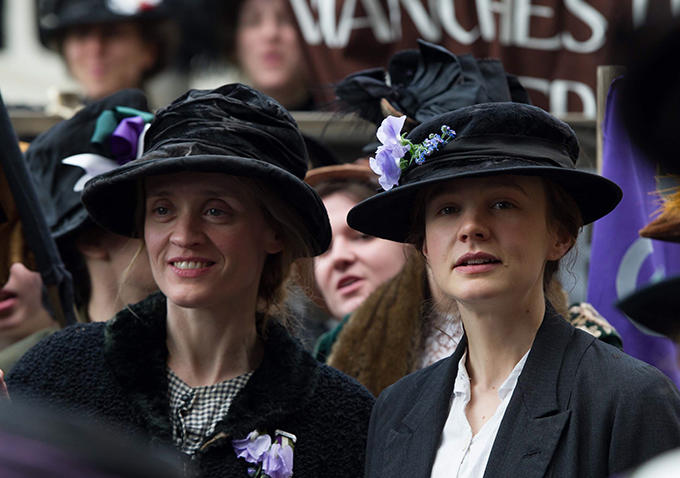
Director: Sarah Gavron
106 mins
Directed by Sarah Gavron and written by the accomplished Abi Morgan, it’s clear both women are keen to pile on the elements of subjugation and degradation in early 20th century Britain, as well as the rights of women in gaining a fulfillment to their demand for parity with their male counterparts on the electoral register. The misogyny is rife throughout as the foul husbands and employers batter home their interpretation of equality, in that women are mere property, an extension of a kitchen or industrial utensil – and in so doing abandoning the women into the streets should they embrace an opinion or worse express a political view. All of these humiliations befall Maud (Carey Mulligan), as she gravitates from hard-working but loving mother, to weapon-chucking domestic terrorist. She becomes a suffragette by accidental circumstance when she goes along to a government meeting on industrial personnel abuse and ends up replacing the intended female speaker with her own testimonial.
Her cowardly weak-willed husband (Ben Whishaw) is appalled by the gossip and irration of these events as his wife ends up in jail – with these and subsequent developments overpowering Maud, as she verges on confession to her police nemesis, Inspector Steed (Brendan Gleeson) who does little more than furrow his brow and stroke his beard in dismay. Meryl Streep shows up for a very brief turn as Emily Pankhurst, uttering an inspirational speech to a horde of eager supplicant women on the street below, and meets up later with Maude (Mulligan) yelping towards her the battle-cry “Never surrender! Never give up the fight!” Mulligan and the ever-wonderful Anne-Marie Duff elevate the film from a relatively thin premise with their sublime performances, but as a whole the picture would have benefitted more from being streamlined and rebranded as a shorter, leaner, more effective television drama.