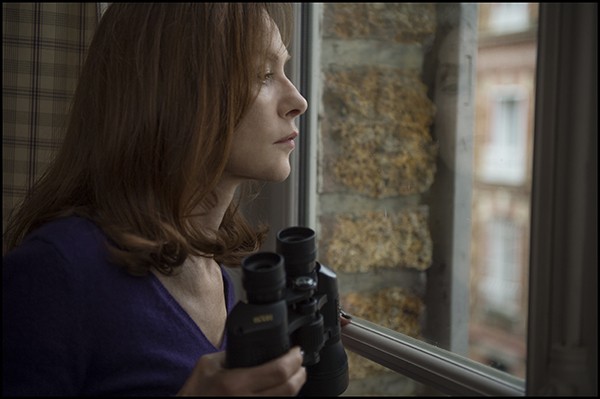
Cast: Isabelle Huppert, Laurent Lafitte, Anne Consigny, Charles Berling
Director: Paul Verhoeven
Duration: 130 mins
Paul Verhoeven is certainly one of the more unique and divisive directors in cinema history. As perhaps the most famous Dutch auteur, he's gone from small, ribald European films to the biggest of Hollywood projects incorporating his own distinct wit, visual sense and narrative acuity to all his projects. In the 80s and 90s he brought something resembling a European sensibility to the glossy blockbuster, elevating something like Robocop, from a simple sci-fi wham-bam outing to an acerbic social commentary, or the infamous Basic Instinct where he created the transition from a sordid revenge thriller into a palpably feminist critique of the male gaze. It's this hybrid of broad genre populism with the more literary sensibility of European art cinema, that makes his filmmaking so compelling. This is hardly unique - Lang, Hitchcock and Kubrick went in the opposite direction - but Verhoeven's craft seems to pull more explicitly at both these strings, crafting work that seeks to entertain as much as enrich.
With his latest Elle, Verhoeven has upped the ante even further, taking a complex narrative riddled with contradictions and deep psychological investigation, and telling it with a pace and precision honed in Hollywood. The story rests upon the shoulders of Isabelle Huppert. For a woman who has spent a career providing complex characters, this may just be her most satisfying - a culmination of everything that makes this performer so electrifying to watch. The film begins with an extremely brutal sexual assault, witnessed by a cat, and from this moment we are taken on a ride of emotions, following a woman who refuses to react in ways to which we have become accustomed in conventional films. Joined by a great ensemble cast, Verhoeven's first French language film breezes by while still digging its nails deep into your skin.
The editing is precise, the storyline dark, complex and sly, and injected throughout with the Dutch director's trademark pitch-black humour. The film collides emotions just as it does imagery, twisting one way then the other, always defying expectation. Yet it's Huppert's gift that really shines - a smirking smile after a violent reverie is a showstopper, and her coiled anger and intense intelligence is palpable throughout. The original play had the lead character running a screenwriting business - but the film wisely switches to have her run a video game development company. This adds even more to the complexity of the character, with inter-cut scenes which echo sexual violence. The film itself is sordid without being exploitational, turning the horror of such violations on its head in ways that are deeply unsettling and provocative. Profound without ever being didactic, sordid without being gratuitous, above all the film succeeds by deftly offering sophisticated and subtle moments of performance. Huppert’s performance is a fine example of truly adult cinema acting, unafraid to delve into the depths to craft a story that plunges its blade in and twists until it gives. This film, most certainly will divide tastes and responses, but for me it is an outstanding and rivetting piece of work.
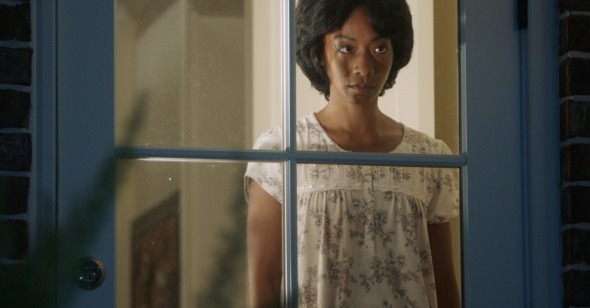
Cast: Daniel Kaluuya, Alison Williams, Bradley Whitford, Catherine Keener, Lil Rel Howery
Director: Jordan Peele
Duration: 103 mins
Get Out is a sort-of a horror/sort-of a comedy thriller, that conjures dread almost immediately – but without resorting to actual ghosts, zombies, or demons. It opens on a young black man, talking on his phone, imparting news that he’s found himself lost in a suburban neighbourhood. He ends the call, looks at the street signs, and a car pulls up behind him. The speed with which this situation, free of all but the most basic context, creates anxiety is at once impressive and depressing. No one else needs to appear on screen to summarise the situation. This is a white area - and this guy is in trouble. The orchestrator of this tension is actor, comedian, and writer-director Jordan Peele. The film’s set-up is that black photographer Chris (Daniel Kaluuya) takes a weekend trip with his white girlfriend Rose (Allison Williams) to meet her parents, who almost stumble over themselves to project their open-mindedness. Rose’s dad (Bradley Whitford) mentions how he would have voted for Obama a third time if he could have, and makes a show of his comfort in touching and jostling this near-stranger. Rose’s mum (Catherine Keener) makes less awkward efforts, and recoils at Chris for retaining his smoking habit.
Something more though, is amiss within this fancy house – as in the way a pair of black workers, a cook and a maintenance man behave with a kind of stiff placidity. Chris is unnerved, and places a few calls to his Transport Security Administration (TSA) friend and dogsitter Rod (Lil Rel Howery) to express his discomfort, but he doesn’t skeedaddle from her home out of his loyalty to Rose. Allison Williams plays Rose as privileged but not clueless and even the characters who are relatively dense keep you guessing about what, exactly, is going on. Williams, Whitford, and Keener are all so believable, that part of the film’s suspense has to do with fitting them into the growing paranoia that Chris feels. It’s extremely rare that a big budget film successfully wrings so much suspense over the degree of obliviousness some white people display with regard to their clear racism.
As Chris, British actor Daniel Kaluuya (UK viewers may recall him as the 'Parking Pataweyo' spoof character in BBC’s “Harry and Paul” comedy series) does quite a lot with his eyes, playing a character who’s clearly accustomed to keeping quiet when he needs to. There are some areas however that Peele doesn’t quite resolve – as in the fact that there is no twist to explain why Caleb Landry Jones, playing the brother of Allison Williams in a painfully well-to-do family, speaks with such a disagreeable mumble, and sometimes the dreaded exposition – which I abhor like you’d scarcely believe - infuriatingly talks the audience through the proceedings. The final stretch of Get Out isn’t exactly full-on terrifying, but Peele manages to find a trickier, more original tone—a kind of rueful, watchful sense of horror, in the face of racism’s strange and deadly permutations.
