Young Adult

Cast: Charlize Theron, Patrick Wilson, Patton Oswalt,
Elizabeth Reaser
Director: Jason Reitman
Running Time: 94 mins.
Director: Jason Reitman
Running Time: 94 mins.
As Mavis Gary, a woman out of sorts with herself, Charlize Theron plays her as being a thirtysomething ghost writer of Young Adult fiction - and as a walking representative, complete with her own dry wit and literary shortcomings, of the lingering snobbery of the adolescents who presumably cut down her creativity.
Unfortunately, all of this rich and wry insight is superficial to the main arc of the film which involves Mavis heading home in an attempt to reclaim her high school sweetheart, Buddy (Patrick Wilson), who's now happily married with a newly born baby. Presented from the inside out, we meet Mavis in her messy flat, where she watches daytime television, squeezes in Wii Keep-Fit sessions, peels off hair-weaves and silicone breast-cutlets from the night before, and maintains her detached lifestyle with a kind of unkempt exactitude. This anti-heroine's initial and overall characterisation is so vivid that her silly mission is hugely overshadowed, and widely out of step with who she seems to be.
Supported by the fact that she not only writes youth-targeted fluff, but has positioned herself in a profession that requires little to no daily-grind of maturity, Mavis's lack of growth is perfectly believable, as is the notion that she'd want to recapture the days when she was a bohemian-cum-glam belle of the ball.
But rather than merely stopping at wishful—or even disoriented—denial, her selfish, insular delusions are stretched into the realm of full-blown mania. In a film that's transparent and even slightly insulting, we are expected to believe that Mavis is convinced that the unquestionably settled and straitlaced Buddy will actually leave his family for her, a ridiculously overcooked pipe dream that negates the shrewd, cynical, and world-weary-despite-her-ignorance toughie that is her alter-ego.
It's not, however, an error large enough to warrant missing out on the rest of the film's merits, most of which can be attributed to Jason Reitman's direction and Theron's superb lead performance. When it comes to capturing frank yet polished modernity, getting at the truths of the here and now, Reitman is the right filmmaker to visualise this material, his eye for current atmospheres and industrial, man-made textures - such as on the gears and circuits of a Memorex cassette tape and its perpetual rewinding of Mavis's favourite song - is a nifty metaphorical touch.
Theron shows all sorts of visible scars of her character's decades-old hot-girl apathy (not to mention fleeting glimpses of the wide-eyed serial killer that steered her to an Oscar in 2003), She never puts a foot wrong as she trudges about in pink pyjama pants and t-shirt, endowing Mavis with a profound disinterest in anything beyond her tunnel vision. Even when Mavis dolls herself up to meet Buda, Beth (Elizabeth Reaser), and happily outshining her simple former neighbours, the breathtaking Theron still conveys an ugliness that's somewhat miraculous, the misery of a pathetic beast pouring out from the bags beneath her eyes.
Somewhat atoning for the failed attempt at a comedy which the script loosely purports the film to be, it nevertheless and uncompromisingly affords Mavis some slyly winning opportunities to share her biting contempt with Matt (Patton Oswalt), the crippled hate-crime victim she ignored in high school, whose forced arrested development amplifies her spoiled, largely voluntary malcontent.
But never is the pain and perverse pleasure of Theron's turn more rewarding than in a vicious final third of the film, with meaty revelations and a mouthful of hysterical harsh language, spat out spectacularly well by the statuesque actress. Theron lays bare a bitch with a heart, however bruised and dark that heart may be.
Hunky Dory
Cast: Minnie Driver, Aneurin Barnard, Danielle Branch, Robert Pugh, Haydn Gwynne, Steve Sepirs, Aled Pugh, Julia Perez, Kimberley Nixon
Director: Marc Evans
Running time: 107 mins
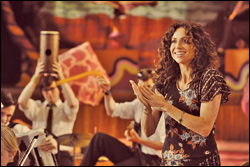
Viv May (Driver) is an enthusiastic, semi-bohemian drama teacher in this “To Miss, Gleefully With Love” 1970s flashback – as she attempts to put on a Bowie/ELO-scored version of ‘The Tempest’ with her class of post-pubescents. The writer, Lawrence Coriat, has dug into the shallow end of the stereotypes barrel, and they’re all here, from the love-struck male lead, to the fat boy with specs whose only romance is with a drumkit, through to the unrequited love interest girl and the confused gay schoolboy. Add in the ancient headmaster who is actually a decent guy ‘deep down’, the overweight misogynistic clipe of a gym teacher, the divorced dad with an off-the-rails son, and who procures a freezer in a vein attempt to win back his wife, as her lover has one – and the whole thing is ready to go.
Director Marc Evans tries hard to underplay the retro factor so that it doesn't go over the top on fashions or haircuts. However, with young love as the central theme as you'd expect with 16-year-olds, putting all of this together in the context of a school musical is tricky to balance without coming across as predictable or saccharine - and on its hands and knees manages to crawl over the finishing line, as the ensemble is pretty decent. Unlike the execrable “Glee”, “Hunky Dory” just about pulls it off.
Extremely Loud & Incredibly Close
Cast: Tom Hanks, Thomas Horn, Sandra Bullock,
John Goodman, Max von Sydow, Viola Davis, Jeffrey Wright
Directed by: Stephen Daldry
Running time: 129 minutes
Directed by: Stephen Daldry
Running time: 129 minutes
Everyone
felt an emotional impact when 9/11 unfolded and throughout its aftermath. We
watched it, heard it, were bemused by it, some established conspiracy theories
from it – everyone physically or metaphorically was in the midst of it. The
world shook and our souls trembled because the civilized world lost something
that day. We lost confidence. We
lost innocence. We lost a sense of security. But
few of us lost our fathers in the tragedy. Ten-year-old New Yorker Oskar Schell
is a naturalist, a pacifist, a martial artist, an oxymoronist.
Most importantly, he's an expeditionist, embarking on incredibly elaborate scavenger hunts designed by his father. In the autumn of 2001, Oskar had been searching for proof of New York City's sixth borough—a supposed sliver of an island that one day simply floated away. Few people believe it ever existed, his dad Thomas warns his son. Evidence will be hard to find he tells him but that he must search. And search Oskar does, finding clues—rocks, pieces of paper, old spectacles —for his father to inspect. And when Oskar asks his dad if one of his clues leads to something, Thomas shrugs his shoulders mysteriously.
For Thomas, the search for the sixth borough is beside the point. The idea is to send Oskar out into the city—encourage the boy to explore, to expand, due to the fact that his boy isn't just a naturalist, a pacifist and an oxymoronist. He's a scared naturalist, pacifist and oxymoronist. He's scared of bridges, of old people, of trains, of swings. He doesn't like interacting with people he doesn't know very well. He's obsessive. Doctors suspect he may have Asperger's syndrome. But tests (as Oskar says) are inconclusive. And so as Oskar searches for the mythical borough, Thomas is on his own quest—a quest to keep Oskar's quick, frenzied brain busy, a quest to keep his son engaged with the world around him. And then along comes 9/11. Oskar's father vanishes in the smoke. What remains is two degrees removed: an old camera, a jacket, an answering machine with six precious messages made that day—bearing his voice, his emotion, his concern, his love, all frozen in that moment. Night after night, Oskar plays them over, one by one.
Most importantly, he's an expeditionist, embarking on incredibly elaborate scavenger hunts designed by his father. In the autumn of 2001, Oskar had been searching for proof of New York City's sixth borough—a supposed sliver of an island that one day simply floated away. Few people believe it ever existed, his dad Thomas warns his son. Evidence will be hard to find he tells him but that he must search. And search Oskar does, finding clues—rocks, pieces of paper, old spectacles —for his father to inspect. And when Oskar asks his dad if one of his clues leads to something, Thomas shrugs his shoulders mysteriously.
For Thomas, the search for the sixth borough is beside the point. The idea is to send Oskar out into the city—encourage the boy to explore, to expand, due to the fact that his boy isn't just a naturalist, a pacifist and an oxymoronist. He's a scared naturalist, pacifist and oxymoronist. He's scared of bridges, of old people, of trains, of swings. He doesn't like interacting with people he doesn't know very well. He's obsessive. Doctors suspect he may have Asperger's syndrome. But tests (as Oskar says) are inconclusive. And so as Oskar searches for the mythical borough, Thomas is on his own quest—a quest to keep Oskar's quick, frenzied brain busy, a quest to keep his son engaged with the world around him. And then along comes 9/11. Oskar's father vanishes in the smoke. What remains is two degrees removed: an old camera, a jacket, an answering machine with six precious messages made that day—bearing his voice, his emotion, his concern, his love, all frozen in that moment. Night after night, Oskar plays them over, one by one.
Historians
of cinema may well note that Thomas Horn's role in Stephen Daldry's
"Extremely Loud and Incredibly Close" is amongst the most assured
debut performances of a child actor - ever. Horn, just thirteen years of
age and obviously a prodigy, had been seen on an American television programme
- Teen Jeopardy. He not only anchors the film but appears in virtually
every scene as a nine-year-old lad burning with the ambition to fulfill a
mission of his own choosing. Though the subject matter - a boy's search
for a lock that fits a key left by his father who had perished in the World
Trade Center on 9/11 - is an occasion to break out the Kleenex, the movie is
peppered by comic touches throughout and, best of all, by a host of stunning
subtle and subdued performances by the supportive ensemble.
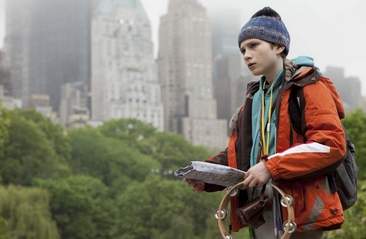
Daldry takes time to convince us in the audience of the close relationship enjoyed by Oskar (Thomas Horn) and his dad, Thomas (Tom Hanks), with Thomas conjuring up an assortment of games to challenge his son's intellect. A jeweller who had always wanted to be a scientist, Thomas settled into his choice as lapidarian in order to support his family, consisting of himself, his wife (Sandra Bullock), and his only son. "Extremely Loud" takes full advantage of the world's most exciting city when Oskar, finding the mysterious key inside a blue vase and thinking that his dad meant for him to exploit it, travels the five boroughs of New York City to find the one person named Black, as that is the name he finds on the envelope containing the key. His aim, which he calculates with exacting precision, could take him three years, and is to meet and consult with 472 people in the phone book named Black to find the one with the lock that the key can fit. (Never mind that hundreds of "Blacks" may have unpublished numbers.) Oskar carries a tambourine as his security blanket wherever he travels, picking up an elderly man known as The Renter (Max von Sydow), living in a separate flat with his grandmother (Zoe Caldwell), an elderly chap who had been traumatised by the bombing in his home town of Dresden and has since been unable to speak. Like marathoners traversing the city limits in slow motion, the two become pals, as inseparable as Oskar had been with his dad.
"Extremely Loud & Incredibly Close" features extraordinarily rich acting by von Sydow (who shuffles along, trying to keep up with a lad who could be his grandson), by Jeffrey Wright (who is most familiar with the significance of the key), by Viola Davis (a ‘Black’ who befriends the boy and delivers him to her ex-husband) and Sandra Bullock (who proves to be as adept in a serious role as she is in rom-com turns). Given a recent case in New York in which a young boy on his own was kidnapped, killed and dismembered, Daldry makes sure to let us know that the youngster was not really alone any part of the way.
This performance by a thirteen-year-old is strong enough to distract us from looking at Tom Hanks as the dean of American acting. Our focus is on the boy all the way. While many parts of Foer's novel from which the film is adapted could not be included - such as the way Oskar deals with a recording of a Hiroshima survivor - readers who are cineastes as well will probably find that this story of loss and recovery does justice to Foer's novel and even if you’re unaware of the book, despite the much-expected grumblings from the US press, Daldry’s objective viewpoint and expert direction of the tragic after-effects of 9/11 makes this an excellent piece of work.
Daldry takes time to convince us in the audience of the close relationship enjoyed by Oskar (Thomas Horn) and his dad, Thomas (Tom Hanks), with Thomas conjuring up an assortment of games to challenge his son's intellect. A jeweller who had always wanted to be a scientist, Thomas settled into his choice as lapidarian in order to support his family, consisting of himself, his wife (Sandra Bullock), and his only son. "Extremely Loud" takes full advantage of the world's most exciting city when Oskar, finding the mysterious key inside a blue vase and thinking that his dad meant for him to exploit it, travels the five boroughs of New York City to find the one person named Black, as that is the name he finds on the envelope containing the key. His aim, which he calculates with exacting precision, could take him three years, and is to meet and consult with 472 people in the phone book named Black to find the one with the lock that the key can fit. (Never mind that hundreds of "Blacks" may have unpublished numbers.) Oskar carries a tambourine as his security blanket wherever he travels, picking up an elderly man known as The Renter (Max von Sydow), living in a separate flat with his grandmother (Zoe Caldwell), an elderly chap who had been traumatised by the bombing in his home town of Dresden and has since been unable to speak. Like marathoners traversing the city limits in slow motion, the two become pals, as inseparable as Oskar had been with his dad.
"Extremely Loud & Incredibly Close" features extraordinarily rich acting by von Sydow (who shuffles along, trying to keep up with a lad who could be his grandson), by Jeffrey Wright (who is most familiar with the significance of the key), by Viola Davis (a ‘Black’ who befriends the boy and delivers him to her ex-husband) and Sandra Bullock (who proves to be as adept in a serious role as she is in rom-com turns). Given a recent case in New York in which a young boy on his own was kidnapped, killed and dismembered, Daldry makes sure to let us know that the youngster was not really alone any part of the way.
This performance by a thirteen-year-old is strong enough to distract us from looking at Tom Hanks as the dean of American acting. Our focus is on the boy all the way. While many parts of Foer's novel from which the film is adapted could not be included - such as the way Oskar deals with a recording of a Hiroshima survivor - readers who are cineastes as well will probably find that this story of loss and recovery does justice to Foer's novel and even if you’re unaware of the book, despite the much-expected grumblings from the US press, Daldry’s objective viewpoint and expert direction of the tragic after-effects of 9/11 makes this an excellent piece of work.
