The Iron Lady
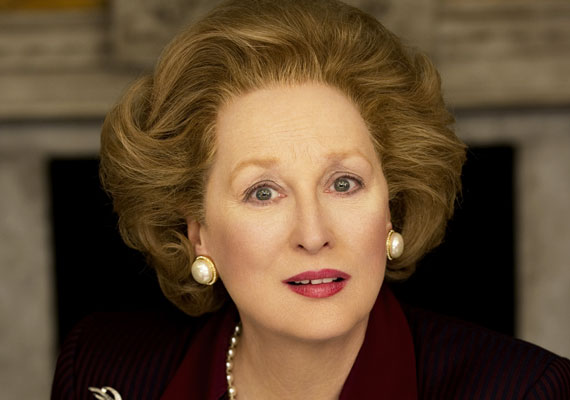
Cast: Meryl Streep, Jim Broadbent, Alexandra Roach, Harry Lloyd, Olivia Colman, John Sessions
Directed by Phyllida Lloyd
Written by Abi Morgan
Running time: 105 minutes
Directed by Phyllida Lloyd
Written by Abi Morgan
Running time: 105 minutes
Meryl Streep certainly deserved her Oscar for her performance in The Iron Lady. Sadly, the film has nothing of any real value other than her performance - Margaret Thatcher walking down a hall, Margaret Thatcher meeting the people, Margaret Thatcher confronting the Labour opposition in Parliament, Margaret Thatcher dancing with Ronald Reagan, Margaret Thatcher drinking a little too much, Margaret Thatcher losing her mind, Margaret Thatcher speaking to her dead husband, Margaret Thatcher cleaning a teacup. The Iron Lady is not, as some critics have argued, apolitical. Nor does the director, Phyllida Lloyd, go out of her way to directly denounce Thatcher’s vicious and brutal economic policies, obscene nationalism, and warmongering.
The politics of this film are revealed instead by Streep’s performance itself. In one central section of the film, we watch Thatcher practising to become Thatcher. She learns to speak with authority, changes her hairstyle and clothes, as she hardens her iron will. What Streep shows is that such a transformation was the essence, the core, the ultimate source of Thatcher’s political power.Growing up throughout the torrid times of this nauseating bitch in power, I'd hear the name "Thatcher" spat out expletively in disgust from the lips of many angry people in the UK (myself included).
Many of you reading this review may be relatively unaware of her, other than that she was Prime Minister of the UK during the 1980s, and not much else. Many, therefore would have appreciated Phyllida Lloyd's biopic doing some extra background homework and offering more insight into her insidious actions.
However, this film simply doesn't do that. It marches straight ahead on the assumption that, just because she was the first female Prime Minister, she was a pioneering feminist. Lloyd simply ignores Thatcher's politics, instead applauding her for being so bold and ballsy in rooms full of men. Amazingly, the writer of this shallow, short-sighted piffle, Abi Morgan, also co-wrote the recent deep character study, "Shame" for Steve McQueen and actor Michael Fassbender (see review on this site).
Lloyd, the director of Mamma Mia!, was probably not the right person for this job. It's a superficial surface work, relying on far too many trivial montages to fill in the blanks in Thatcher's career. It also persists with the annoying gimmick of focussing on an aged, senile, doddering, retired Thatcher, who speaks to the ghost of her dead husband Denis (a badly miscast and wasted Jim Broadbent).
This Must Be The Place
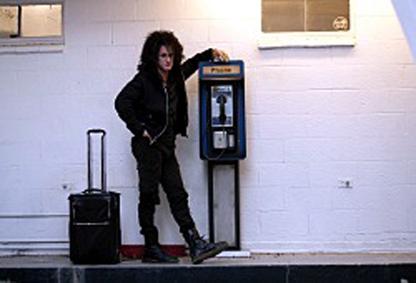
Cast: Sean Penn, Judd Hirsch, Frances McDormand, Eve Hewson, Kerry Condon, Harry Dean Stanton
Director: Paolo Sorrentino
Director: Paolo Sorrentino
From the director of Il Divo – this had so much potential – but sadly “This Must Be The Place” is a dreadful disappointment - being nothing more than an eclectic exercise in self-indulgence.
Sean Penn of all people plays Cheyenne, who is a retired musician, dressed in goth black, with white face powder, black mascara and lipstick. He lives in a large mansion near Dublin with his wife (McDormand) but something is gnawing away at him, as he spends his days wandering around the locality speaking in whispers and meek tones.
He eventually meets up with an old Nazi hunter (Hirsch) who knew his estranged father. This inspires him to then embark on a quest to kill the former concentration camp commandant who had tortured and tormented his father.
Following a misleading and essentially useless first act set in Dublin the film settles into a kind of eccentric road movie. Just as we’re becoming accustomed to the goth Sean Penn living in Ireland, for no apparent reason the location inexpicably shifts to Utah.
This appears to be the foundation of Sorrentino's film – total unpredictability. Random quirkiness, cinematic stylishness and Sean Penn's wild hairdo. The stylish excesses which were rampant in Il Divo are insufferable here. Sorrentino throws in too many mismatched characters, quirks, locations, music and camera language.
The casting of McDormand as Penn's wife, a middle-class ex-hippie, is a ridiculous waste of a great talent, and considering this film takes place in Dublin and the American southwest, made by Italian filmmakers with music from David Byrne and Will Oldham, there are just too many mismatched elements that just don't fit together.
Sean Penn of all people plays Cheyenne, who is a retired musician, dressed in goth black, with white face powder, black mascara and lipstick. He lives in a large mansion near Dublin with his wife (McDormand) but something is gnawing away at him, as he spends his days wandering around the locality speaking in whispers and meek tones.
He eventually meets up with an old Nazi hunter (Hirsch) who knew his estranged father. This inspires him to then embark on a quest to kill the former concentration camp commandant who had tortured and tormented his father.
Following a misleading and essentially useless first act set in Dublin the film settles into a kind of eccentric road movie. Just as we’re becoming accustomed to the goth Sean Penn living in Ireland, for no apparent reason the location inexpicably shifts to Utah.
This appears to be the foundation of Sorrentino's film – total unpredictability. Random quirkiness, cinematic stylishness and Sean Penn's wild hairdo. The stylish excesses which were rampant in Il Divo are insufferable here. Sorrentino throws in too many mismatched characters, quirks, locations, music and camera language.
The casting of McDormand as Penn's wife, a middle-class ex-hippie, is a ridiculous waste of a great talent, and considering this film takes place in Dublin and the American southwest, made by Italian filmmakers with music from David Byrne and Will Oldham, there are just too many mismatched elements that just don't fit together.
