Mandela: Long Walk To Freedom
Cast: Idris Elba, Naomie Harris, Tony Kgoroge,
Terry Pheto
Director: Justin Chadwick
146mins
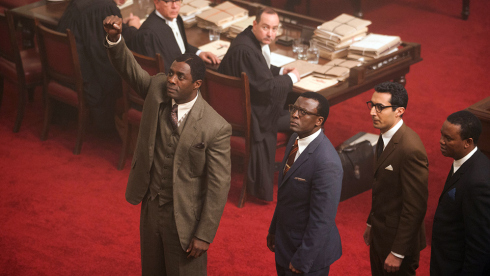
Sadly – at the time of writing - with his recent demise – this film, as a celluloid testament to Nelson Mandela’s remarkable life, proves disappointingly empty. It’s a dull, glossy and uncomplicated portrait of a man whose personal and political legacy is marked by serene idealism and shrewd calculation. In contrast to Spielberg’s Lincoln for example, which boldly revealed the horse-trading and gamesmanship necessary to pass the American Thirteenth Amendment, it’s discouraging to witness this attempt at defining a wondrous individual in that it acts more as monument than recent history. Lurching from one major event in Nelson Mandela’s life to another, with little context or nuance, or even any real form of narrative glue, Long Walk To Freedom idolises Mandela without offering a defining insight into him or his country. It’s a laborious journey on the screen and bears no credible resemblance to the enormity of the one endured by its subject. Based on Mandela’s memoir, Long Walk To Freedom casts Idris Elba, the chameleonic and exceptional British star of Luther and The Wire, in the lead role. Elba scarcely resembles Mandela, but he carries himself with a dignity and authority that’s by far the film’s most compelling element, which makes its shortcomings all the more unfortunate.
Like nearly all bad biopics, the film tries to cover the entire arc of its subject’s adult life, from his first marriage and early activities as a lawyer and African National Congress activist in Johannesburg to his 28-year prison term and subsequent triumph in negotiating an end to apartheid. However the film's attempt to adequately portray the immense torment and inhumanity of Mandela's near-three decades incarceration in Robben Island fails, and all of this leaves scriptwriter William Nicholson and director Justin Chadwick with too great an amount of significant developments to cover, and their solution is to gently touch on all of them, rendering many as almost insignificant – when the reverse was blatantly the case.
The one major relationship explored here is the long, contentious marriage between Mandela and his second wife, Winnie (Naomie Harris), a social worker whose agitations against the white minority government took a more radical approach. When Mandela and nine other leaders of the ANC were given life sentences for various acts of sabotage in 1964, Winnie stayed with him while continuing to fight against apartheid, which led to her own time in prison, including 18 months in solitary confinement. The Winnie who emerges from captivity in Long Walk To Freedom is reborn an angry firebrand who advocates violence against both the authorities and anyone deemed an informant or traitor to the cause.
Once Nelson is finally freed though, he not only has to acclimatise himself to married
life again after two decades, but negotiate a political path that puts him at
loggerheads with her. There’s
too much life in Mandela’s 700-page autobiography to condense into one feature
film, but Nicholson and Chadwick nevertheless have a go - and attempt to mark out the bullet
points, reducing Mandela to a simple symbol of courage and peace, held aloft by
the film's soaring score.
What’s missing from Long Walk To Freedom is a
deeper sense of Mandela’s pragmatism, his unerring ability to think through the
politics and compromise necessary to achieve his goals. Harris is very good as
Winnie, but the husband-and-wife dynamic isn’t as complicated as their personal
history and conflicting agendas might have made it. She’s angry and violent;
he’s shrewd and temperate – so they split up – but this again is glossed over
quickly. There
are glimmers of intrigue in Mandela’s negotiations with F.W. de Klerk (Gys de
Villiers), the state president who brokered the deal to grant Mandela
unconditional release from prison and allow the country’s black majority the
right to vote.
First confronted with de Klerk’s underlings, who try to press a
power-sharing deal over “one person, one vote” democracy, Mandela walks an
extremely thin tightrope in defiance of the ANC, the government, and the more
radical impulses of protestors, to find a just way through for himself, de
Klerk, and the country as a whole. Long Walk To Freedom could have used a
great deal more of Mandela’s political canniness, but unfortunately fails to – and to cap it all - Bono
plays us out over the credits.
12 Years a Slave
Cast:
Chiwetel Ejiofor, Michael Fassbender, Benedict Cumberbatch, Paul Dano, Paul
Giamatti, Adepero Oduye, Lupita Nyong’o, Sarah Paulson,
Brad Pitt, Alfre Woodard
Director: Steve McQueen
134 mins
Cinema
as a means to inform, open deep emotions and elicit profound responses – is
here in the exemplary 12 Years a Slave. This film also uses the visual power of
the medium to enlighten. Steve McQueen’s visual audacity makes his film hit
audiences with a force they’ll rarely feel at the picture house. This adaptation
of the true story of Solomon Northup—an African American who was born as a free
man, but was abducted and sold into slavery, only to be rescued after over a
decade of labour on the cotton plantations—is a bold, brutal, and ultimately
transformative film experience. Without question, it is quite simply a cinematic landmark.Brad Pitt, Alfre Woodard
Director: Steve McQueen
134 mins
Rarely have the cruelties of the deep South slavery atrocities been so thoroughly catalogued. McQueen, who made Hunger and Shame, spares his audience little. In re-telling the harrowing true story of Northup (Chiwetel Ejiofor), McQueen meets the atrocities of the era head-on. His unblinking gaze settling not only on oozing lacerations—the barbaric handiwork of the wealthy white barbarians—but also on the dehumanising spectacle of people trotted out like cattle, of children torn from the arms of their screaming mothers, and of a slaver raping, in the dead of terrible night, a young woman he regards as his “property.” Viewers who avert their eyes won’t escape, as hearing the sickening slap of leather against skin, invariably accompanied by a bellow of pain, is just as disturbing as seeing it. If there was any doubt that this is a horror film, the music (by Hans Zimmer) pounds and roars with dread—the appropriate soundtrack for the madness of history.
Deeply, and unsentimentally, 12 Years A Slave delves into the unpleasant details of Northup’s 1853 memoir. Yet it’s more than just a litany of sorrows. Channeling the evils of human bondage through the experiences of one weary figure, McQueen has constructed another intensely physical character study about a man trapped in his own flesh. However, while Hunger and Shame found the director looking upon his subjects from a certain distance, his interest devoted more clearly to surfaces than psychology, 12 Years A Slave erases the emotional distance between him and his protagonist. Though still a proponent of superb long takes, McQueen no longer seems obsessed with the perfection of his images; he’s instead found a story—an episodic one, headlined by a complicated victim/hero—in whom he can truly invest.
Spanning a dozen horrendous years, with a few achingly sad flashbacks shown along the way, the plot finds Northup—a husband, father of two, and gifted violinist, living in Saratoga, New York—falling prey to a pair of immoral opportunists, who force him into the clutches of a slave trader. Stripped of his identity, the former free man (rechristened Platt) is soon bounced around amongst plantations in Louisiana. His first owner, Mr. Ford (Benedict Cumberbatch), seems about as upstanding as one could expect a slave-owner to be, lavishing compliments (and a violin) upon his suspiciously well-educated new slave. Of course, the man’s decency has limits – as when Northup rebels against a petty, snivelling carpenter (Paul Dano, whose character earns him the most deserved beating since his portrayal in There Will Be Blood), Mr. Ford saves his slave’s life but denies him his freedom, trading him to a notoriously cruel counterpart, rather than take a loss on the purchase. Through this story strand, 12 Years A Slave punctures the romantic myth of the kindhearted slave-owner.
Screenwriter John Ridley displays a knack here for 19th-century American vernacular. His script gains a new dimension of terror and psychosexual drama once Northup ends up in the cotton fields of sadistic drunk Edwin Epps (Michael Fassbender in blistering form), who constantly yanks his slaves into the middle of bitter spats with his viciously vindictive wife (Sarah Paulson). Proving yet again why he’s one of the most exciting actors working today, Fassbender transforms his character into a compelling human monster—a figure for whom malice and affection are intrinsically entwined. There’s a subplot, the film’s most devastating, about a young girl, Patsey (Lupita Nyong’o), forced to bear both the lecherous advances of her master and the violent jealousy of his wife. Her ordeal rivals Northup’s in terms of nightmare proportions, and Nyong’o seems to carry the full weight of this trauma on her frail shoulders.
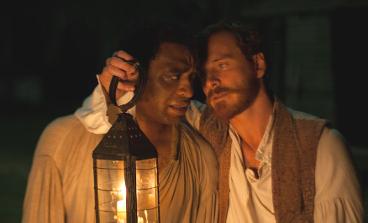
But the true standout of a cast which is peppered with sublime performances, is the actor at its centre. In a remarkably nuanced performance, Ejiofor portrays a man at war with his very humanity. To survive, Northup must suppress traces of his past—his way with words, his fierce intelligence—and embrace his future as an anonymous slave-worker, lest the oppressors learn the dangerous secret of his origins. That conflict provides 12 Years A Slave with its dramatic backbone, as Ejiofor slips further and further into hopelessness (and the role of Platt) as the years go by. There’s poetry in his struggle, enhanced by a director totally at one with the emotional states of his characters. For all the hardships he starkly depicts, McQueen also knows just when to slip in an image of overwhelming, metaphoric beauty and there are several here. 12 Years A Slave is all about inevitable change and not just for its unfortunate hero.
Such flawless filmmaking deserves the highest of praise, but at the same time it's not pleasant to watch. However, if you're willing to subject yourself to its horrors you'll be rewarded with some of the highest levels of directing and acting you'll assuredly ever see, but in the end you'll be leaving the cinema in bits.
