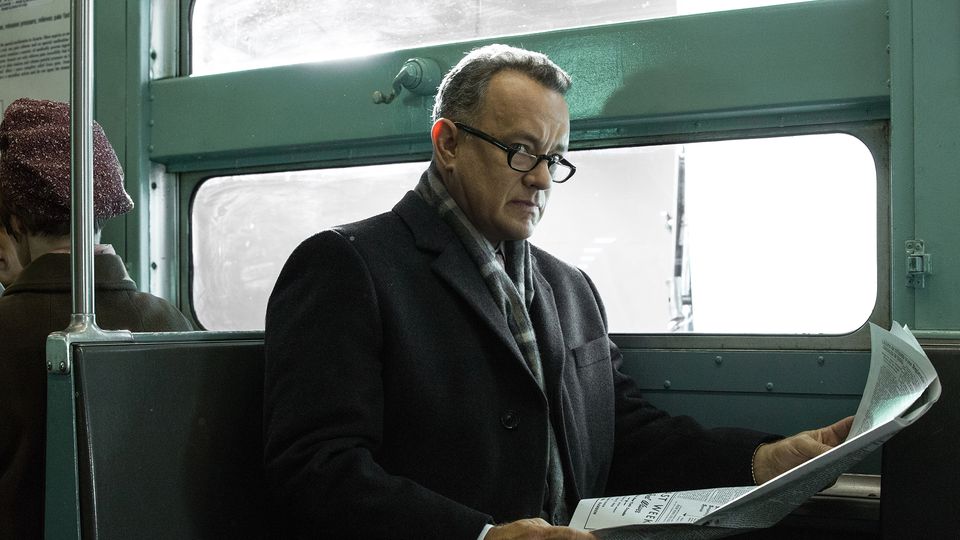
Director: Steven Spielberg
135 mins
The never-disappointing Steven Spielberg here offers an eloquent, wonderfully written (by the Coen Brothers, Joel and Ethan) spy-paranoia tale inspired by the exploits of an American insurance lawyer with a heavy cold, James B. Donovan, who engineers an extraordinary career diversion into that of cold-war negotiator.
Set for the most part in 1960s East Berlin, the film features two outstanding displays of acting, from Tom Hanks playing Donovan, who is co-erced by his boss (Alan Alda) into taking on the dubious job of defence attorney for alleged KGB agent Rudolf Abel – this via a sublime acting masterclass from the magnificent Mark Rylance, who has now achieved the zenith in both theatre stage and cinema screen, with a measured, beautifully-paced and unforgettable performance. Following a dubious US court case and unanimous guilty verdict, Donovan then finds himself representing the CIA in their efforts to do a trade with Abel's 'bosses' for downed U2 photo-reconnaissance pilot Francis Gary Powers (Austin Stowell). Just to further intensify the murkiness of the waters, Donovan also decides he’d like secure the release of an economics student who found himself on the wrong side of the newly built Berlin Wall – this being an exchange complicated by the fact that said student is of no worth whatsoever to American counter-intelligence, added to the fact that he is being held by the East German authorities rather than the Soviets.
The premise allows Speilberg to skew the misty-eyed principles of American democracy when measured against its laws and policies but with a masterly command of the nuts and bolts of film grammar that’s easy to take for granted, but which still puts him in a different category from just about everyone working in cinema today - within this - which is certainly his best film in years.
Shot in spacious anamorphic widescreen and making economical use of Thomas Newman’s perfectly minimal score, Spielberg renders the negotiation process as a conflict of colours and forms, which comes to a head at the snow-covered Glienicke Bridge—the notorious prisoner exchange point connecting Potsdam with West Berlin, framed here as a corridor of white between two masses of shadow. The film is full of thick, broad strokes: the courtroom rising at Abel’s trial cuts straight into teary children being shown moving images of nuclear explosions, and a failed fatal escape at the Berlin Wall gets a delayed mirroring near the end in a shot of youngsters happily climbing over fences in Brooklyn.
The entire film articulates itself very well, both tonally and visually, and its two most suspenseful sequences are both effectively wordless – you’ll see what I mean when you go along to view it - which I advise you to do, without delay.
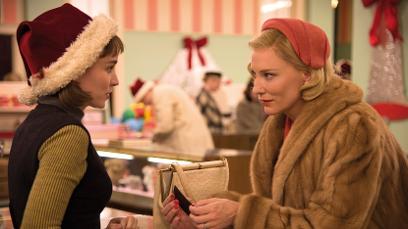
Cast: Cate Blanchett, Rooney Mara, Kyle Chandler, Sarah Paulson, Jake Lacey
Director: Todd Haynes
118 mins
A basic description of writer Patricia Highsmith as a romantic novelist would be inaccurate, mainly due to her unerring ability to create tales of psychological treachery where trust is at a premium. However, her novel Carol from 1952, is a slight variance on this, which perhaps is why she had it published under a pseudonym.
Heartache, longing and optimism prevail throughout this love story and Todd Haynes's beautiful screen adaptation cherishes each unspoken moment of its forbidden romance. However, unlike his peerless Douglas Sirk homage Far From Heaven, this time out, Haynes has avoided use of the glorious technicolour 1950s vistas for film stock which more than adequately replicates that pre-cynicism era.
Therese (Rooney Mara) reluctantly works in the toy dolls counter in a 1940s department store in Manhattan, clearly unfulfilled by her present employment ritual, as she yearns for something more, but just what, she can't quite yet define. Suddenly, entering the shop and blisteringly displaying enough colour to outdo the twinkly festive settings soars Cate Blanchett's Christmas Carol, a stunningly glamorous femme fatale on the brink of divorce, and who immediately dislodges Therese's world.
"What a strange girl you are. Flung out of space," Carol tells Therese, on a hastily-organised debut lunch date, and it's an appropriate description, as Mara offers a striking performance exuding both alienation and awakening with tempered subtlety. Her sense of unrequited love and disillusioned guilt around over-anxious boyfriend Richard (Jake Lacy) is as palpable and credible as her overwhelming love for Carol.
Haynes successfully evokes a physical sense of longing between both protagonists as every cautious glance and fleeting touch is loaded with meaning. Despite the film's admirable sexual restraint, it is still intensely sensual when the inevitable moment finally unfurls itself.
The ugly realism of being gay in the 1940s is evident too, as paranoia seeps into Carol and Therese's carefree road trip, where events conspire towards making them feel more like fugitives on the run – and creating a sense that a bleak conclusion seems almost inevitable. When that finale arrives, we are treated to a ravishingly cinematic series of gliding moments, in which dialogue is rendered superfluous by the faces of Blanchett and Mara.
