The Dark Knight Rises
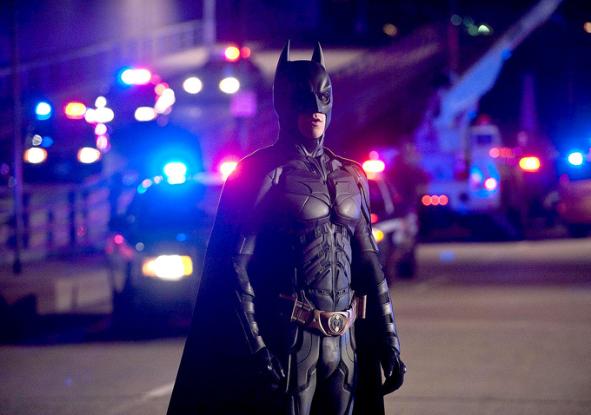
Cast: Christian Bale, Anne Hathaway, Tom Hardy, Gary Oldman, Michael Caine, Joseph Gordon-Levitt
Director: Christopher Nolan
Running time: 2 hours 46 minutes
Eight years after the events of
“The Dark Knight,” Bruce Wayne (Christian Bale) has become a
recluse, limping around his estate due to injuries sustained as Batman,
while the public speculates about his sanity. His faithful butler Alfred (Michael
Caine) informs him that Wayne Enterprises is in major financial
trouble, due to a clean-energy research project which Bruce began but then put
in cold storage. However, when a
masked, sadistic terrorist called Bane (Tom Hardy) bankrupts
the Wayne wealth and launches a populist uprising using an underworld of
thieves and criminals, Bruce is forced to don the cape and cowl again to try
and restore order. Meantime Gotham
still harbours the conviction that
Batman was responsible for the death of district attorney-turned-psychopath
Harvey Dent (Aaron Eckhart).
“The Dark Knight Rises,” conveys disenchantment and disillusionment about America from the perspective of non-Yank Christopher Nolan as he dissects the USA’s financial woes, clash of cultures, 1% v. 99%-style class warfare with a scalpel, assigning culpability to all involved and condemning the whole system. From the corporate fat cats to the poor scraping by on minimal incomes, everyone aspires to change their situation, to triumph over the forces of opposition, or to wipe the slate clean.
Added to this, Bane more or less distills the status quo of America into a few depressingly succinct ideas, which form the basis of his plans: fuel his followers with a sense of fear, incite them to anger by suggesting betrayal, allow them the pretence of hope, and they will become believers. He leads with a combination of ruthless control and facetious empowerment, keeping his minions under his thumb and turning Gotham into a battleground for revolution – but only for his own nefarious purposes. This concept is certainly nothing new, but Nolan makes it frighteningly palpable in this fictional setting without undermining the real-world implications of this sort of manipulation.
Although its array of recognisable talent and a story with an incredible variety of moving parts suggest the necessity of co-operation – a well-oiled machine whose parts all work together towards a common goal, Nolan allows almost every “important” character an opportunity to shine, to distinguish him or herself. As the protagonist himself has said numerous times in all of the films, “Batman could be anyone,” but the point Nolan seems to be making is that he can be any one – even working within a system that requires the cooperation and co-ordination of others, a person can still distinguish himself with an act of intelligence, sensitivity, leadership, or heroism.
Nolan continues his treatment of familiar storylines – especially those whose conclusions probably come as little surprise (although they won’t be spoiled here). Perhaps most importantly, the caped crusader remains the root of the entire ensemble, and it’s his troubles that provide the foundational themes for the rest of the characters, and the story as a whole. Following eight years of inactivity, Bruce is convinced that he’s neither able to save Gotham nor redeem himself, no matter how desperately he wants to. Bane wants to fulfill the destiny of Ra’s Al Ghul – which was thoroughly detailed in “Batman Begins” - which means enabling Gotham to destroy itself and rebuild on top of the rubble. And Selina Kyle is a criminal desperate for a fresh start, but unable to find a legitimate way to seek redemption.
As both Batman and Bruce Wayne, Christian Bale’s work here is excellent, and he gives the character such an inescapable melancholy – a certain perseverance in the face of absolute resignation to his fate – that he becomes a more tragic figure than ever. That said, he’s aided enormously by a never-better Michael Caine, who turns with hope and palpable love what might otherwise be expository dialogue into searing, supportive criticisms of Wayne’s self-destruction. Nolan’s Catwoman is the best cinematic rendering of the character to date, allowing Anne Hathaway sex appeal, assertiveness, humour and real humanity in equal measures, not to mention motivation that places her on equal footing with her male counterparts without making her a fetish object who’s ultimately subject to them.
Tom Hardy’s Bane is a different sort of villain – a focused and more ideologically-developed version of Heath Ledger’s anarchistic Joker – but one with equally ruthless charm. After brutally taking control of a building, he surveys his hostages, and offers one of them an almost-friendly “what’s up” nod. As many obstacles as Bane faces as a compelling character – chief of them being having his face covered almost entirely, and constantly, by a mask which also obscures much of his dialogue – Hardy juxtaposes an almost jaunty vocal intonation with a sort of monolithic, chilling stillness, creating a villain worthy of the series’ rogue’s gallery. His presence, response mechanisms, menace and total acting ability are to be revered. Cinematically the film is gorgeous, meticulously constructed and seemingly effortless in execution, even with so many moving parts racing towards what is ultimately a narratively and thematically cohesive finale.
Nolan’s film is a reminder that superheroes aren’t merely a frivolous distraction, or even a wish-fulfillment fantasy, but an embodiment of our best selves – or at least what we want our best selves to be. A cinematic, cultural and personal triumph, “The Dark Knight Rises” is emotionally inspiring, aesthetically significant and critically important as a film – as a mirror of both sober reflection and resilient hope.
