Steve Jobs
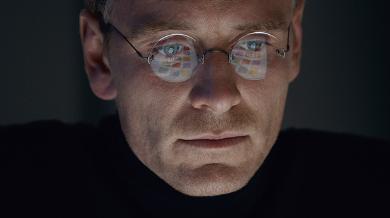
Cast: Michael Fassbender, Kate Winslet, Seth Rogen, Jeff Daniels, Michael Stuhlbarg, Katherine Waterston, Perla Haney-Jardine, Ripley Sobo, Makenzie Moss, Sarah Snook, John Ortiz, Adam Shapiro, John Steen
Director: Danny Boyle
122 mins
Danny Boyle’s film looks at important aspects of the late Apple CEO's life and how he was a man known primarily by way of his career and highly-crafted public image – and in this, writer Aaron Sorkin (adapting the book by Walter Isaacson) gives the viewer a quite literal behind-the-scenes story. From what we do know of Jobs, he was a man who valued design and structure above all else. In this, we see him obsessing over the measurements of an all-in-one computer, which is supposed to be a perfect cube, and being quite irritated by the notion that at least two of the sides are off by a matter of millimeters. Sorkin reflects that aspect of the man, by giving us a straightforward three-act structure, with the preparation for the launch events of three separate computers at three different points in Jobs' life, serving as those acts – with a notable visual contribution from director Danny Boyle using different film/video stock for each act to reflect the respective era. The film is, to all intents and purposes, boldly theatrical in presentation, which serves to make its narrative decisions all the more refreshing. The film's scope—three specific points in time, set within two relatively fixed locations—is too limited for the broad strokes of standard biography – however there, though, is the film's central strength. It isn't broad, except, perhaps, in its psychological scrutiny of Jobs as this leads to the film's most obvious moments of biographical cramming, which Sorkin attempts to downplay by the main character's confounded response to the apparent non sequiturs. The film's specific strength is in its repeated scenario, in which Jobs, convincingly played by Michael Fassbender, finds himself preparing for the biggest moment of his life to date while having to contend with repeated onslaughts of his personal failings. He's distracted by the forthcoming presentations, of course, but the film gives us the impression of a man who would be distracted without the pressure. For a man who wants to change the world, everything unrelated to his work is a irritating distraction, and anyone who even hints that he might have emotional deficiencies is perceived as an obstacle. This interpretation of Jobs paints him as the loneliest, most insecure man in a room filled with people who believe he's a genius. This Jobs wants everyone in the world to know not only that he's a genius, but also that he's a certain kind of genius. He'd much prefer it if everyone failed to accept that the company's co-founder Steve Wozniak (Seth Rogen) actually did all the building and coding of the first computer they made in a garage. It pisses him off that John Sculley (Jeff Daniels in a superb performance here too), the man whom Jobs courted to become the company's CEO, seems to have a better business sense than him. It drives him into a controlled rage that Time magazine chose the computer over him for the title of "Man of the Year" and that, to add insult to injury, the computer on the cover isn't even from his company. Joanna Hoffman (Kate Winslet), the head of Jobs' marketing team and his semi-confidant, tries to keep Jobs' fragile ego in check, while also attempting to make him face his personal responsibilities. The main one of those is Chrisann Brennan (Katherine Waterston), who is the mother of Jobs' daughter Lisa (Makenzie Moss, Ripley Sobo, and Perla Haney-Jardine at the character's various ages). Jobs denies that he's the girl's father, despite a paternity test all but confirming it. All of this is in 1984, as Jobs readies himself for the announcement of the Macintosh personal computer. A lot of that bleeds into 1988 after Jobs left or, depending on whom one asks, was fired from the company and ventured out on his own. He's a man of grand vision who either obsesses over little details (the Macintosh's "voice" saying ‘hello’) or dismisses vital ones (his alleged "perfect cube" doesn't actually have an operating system) depending on the potential outcome. In the third act in 1998, Jobs has transformed into the jeans-and-black-poloneck-wearing bespectacled guy in white trainers whom everyone loves. He seems to have become more laid back, but it could well be just an act. So what does all of this tell us? It fails to illuminate too much about the man or his career that a person with even a passing interest in Jobs wouldn't already know. However, it fails to acknowledge peerless design genius Sir Jonathan Ives (his surname’s initial, heralding the prefix on the world’s best selling technological communications apparatus). Therefore it might seem odd to praise and actually make a film about a real-life subject that doesn't offer a great deal of enlightenment on the actual protagonist, but Steve Jobs is highly effective as an exercise in classical form, highlighted by Sorkin's biting brand of hyper-aware dialogue and a breathtakingly outstanding performance from Fassbender. In essence the film is a highly efficient dramatic device. |
CREED
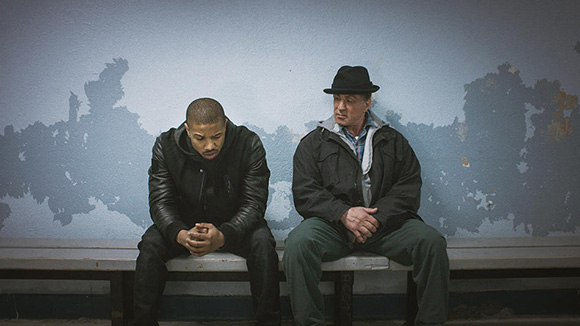
Cast: Michael B. Jordan, Sylvester Stallone, Tessa Thompson, Phylicia Rashad, Andre Ward, Anthony Bellew, Ritchie Coster
Writer/Director: Ryan Coogler
127 mins
Following the ‘Rocky’ sextet, including “Rocky Balboa”, cinemagoers may have felt enough was more than enough of Sylvester Stallone’s Philadelphian pugilist, but lo and behold, along comes “Creed” - proving that there’s still some flickering, mumbling life left in the old Italian stallion. It was clear that the ageing protagonist and the ensuing franchise required a transfusion of new blood, and along it has duly come, this time provided by writer-director Ryan Coogler. Michael B. Jordan shines with a vibrant performance in the title role.
As we all now know - given any opportunity, Stallone was never going to throw in the towel as Rocky, and in this he adopts the mantle of trainer to a young fighter – mirroring Burgess Meredith’s take as Mickey earlier in the series. Stallone did something similar in “Rocky V,” but this time out his charge is Adonis Johnson (Jordan), the illegitimate son of Rocky’s old mucker/opponent/ partner Apollo Creed. He (Adonis) has resigned from his lucrative financial services job to fulfil a deep-rooted passion for the ring and in so doing, to hopefully emulate his father, with the inevitable request to seek out Rocky’s help in training to develop his career.
Initially Rocky is unattracted by the prospect, having shown little interest in attending the gym for several years, preferring to reminisce with customers at Adrian’s, his restaurant, or visiting the graves of his late wife of the same name and that of his much-missed friend Paulie. In time, of course, he relents, and soon he is training young Donnie, as Johnson prefers to be called, with the young fighter running along to a hip-hop soundtrack accompanied by motorcyclists. Donnie also takes time out to begin a romance with his feisty downstairs neighbour Bianca (Tessa Thompson), a singer with a progressive hearing disorder. Donnie doesn’t want to play on his dad’s fame, preferring to box under the Johnson name, but a local gym owner susses out his origins and spills the beans. He elicits an offer for a bout against the current light-heavyweight champ, “Pretty” Ricky Conlan (Anthony Bellew), a Liverpudlian wide boy who has an imminent appointment at Her Majesty’s pleasure and needs a quick, but substantial pay-day before checking into the clink. Rocky advises against the kid, telling him that he may be moving too quickly, but Donnie is relentless in his pursuit for boxing glory. The training regime therefore begins in earnest, but is drawn to an unexpected hault when Rocky is given devastating medical news.
Coogler successfully proves
that he is a director perfectly in tune with his vision and his actors, as he
clearly has what it takes to bring such a familiar character out of retirement
and introduce another one without soiling such a much-loved franchise. He has brought the “Rocky” template that Stallone
fashioned in the earlier films into the next generation, and thankfully he
doesn’t mess around with what has gone before. Rocky maintains his clumsy but
charming likeability and Stallone clearly relishes the opportunity to play his
alter-ego once again, and it's a joy to report that his performance is wonderful. As terrific as Stallone
is, however, it’s Jordan who is the key to the film’s success with his mixture
of intensity and vulnerability. His performance is so good that the ending,
which seems to invite a sequel, doesn’t fill you with dread.
Credit must also go to the cinematographers and editing team, as the visceral excitement of the fight sequences are outstanding. Creed’s first fight, done in what appears to be a single take, is hugely impressive in choreographic terms. If you harboured any doubts that the “Rocky” series could not survive another film then “Creed” should convince you otherwise.
