THE DANISH GIRL
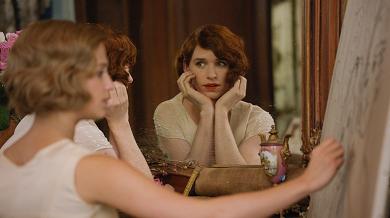
Inspired by David Ebershoff’s 2000 novel of the same name, the tale concerns the real-life ordeal of landscape artist Einar Wegener (Redmayne), who in 1920s Copenhagen finds his world thrown into gender chaos when his portrait-painter wife Gerda (an excellent portrayal by Alicia Vikander) asks him to stand in for one of her female subjects. A gentle, soft-spoken man, Einar immediately senses a sexual rush from the feel of women’s stockings on his legs, and of the hem of a dress on his fingertips. It’s a tiny, fleetingly trivial incident and treated for laughs by Gerda and her friend Oola (Amber Heard), but it’s anything but to Einar, who is soon wearing negligees beneath his suits, and embracing a female persona he dubs “Lilly.” Hooper tackles these early awakening sequences with extreme close-ups set within a relatively boring apartment in Denmark, with a redundant pet dog who appears regularly but is only very briefly referred to once in the whole film, and then only to invite the poor mutt out for a stroll. The story is treated with such delicacy that it only rarely exudes any authentic emotion— which is a shame given that Einar’s search for identity is fundamentally messy. At first, Einar’s desire to dress as a woman strikes Gerda as merely a mild perversion, and she encourages it by accompanying him on a search for wigs, dresses and shoes, and then having him attend a gala ball as Lilly. What she doesn’t foresee, however, is that Einar isn’t just playing a “game,” but in fact feels most comfortable—most like himself—when he’s Lilly, a revelation that Gerda only begins to genuinely comprehend when, at the ball, she finds Lilly, in private, kissing a man named Henrik (Ben Whishaw).
In scenes that find Einar mimicking a woman’s gait or hand-gestures, and in countless shots of Einar studying his face, deportment and body in the mirror, The Danish Girl conveys Einar’s internal processes. While those moments are certainly dramatised with thought, there’s so little ambiguity about Hooper’s depiction of, or attitude towards, Einar’s discovery of him/herself—which various then doctors want to label as a symptom of schizophrenia or deviance, thus requiring institutionalisation—that the film merely floats by on a placid breeze of earnest voyeurism. As Einar gives way to Lilly, eventually opting to undergo the world’s first-ever sexual reassignment surgery (courtesy of Sebastian Koch’s daring doctor), the film’s story also becomes increasingly focused on Gerda’s painful estrangement from Einar and her budding feelings for Einar’s childhood friend Hans (the perennially tedious Matthias Schoenaerts)—a thread that, like the rest of the proceedings, plays out with tact and compassion but almost no verve or complexity.
As a couple caught between two worlds, and forced to co-exist in a space that’s incompatible with traditional marriage and frowned-upon by mainstream society, Redmayne and Vikander are certainly compelling, treating their characters’ arduous attempts to transform themselves—and, also, to reconfigure their ideas about each other, and the future—with graceful precision. In the less overtly showy role, Vikander in particular proves magnetic, beautifully expressing Gerda’s difficult task of losing her husband and altering her entire worldview, all while remaining true to a person that she did, and still does, love very much. Redmayne’s performance is a study in manner, grace and poise and he succeeds very well, but the film as a whole is a rather vapid contruct and elicits insufficient sympathy, empathy or emotion.
THE REVENANT
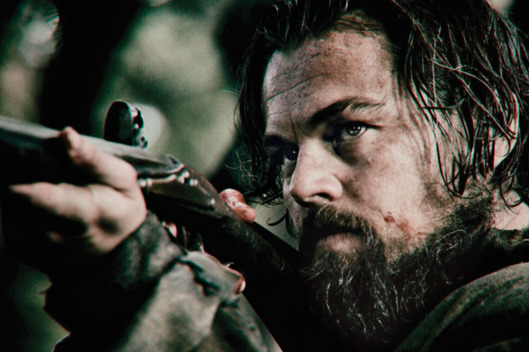
Cast: Leonardo DiCaprio, Tom Hardy, Domnhall Gleeson, Will Poulter
Director: Alejandro Gonzalez Inarritu
156 mins
Trees spring from a placid body of water and stretch all the way to the sky, as natural sunlight catches your eye. Oscar-winning director Alejandro Inarritu (Birdman) and Oscar-winning cinematographer Emmanuel Lubezki (Gravity) show a serene forest setting - beautiful and peaceful, giving little if anything away about what lies ahead. The film then alters tone in a punishing, visceral, grisly and utterly captivating sequence with one of Inarritu’s incredible uncut long shots. The film is a powerful experience and will challenge both your mind and spirit’s endurance.
A hunter fires a rifle shot – one of many from a large party of disparate mercenary individuals, hired for the seeking of animal pelts on the American frontier during the 1820s. Within seconds, the men in the party – led by Andrew Henry (Domhnall Gleeson) and his expert tracker Hugh Glass (Leonardo DiCaprio) – are viciously attacked by natives. With the earlier peacefulness shattered, arrows and bullets torpedo through bodies as men attempt to make it on to the safety of a nearby boat, the survivors reduced to around a dozen or so.
Glass has been tasked with guiding this party to safety, but eventually he finds himself in extreme circumstances as, while scouting the land, he views some playful bear cubs. However, also in the vicinity is their ferociously defensive mother. What follows is a brutal, unrelenting sequence – the attack lasting for what seems an eternity, with Glass’s screams matching the protective bear’s growls, beat for beat. The animal is CGI, but the torment conveyed is horrifically real in every possible sense. It is an astonishing piece of filmmaking. As a result, Glass is physically, mentally and spiritually bereft, and Inarritu and indeed DiCaprio, embrace everything both painful and uncomfortable about the sequence as it plays out.
Against all imaginable odds, Glass doesn’t die from his wounds, but his torment doesn’t end there. John Fitzgerald (Tom Hardy), his polar opposite in the group is the headstrong member of the drastically damaged hunting party. He’s very unhappy that they have been attacked. He’s also somewhat miffed that they no longer have as many pelts as they once did, as it means he might end up being paid less than he had originally believed. Unchuffed is putting it mildly that they’re now responsible for transporting a near-dead tracker who can no longer assist the group on their journey home. As he is offered the opportunity to do the unthinkable, Fitzgerald inevitably attempts it – leading to a finale showdown we slowly build to, as the tension mounts.
Inarritu and screenwriters Mark L. Smith and Michael Punke have constructed a straight-line vengeance thriller that’s marked by the environmental difficulties keeping one man (DiCaprio) from his sworn enemy. The bear is but the tip of the iceberg. Left for dead on a frigid tundra, a seething DiCaprio literally crawls his shattered frame through mud, snow and raging rivers, all with a burning intensity in his eyes and spittle that’s constantly flung from his lips through his cumbersome beard. Glass’s ordeal is utter torture and DiCaprio's performance here is nothing short of astonishing.
Tom Hardy is outstandingly good too, as the sinister Fitzgerald, with loads to play with in his character, from his selfish motivations to the unearned bravado he finds when faced with the notion that Glass is on a mission to kill him. Hardy has played not entirely dissimilar types previously on screen – arrogant, aggressive, brash and physically imposing - but his immense talent lies in his ability to find completely fresh ways to portray such an individual. He is such a complex and fascinating performer.
The Revenant is technically magnificent - filled with breathtaking cinematography and long, operatically-staged shots which are the speciality of Inarritu. It is unapologetically cruel and startlingly realistic with its violence. It offers the least amount of emotion necessary to get us to invest in Glass’s vengeful quest, putting its lead actor through a physical and emotional grinder. The eventual Hardy-DiCaprio confrontation – and the open-ended finale – fully justifies the earlier bursting of the pain threshold.
