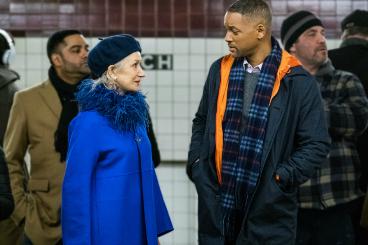
Cast: Will Smith, Edward Norton, Keira Knightley, Michael Pena, Naomie Harris, Jacob Latimore, Kate Winslet, Helen Mirren, Ann Dowd and Kylie Rogers
Director: David Frankel
Duration: 96 mins
Collateral Beauty isn't quite a totally shameless, crudely manipulative tearjerker, as despite the effort, it doesn’t even ascend to that nadir. It opens with several minutes of astonishingly lazy exposition that almost beggars belief. This is followed by the film’s tasteless premise, as Howard Inlet (Will Smith), top man/head of a hugely successful New York advertising agency, is left distraught by the death of his six-year old daughter, and his grief forces him into splitting from wife and going into devastated isolation. Depressed and uncommunicative, his sole project at work is in constructing elaborate domino arrangements and then watching them collapse. Sort out your own metaphor. The business naturally suffers and is in danger of going under, unless Howard can be pulled back from the brink or, alternatively, moved aside and allow a rival company to buy out the agency. Whit Yardsham – a close colleague of Inlet (Edward Norton), a divorced dad having trouble with his daughter Allison (Kylie Rogers) - convinces two other senior work figures - Claire Wilson (Kate Winslet), whose biological clock is ticking, and Simon Scott (Michael Pena), a decent guy but with a cough bound to create its own narrative - into hiring private investigator Sally Price (Ann Dowd) to spy on Howard and find something they could use to have him declared legally incompetent.
Whit suggests that they hire three actors from a struggling theatre company —Brigitte (Helen Mirren), Raffi (Jacob Latimore) and Aimee (Keira Knightley)—to approach Howard performing respectively in the abstract guises of Death, Time and Love and push him into actions where he can be filmed and digitally edited to prove his mental instability. It wouldn’t be fair to reveal in detail what results from all this, other than the utter inanities that follow, such as the ease and speed with which the actors are digitally removed from the footage of their interaction with Howard so that he appears to be engaged in solitary rants. I also work in digital film/theatre so let me assure you - that is not at all an inexpensive, quick or easy process. However it is towards the end section where this film goes completely off the rails. It offers not only one cathartic climax but a load of them, before adding a few final ludicrous twists. If just one of these plot turns actually occurred in a film, it would justifiably be dismissed as ludicrous; but as they’re piled one on top of the other, Collateral Beauty (whatever the hell that is) descends to a level of absurdity that very few films have ever approached, let alone reached. In the process, any emotional investment you might have made in the story simply evaporates as you stare at the screen, gawping at the ridiculousness of it all.
Smith gives a performance that comes across more as a sad appeal for award recognition than an authentic expression of a father’s pain. Norton, Winslet and Pena have rarely—if ever—been worse, and the same can be said of Knightley and of Harris, whose blissful smiles suggest that she was thinking of something other than the script during filming. The only person who adds any sort of spark to the proceedings is Helen Mirren who in a rare decent moment yells of her performance within a performance, "That was Grotowski, that was pure Stella Adler!" - an oasis in this desert of bilge. Collateral Beauty aims to warm your heart, but it’s more likely to give you heartburn.
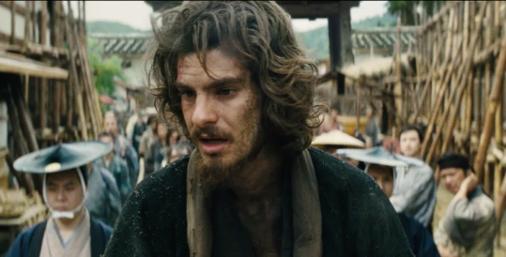
Cast: Andrew Garfield, Adam Driver, Liam Neeson, Ciarin Hinds, Tadanobu
Asano, Issei Ogata
Director: Martin Scorsese
Duration: 159 mins
Trailer: https://www.youtube.com/watch?v=IqrgxZLd_gE
Silence can speak loudly to the faithful. There is silence during a church service, when believers enter into a wordless communion with whichever god is of their choosing. Or the silence of despair that surrounds pleas through prayers unanswered or unheard. Based on the 1966 novel by Shusako Endo Silence is set in Japan in the 17th-century, where Christianity has been banned, with any missionaries and believers forced to repudiate their faith or they would face martyrdom – with many choosing the latter outcome. There is one priest however from Portugal and whose fate remains a mystery. Was he executed? Did he go into hiding? Or did he - most disturbingly to the priests at home, who loved and admired him - publicly desecrate holy images and recant Christianity, just to survive? Two young recently ordained Jesuits make the decision to head into Japan to find out whether he is in hiding or if he avoided execution by renouncing his beliefs in public. Martin Scorsese’s fascination with faith, guilt and duty frequently attracts him towards tackling religious subjects (Kundun, The Last Temptation of Christ) and with Silence - which Scorsese adapted with Jay Cocks - he gets the chance to examine commitment to faith - at length. As Father Rodrigues wonders, with the familiar, incessant rhythms of the liturgy, "What have I done for Christ? What am I doing for Christ? What will I do for Christ?" Of course, being a Scorsese film, Silence means that no matter how intellectual or existential the questions become, they - and all their possible answers - are presented with vivid images and extraordinary performances.
The cinematography by Rodrigo Prieto takes us into a terrifying world where gorgeous mountains look down on crashing waves but mostly the film is set in a place of the dead, where fog and mist merge into smoke and steam. Imagery such as a long cascade of steps in Portugal with three Jesuit priests in black robes walking down them, the bloody feet of a believer, raw and blistered after a long pilgrimage mix with shots of an abandoned village, inhabited only by feral cats. Adding to this is the cast. Liam Neeson is the missing Jesuit, Adam Driver and Andrew Garfield play the two young priests on the quest, and the imperious Ciaran Hinds performs the role of their superior in Portugal. All are superb, conveying at times the utter anguish and the arrogance of faith. Tadanobu Asano's translator and Issei Ogata's grand inquisitor are clever and unrelenting, with their assaults even more terrifying than torture, as they dissect not only the believers' bodies, but their belief. This is an outstanding film, and despite its setting and period it is still very much a Martin Scorsese picture. Self-doubt, self-sacrifice and self-knowledge. It brings to your own mind, the burning question: What have I done with my life - and why didn’t I do more?
