THE LONE RANGER
Cast:
Johnny Depp, Arnie Hammer, Tom Wilkinson, Ruth Wilson
Director: Gore Verbinski
Running time: 2hrs 30mins
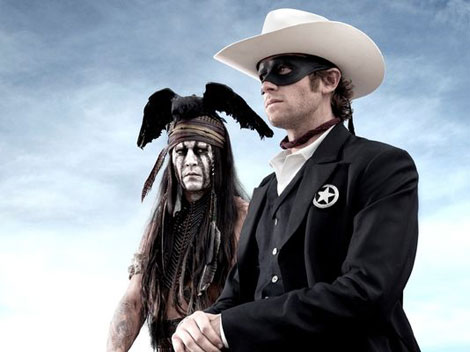
The Lone Ranger is actually a great deal better than most USA critics would have you believe – as it inspires feelings ranging from disrespect to downright scorn for the following American institutions: the U.S. military, the U.S. government, American capitalism, and indeed the Lone Ranger himself (Armie Hammer), who starts out as a bumblingly naive lawyer named John Reid. At one point, his eventual saviour Tonto (Johnny Depp) drags kemosabe through a pile of dung (horse shit for the uninitiated in the parlance this side of the Atlantic).That's right, the Lone Ranger gets dragged through equestrian ceich. I can just imagine the horror on the countenances of some yankee film journos as this hugely entertaining western exploit exposes millions of American children to such an awful procedure.
As you may have gathered, I had a fine evening with this film. The Lone Ranger stays up a bit past its bedtime with the running length, though this is par for the course with director Gore Verbinski, who guided Depp through the first three Pirates of the Caribbean flicks. There is a clear weight of serious dosh in the picture, most of it being put to exceptionally good use evoking the Wild West of 1869 on a scale you're not likely to see again on the big screen any time soon.
The budget also brings us a hugely exhilarating climax involving two trains. Verbinski shoots his action sequences cleanly and unabashedly, with imagination and verve.
There has been some political correctness nonsense expounded regarding the casting of Johnny Depp as Tonto instead of a Native American actor. Depp, who claims Cherokee or Creek ancestry and was last year adopted into the Comanche Nation, has his heart in the right place however. If you can rummage around in car boot sales, ebay or Amazon to uncover his sole outing as a Director, 1997's The Brave, you will find a man very much in tune with the bitterness and rage of indigenous Americans. In addition, check out Jim Jarmusch's acid western Dead Man, where you’ll find that Depp's dying white man William Blake was befriended by a Native American and dispatched in appropriate ceremonials.
Here however, Depp portrays (very well it must be said) the Native American who saves a white man. Depp's Tonto is weird and unstable, driven mad by the genocidal treachery of white men. This is not the over-the-top 'Jack Sparrow' in another guise that some notices may lead you to expect – his performance has the derangement of pain in it.
The story concerns John Reid (aka The LR) and Tonto teaming up to capture the nauseating and disgusting Butch Cavendish (William Fichtner in a performance of exceptional mankiness), but simply capturing him doesn't get the job done as the threads and tentacles of corruption reach deeply out from him to the "values" on which America was founded. You can't just blow this bad guy away - there's a whole government/corporate apparatus structure backing him up. Against this, Reid and Tonto are obliged to obscure their faces and charge forward. Incidentally the tale is related to us in flashback by a now-old and decrepit Tonto.
"The Noble Savage," reads the condescending banner underneath the old, posing Tonto (it's 1933), and The Lone Ranger shows how apt this is while redefining almost every white man on the screen as an ignoble savage. Despite Tonto’s best efforts however, an entire Comanche tribe is mowed down by America's Cavalry. I sense an attack of right-wing media guilt at play here in the US’ over-caustic reviews of “The Lone Ranger”.
Pain hurts – as does the truth.
ONLY GOD FORGIVES
Cast: Ryan
Gosling, Kristin Scott Thomas, Luke Evans, Vithaya Pansringarm, Tom Burke
Director: Nicolas Winding Refn
Running Time: 90 mins
Director: Nicolas Winding Refn
Running Time: 90 mins
Nicolas Winding Refn has been mooted as some kind of cinematic genius. Having established himself as a filmmaker to watch on the basis of such cult items as "Valhalla Rising" the "Pusher" trilogy and the unforgettable “Bronson” with Tom Hardy, Refn finally made his breakthrough in 2011 with "Drive," a violent and stylish thriller in which an enigmatic Ryan Gosling found himself in the middle of an increasingly gory conflict with a brutal crime boss. Although it was not quite the commercial breakthrough that some hoped that it would be, it earned acclaim and solidified Gosling as one of the hottest new stars around and put Refn on everyone's list of directors to watch.
With, "Only God Forgives," his highly-anticipated follow-up, Refn has reunited with Gosling but the result is an appallingly pretentious bore in which scenes of overly stylised nonsense are interspersed with graphic sequences of nauseating violence. The whole film is so dreadful that not only will most filmgoers feel like walking out before it reaches its conclusion, but many may find themselves retrospectively downgrading their opinions of "Drive" in addition.
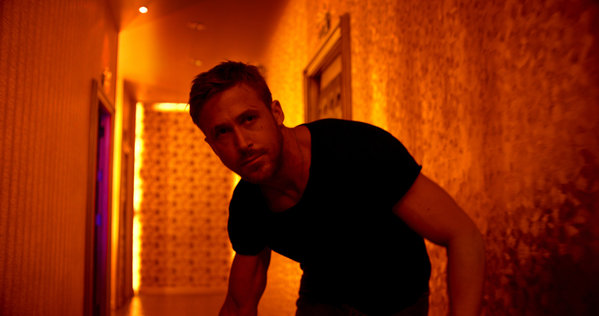
Set in Bangkok, the film stars Gosling as Julian, an enigmatic tough guy who runs a semi-legal boxing club with his older brother Billy (Tom Burke). Julian prefers to unwind after a hard day by having himself tied to a chair so that he can watch impassively while his favourite stripper (Rhatha Phongam) masturbates in close proximity. Billy’s recreation consists of acquiring the services of a teenage prostitute and then brutally beating her to death afterwards.
This attracts the attention of local police chief Chang (Vithaya Pansringarm), a man who has his own unique brand of justice. This instigates a series of increasingly brutal and enigmatic events that are without exception, pretentious and gratuitous in the extreme.
In amongst the mayhem Julian, for some unexplained reason, decides to invite his favourite stripper to have dinner with him and and his mother (chillingly portrayed by a barely recogniseable Kristen Scott Thomas), which is right up there amongst the most uncomfortable meet-the-parent scenes ever filmed.
Prior to all of this, Refn has taken the kind of base material most ordinarily found in the grubbiest of genre films and approached it in such an overtly stylised manner that the end result transcends its lowly beginnings and mutates into some kind of ludicrous arthouse/grindhouse hybrid.
The trouble with "Only God Forgives" is that he has pushed the stylized look and sound of the film as far as it possibly can go while utterly neglecting everything else. The story is thin to say the least and ridiculously one-dimensional, the characters even less so and there is so little dialogue throughout that it almost feels like a silent movie at times. This is actually a brilliant idea under the circumstances, once you get a load of the tripe script masquerading as dialogue on display… that and the preposterous karaoke scenes with inane subtitles.
Initially this stripped-down narrative approach is mildly interesting, but there are more words in this review than there are to be had in all of its dialogue exchanges. If the protagonist Julian was meant to be an extreme parody of the classic taciturn antihero, what Gosling does here with him might have been inspired, but I fear that he and Refn want us to take him seriously – making this film all the more laughable as well as nauseating.
In summation, “Only God Forgives” is dramatically inert, achingly pretentious and repugnantly violent (we get to see brutal beatings, stabbings, slicings, burnings, dismemberments and eyeball gougings, not to mention (I won't) what occurs during the final scene. This is the kind of feature that is so bad that you almost want to nudge the person next to you to make sure that you are not somehow hallucinating at just how awful it really is. Even if you were to view it as some kind of luridly salacious pulp-art nonsense, it is a failure because for that to happen, it would have to be so bad that it was actually good and it only achieves the first half of that equation. If there is anything good to be said about it, it is that it fails so completely on practically every imaginable level – and that there is the hope that it may serve as a way for Refn to clear the decks of every bad idea and deranged artistic impulse and allow him to approach his next project with a clean slate to match his obvious cinematic talents.
If that proves to be the case, hopefully his next film will find him living up to the immense promise of his earlier films. If not, then – pardon the inevitable irresistible pun - but not even God is likely to forgive him for any future trespasses.
