Headhunters
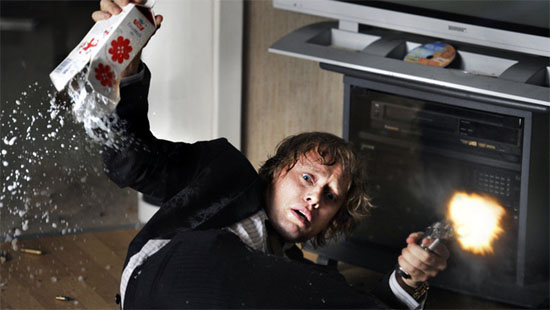
Directed By: Morten Tyldum
Cast: Aksel Hennie, Synnøve Macody Lund, Nikolaj Coster-Waldau, Julie R. Ølgaard
Cast: Aksel Hennie, Synnøve Macody Lund, Nikolaj Coster-Waldau, Julie R. Ølgaard
Headhunters is a crime thriller based on Jo Nesbo’s 2008 best seller and produced by the people that brought us the original adaptation of the Stieg Larsson trilogy. Don’t let that fact fool you into expecting more of “The Girl with the Dragon Tattoo,” however, as Headhunters is nowhere near as dark.
Roger Brown (Askel Hennie) is a well respected high-powered headhunter who prizes his and his clients’ reputation above all else. He has a beautiful trophy wife named Diana (Synnøve Macody Lund) and together they live in a model home. The last thing Roger would want you to notice about him is his stature, in other words . . . he’s a wee smout (i.e. he is short). He can’t actually afford his dream lifestyle but deems it necessary in order to distract those around him (especially his wife) from his shortcomings in the height department. In order to help keep up the facade he works as an art thief on the sly. His two roles work in conjunction — he uses the meetings with the clients he head-hunts to find out everything he needs to know about them in order to steal expensive works of art from them.
At an art exhibition Diana introduces Roger to a friend of hers who turns out to be a perfect fit for both roles. Not only is Clas Greve (Nikolaj Coster-Waldau) ideal for a position at rival GPS firm Pathfinder, he’s also thought to possess a rare Rubens worth many millions. However, in order to successfully schmooze Clas, Roger must first get his suspicions under control that Clas is sleeping with his wife behind his back.
Headhunters is a highly stylised picture, especially in the first few scenes where Roger introduces us to his idyllic lifestyle (imagine a film equivalent of an IKEA catalogue). In the accompanying narrative Roger tries to convey to the audience the same impression he tries to give everyone around him which is that he’s a bastard. The fact that these scenes are interspersed with scenes of Roger cheating on his wife and the fact that for some unknown reason Roger refuses to help his brooding wife conceive a baby, confirm that he is indeed as heartless as he makes himself out to be. He appeared to need to have it all externally, in order to hide the fact that he has no substance internally. Headhunters is also very structured. It’s divided into chapters and despite any initial dislike of Roger, he surprisingly manages to claw his way back from the lowly realms of heartless bastard during the 100 minutes of running time.
And all due to an extremely well crafted screenplay by Lars Gudmestad and Ulf Ryberg it works. While, this is ultimately a crime thriller the film has more than its fair share of pure comedic moments to offset some of the very dark ones and achieving such a difficult balance (as it does) is what really gives it that extra dynamic. What they’ve written is also very touching. After Roger hits rock bottom (he literally goes from headhunter to getting his head hunted), the comedy moments are exchanged for moments of true despair.
Now completely vulnerable and on the run, Roger is forced to shave his head raw. Covered in blood (never has a protagonist been covered in more bodily substances throughout a film) and resembling some sort of weird alien/Yul Brynner, Roger experiences a moment of rebirth into resourceful fighter. Stripped of everything he’s held dear, he attempts to make contact with Diana and only then, when completely exposed, is Roger finally able to make some sort of true connection with her. Finally, there’s suspense too — even after the scene of Roger and Diana being reunited it was still unclear as to whether she could be trusted or not. There are lots of different narrative strings intricately woven together to keep audiences guessing the entire way through and the plot takes completely unexpected directions.
Roger’s hair, however, is the true star of this movie. It plays almost as big a role in it as he does, changing to reflect every new phase of the story. Its repertoire included slicked back at the beginning showing “man in control.” Then there was messy showing “man with a distinct lack of control.” Then finally there was shaved depicting “vulnerable fighter.” Roger really steps up when times get tough for him and becomes almost as loveable as his ever-changing hair by the end. For someone who portrayed himself to be all style and no substance at the beginning, Roger more than disproves his own theory by becoming extremely resourceful in the toughest of situations.
Roger Brown (Askel Hennie) is a well respected high-powered headhunter who prizes his and his clients’ reputation above all else. He has a beautiful trophy wife named Diana (Synnøve Macody Lund) and together they live in a model home. The last thing Roger would want you to notice about him is his stature, in other words . . . he’s a wee smout (i.e. he is short). He can’t actually afford his dream lifestyle but deems it necessary in order to distract those around him (especially his wife) from his shortcomings in the height department. In order to help keep up the facade he works as an art thief on the sly. His two roles work in conjunction — he uses the meetings with the clients he head-hunts to find out everything he needs to know about them in order to steal expensive works of art from them.
At an art exhibition Diana introduces Roger to a friend of hers who turns out to be a perfect fit for both roles. Not only is Clas Greve (Nikolaj Coster-Waldau) ideal for a position at rival GPS firm Pathfinder, he’s also thought to possess a rare Rubens worth many millions. However, in order to successfully schmooze Clas, Roger must first get his suspicions under control that Clas is sleeping with his wife behind his back.
Headhunters is a highly stylised picture, especially in the first few scenes where Roger introduces us to his idyllic lifestyle (imagine a film equivalent of an IKEA catalogue). In the accompanying narrative Roger tries to convey to the audience the same impression he tries to give everyone around him which is that he’s a bastard. The fact that these scenes are interspersed with scenes of Roger cheating on his wife and the fact that for some unknown reason Roger refuses to help his brooding wife conceive a baby, confirm that he is indeed as heartless as he makes himself out to be. He appeared to need to have it all externally, in order to hide the fact that he has no substance internally. Headhunters is also very structured. It’s divided into chapters and despite any initial dislike of Roger, he surprisingly manages to claw his way back from the lowly realms of heartless bastard during the 100 minutes of running time.
And all due to an extremely well crafted screenplay by Lars Gudmestad and Ulf Ryberg it works. While, this is ultimately a crime thriller the film has more than its fair share of pure comedic moments to offset some of the very dark ones and achieving such a difficult balance (as it does) is what really gives it that extra dynamic. What they’ve written is also very touching. After Roger hits rock bottom (he literally goes from headhunter to getting his head hunted), the comedy moments are exchanged for moments of true despair.
Now completely vulnerable and on the run, Roger is forced to shave his head raw. Covered in blood (never has a protagonist been covered in more bodily substances throughout a film) and resembling some sort of weird alien/Yul Brynner, Roger experiences a moment of rebirth into resourceful fighter. Stripped of everything he’s held dear, he attempts to make contact with Diana and only then, when completely exposed, is Roger finally able to make some sort of true connection with her. Finally, there’s suspense too — even after the scene of Roger and Diana being reunited it was still unclear as to whether she could be trusted or not. There are lots of different narrative strings intricately woven together to keep audiences guessing the entire way through and the plot takes completely unexpected directions.
Roger’s hair, however, is the true star of this movie. It plays almost as big a role in it as he does, changing to reflect every new phase of the story. Its repertoire included slicked back at the beginning showing “man in control.” Then there was messy showing “man with a distinct lack of control.” Then finally there was shaved depicting “vulnerable fighter.” Roger really steps up when times get tough for him and becomes almost as loveable as his ever-changing hair by the end. For someone who portrayed himself to be all style and no substance at the beginning, Roger more than disproves his own theory by becoming extremely resourceful in the toughest of situations.
Marley

Directed by Kevin Macdonald
Running time: 144 mins
Running time: 144 mins
“Marley,” wonderfully directed by Kevin Macdonald, is an outstanding and extraordinarily moving documentary about the enigmatic reggae music legend Bob Marley. More surprising is that it has taken so long for such a film to be made.
Collating elements from an exhaustive number of precious photos, archive film, and interviews with Bob Marley and his family members, musicians, and girlfriends, McDonald tells the fascinating story of Bob’s enormous success against all odds. Even audiences who don’t identify themselves as fans of Marley’s music will find a great deal to appreciate in the charismatic singer’s humanitarian message.
From his impoverished youth as an outcast mixed-race child in Trench Town, Jamaica to a 16 year old black mother and a white mature father, to his status as a major figure in popular music, Bob is shown to have been a very shy but complex man with an ingrained lust for music, women, football, and life.
“Marley” is as balanced a documentary as you could possibly hope for, considering the enormity of its subject. We see his birthplace, a dilapidated shack in Trench Town. “It carry a heavy vibration,” Marley recalled. The real theme of Macdonald’s film however, is belonging and exile. Inspiring though “Marley” is, it tends to deploy his music purely as an illustration of his life.
Unfortunately, not once do we hear a song being played straight through from beginning to end. “Marley,” by reminding us of the longing and the indignation from which the music leaped, does a great job of turning the volume back up - if only it had found some more time to stop and listen.
Collating elements from an exhaustive number of precious photos, archive film, and interviews with Bob Marley and his family members, musicians, and girlfriends, McDonald tells the fascinating story of Bob’s enormous success against all odds. Even audiences who don’t identify themselves as fans of Marley’s music will find a great deal to appreciate in the charismatic singer’s humanitarian message.
From his impoverished youth as an outcast mixed-race child in Trench Town, Jamaica to a 16 year old black mother and a white mature father, to his status as a major figure in popular music, Bob is shown to have been a very shy but complex man with an ingrained lust for music, women, football, and life.
“Marley” is as balanced a documentary as you could possibly hope for, considering the enormity of its subject. We see his birthplace, a dilapidated shack in Trench Town. “It carry a heavy vibration,” Marley recalled. The real theme of Macdonald’s film however, is belonging and exile. Inspiring though “Marley” is, it tends to deploy his music purely as an illustration of his life.
Unfortunately, not once do we hear a song being played straight through from beginning to end. “Marley,” by reminding us of the longing and the indignation from which the music leaped, does a great job of turning the volume back up - if only it had found some more time to stop and listen.
