Lincoln
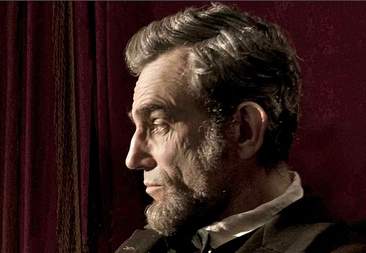
Cast:
Daniel Day-Lewis, Sally Field, Tommy Lee Jones, David Strathairn,
Joseph Gordon-Levitt, James Spader
Director: Steven Spielberg
Running Time: 149 minutes
Joseph Gordon-Levitt, James Spader
Director: Steven Spielberg
Running Time: 149 minutes
With "Lincoln", Steven Spielberg has crafted a melodramatic, spiritual and historical dissection, and a stirring biography. The title intimates that this is a biopic when it’s actually a highly riveting political drama which is as engaging as it is inspiring in its exploration of the world around Abraham Lincoln. In truth, the film paints a wider portrait of the political machinery operating behind the Civil War; however - with the sixteenth president casting a long shadow - and the result is the most comprehensive cinematic portrait of Lincoln: his genius, his triumphs, his failings and, most importantly, his overwhelming decency. Based on Doris Kearns Goodwin’s book “Team of Rivals: The Political Genius of Abraham Lincoln,” Spielberg’s film peers into a brief but crucial period in American history. A couple of months after Lincoln’s re-election, the war is winding down towards to its conclusion, which is both uplifting and also a huge burden for the president. On the one hand, its end retains the Union; on the other, it also ensures that even a preserved Union is likely to still retain slavery. Contrary to perceived wisdom, slavery didn’t end with the USA Emancipation Proclamation, nor was it snuffed out by default when Lee surrendered at Appomattox. Instead, Lincoln and the Republican party faced enormous dissent within congress over the passage of the Thirteenth Amendment that would outlaw slavery, so the film chronicles his administration’s furious attempts to force the bill through the House before the war’s end drains the perceived political need for the amendment. The president, of course, is looking beyond its immediate function and views it as a victory for fundamental human rights.
While history has revealed the Democrats’ folly in underestimating him, this film accurately presents Lincoln as a beleaguered leader under siege from a fractious segment of his own government, so it unfolds like a conventional underdog story that finds Lincoln and his cabinet showing their fearlessness towards messing around in political grey areas. This is a shrewd, calculating statesman who deploys associates to engage in dirty work on his behalf, and the film tracks the administration’s progress in securing the remaining necessary votes - many of which are essentially bribed and bought off by a trio of lobbyists - from dissenting Democrats. Far from being ponderous, Tony Kushner’s script injects the film with wit and warmth without underplaying its momentous drama. The film is remarkably entertaining and fascinating despite a sprawling approach that supplements Lincoln’s public struggle with his private, family conflicts. Presenting a more intimate view of Lincoln’s life, this dimension reveals that the president had to navigate a different sort of minefield behind closed doors; dealing with his eccentric but influential wife’s grief, his son’s desire to join the army to fight for the Union cause, and his own lingering regret over his youngest son’s death. He nevertheless manages to tiptoe around all of this and lead his country through its most tumultuous era.
This portrait of a quite extraordinary man is superbly painted through Daniel Day Lewis’s ability to exist beyond the historical monolith. As President Lincoln, not only does he physically match his craggy looks and awkward gait, but he also brings a gentle lilt to Lincoln’s voice that’s apparently more historically accurate than the booming, authoritative delivery enshrined in popular culture. Lewis’s Lincoln is also highly authoritative, a fact that becomes clear as soon as he commands the screen without even being glimpsed during the film’s opening scene. From his first lines, there is no mistaking Lewis as anyone but Abraham Lincoln, as the actor transcends performance; this is something of a complete transformation that’s done in a most unassuming and unobtrusive manner.
Lewis’s ability to simply glide into the role is never more evident than it is during the film’s smaller, quieter scenes, of which there are many; as he captures the homespun, personal qualities that make his Lincoln so endearing. He provides the definitive answer about which American president you’d like to have a pint with: it’s Lincoln, specifically his Lincoln, a guy who was comfortable commanding a room and drawing in an audience by spinning some anecdotes. An earnest, undiluted sense of pure humanity flows from the performance that renders Lincoln into an ordinary man thrust into extraordinary circumstances. However, Lewis never allows the president to condescendingly tower above them; it’s quite a feat.
Spielberg’s tremendous ensemble surrounds Lewis with equally matched talent that pushes his film beyond its one-man show confines. This is a marvellous piece of work, shouldered by many fine performances; most prominent being Tommy Lee Jones as famed abolitionist Thaddeus Stevens, here fuelled by pointed, witty barbs. Jones is often in loveable curmudgeon mode, but there’s also a great, understated moment late in the film that finds Stevens alone in the congressional chamber on the eve of the amendment’s vote, and the momentum is felt in the actor’s body language. We’ve only spent a couple of hours with this character, but it’s clear that his entire life has come down to this moment, so Spielberg finds a nice balance between the levity and poignancy found in the character. Sally Field gives a faceted and nuanced performance as Mary Todd Lincoln, a complicated figure who, like her husband, is able to publicly shed the grief that privately torments her, and Field is at her best when she’s right there on the political front lines with her husband. She’s every bit as tough as the president, and the fiery Field even holds her own against Jones’s Stevens in one of the film’s more memorable encounters.
David Strathairn provides stability as Secretary of State William Seward, and the chemistry he shares with Lewis makes for an uncanny relationship built on respect, admiration, and even a little tough love. The lobbyists assembled by Seward is perhaps the most unexpected delight; spearheaded by James Spader, and rounded out by John Hawkes and Tim Blake-Nelson, bringing a refreshing comic touch to the political proceedings. Joseph Gordon-Levitt impresses too, in the role of the bleeding heart idealist aching to move to the front lines. Simply put, there’s not a bad performance on show, and each actor is finely tuned on the same wavelength by Spielberg.
The director is the guiding force, but Spielberg’s touch is arguably as subtle as it’s ever been. He knows he’s assembled one of the most impressive casts of his career and the period is authentically realised with a sparse natural quality. This is just Spielberg doing what he does best: telling tight, engaging stories. He shows his command of the same old suspense skills from early in his career since the whole film is essentially a race against time, with Lincoln manipulating both the Confederacy’s negotiated surrender and the Thirteenth Amendment. The climax, focusing on the House’s vote for the measure’s passage is truly riveting, edge-of-your seat stuff; never mind that the outcome is obvious to anyone with a working knowledge of American history - it simply doesn’t matter because Spielberg has so masterfully invested into this world and these characters, particularly its ideals and ideas.
