San Andreas
Cast: Dwayne Johnson, Kylie Minogue, Archie
Panjabi, Carla Gugino, Art Parkinson, Alexandra Daddario
Director: Brad Peyton
114 mins
Director: Brad Peyton
114 mins
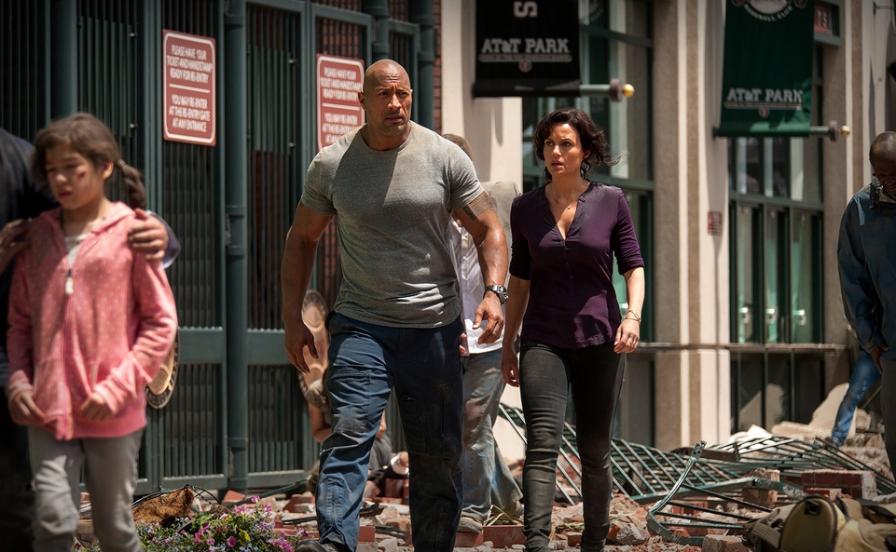
Screenwriter Carlton Cuse, on scribbling together the script for a revisit to ‘Disaster Film Cliché Central’ has accessed the default setting and slapped them all in. “San Andreas” viewers will be able to predict in advance, without missing a beat, just about every uttered word and physical move. Dwayne Johnson stars as big Ray, a military veteran back from a tour in Afghanistan and handling dodgy helicopter rescues in California, when an inevitable series of earthquakes along the San Andreas Fault reduce San Francisco and the surrounding districts into a mass of digital rubble. Caught up, but of course, in the collapse is big Ray’s estranged wife Emma (Carla Gugino), their beloved daughter Blake (Alexandra Daddario) and Emma’s loaded new squeeze Daniel (Ioan Gruffudd). Personality-bypass Serena (Archie Pajabi) hangs around big Ray giving him lazy-script nudges to reveal his backstory. Meantime, seismology-studies director Lawrence (Paul Giamatti), babbles his own crummy expositions about fault lines. Apparently California is 100 years overdue for a major seismic shoogle, the kind that requires a lot of horrified staring at computer-generated wave patterns and flashing red dots on maps beforehand. Fortunately, gawky, geeky, spekky Lawrence has just pioneered a new earthquake-prediction model by warning people just in time, for a few extra pre-earthquake “oh my gods!”
This sickeningly idle exposition stuff is a major nuisance with this film. Big Ray stares glumly at a stack of unsigned documents labelled “DIVORCE PAPERS” in red – and this is the film’s idea of subtlety, because it doesn’t involve Serena asking “So, your wife wants to divorce you for being distant and uncommunicative after the tragic death of your other daughter, but you aren’t ready to let go, right?” Later, a character played by Kylie Minogue (yes, her) suddenly asks Emma for no apparent reason other than it was in the script: “So, you had another daughter, but she drowned, right?” The drama between big Ray and Emma largely exists so it can be resolved, via lengthy predictable monologues. Viewers may have to actively push themselves to feel any emotional engagement in a relationship that consists largely of boxes to tick: estrangement, nearly fatal trauma, monologue about feelings, the end.
It’s far easier to get involved in the impressive earthquake sequences. The many rescues are all preposterously unlikely, with a casual disregard for physics and biology, but Cuse and director Brad Peyton made a smart move in making big Ray a pilot: During much of the architectural carnage, he has a god’s-eye view of rippling landscapes, collapsing buildings, and cities in flame. More significantly, though, he gets a waterline-level view of a tsunami, in the film’s least-believable but most breathtaking setpiece, he rides a tsunami! Good on you, big Ray! San Andreas doesn’t have much interest in the lives lost during its sequence of catastrophes, but it does dish out plenty of the large-scale spectacle that matters in disaster films of this type. San Andreas doesn’t follow the template used by the likes of Towering Inferno and The Poseidon Adventure – ie the cast-attrition disaster movies where a group of survivors is whittled away one by one, often via heroic sacrifice or cowardly mistakes. Peyton and Cuse’s film is more in the realm of The Impossible and The Day After Tomorrow, where a tiny family group is all that matters, and the tens of thousands of lives lost outside that group can just get to hell, who cares about them anyway. San Andreas centres on a father’s unlikely determination to cross a disaster zone to save an adult child, with only a minimal idea of where his daughter might be in a city approaching a population of 1 million. But you just know big Ray the Rock will find her.
Disaster movies are rarely sensitive about the actual human cost of disasters, but this one feels unusually callous. Ray, Emma, and Blake aren’t much better. All of them occasionally try to steer other panicked people towards safety, but just as often, they walk by bleeding victims without a glance. In one of the film’s odder moments, Blake loots a fire truck, oblivious to the crowds around her, or the possibility that it’s still in use as an emergency vehicle; she acts like a videogame character, casually using up every resource she sees, in case a later level requires it. Similarly, as big Ray cruises through a flooded San Francisco randomly looking for Blake, he passes by other victims and rescue efforts without any remote interest. This is a film about family, not about pulling together in a crisis, or even taking a basic interest in humanity. Blake does pick up a couple of survivors early along the way—British love interest Ben (Hugo Johnstone-Burt) and his little brother Ollie (Art Parkinson). But expanding her family group by two is a small trade-off for the protagonists exhibiting more than a glancing interest in anything but their own survival. And that attitude makes San Andreas feel unusually ghoulish, whether it’s rushing doomed, anonymous people through a city that’s become a morbid funhouse full of fatal traps, or tittering just a bit over its characters’ horror-flick-level poor choices. The film dismisses millions of people in order to focus on a family unit, but without making that family unit more than a bunch of pretty faces with fervently sincere ‘acting’ and a mouthful of well-worn disaster clichés.
