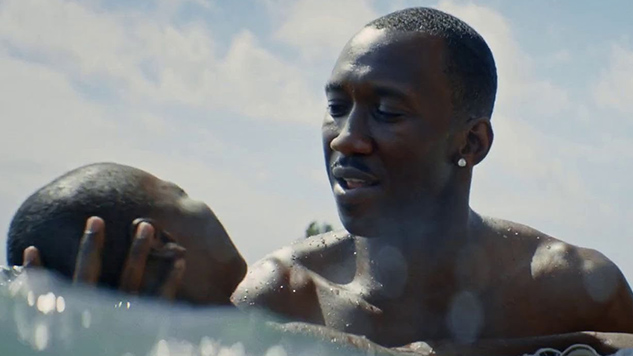
Cast: Alex Hibbert, Ashton Sanders, Trevante Rhodes, Mahershala Ali, Naomie Harris, Janelle Monáe, André Holland, Jharrel Jerome, Jaden Piner
Writer/Director: Barry Jenkins
Duration: 1hr 50mins
Taking out most of Moonlight’s outer flesh – what’s left are the bones of a coming-of-age story. Barry Jenkins’ film plays around with the passage of time in a story of a black youngster growing up in Miami. The protagonist, Chiron—“Chi” like “shy,” “ron” like the Rhône—is played by a trio of actors across three different segments set in three separate periods of his life, each titled using the monickers best suited to him from one chapter to the next: “Little”; “Chiron”; “Black.” He is portrayed as a child by Alex Hibbert, as a teenager by Ashton Sanders and as a man by Trevante Rhodes, each bringing singular quiet flourishes to Chiron’s reserved persona while still maintaining a consistent individuality. Their ensemble performance is quite an impressive achievement with Moonlight being painted through by brushstrokes of silence. There is also Jenkins’ unobtrusive direction, of Chiron’s mute trepidation, of his friends and adult carers, who speak to him in the knowledge that he’ll say little and less to them in return if indeed he says anything at all. The film’s loudest components contribute to Chiron’s torment, such as his drug-addict mother, Paula (Naomie Harris), or the school bully, Terrel (Patrick Decile). Nothing, of course, causes him as much turmoil as the uncertainty of his own sexuality - and that element is rendered in hushed apprehension.
Helmer/writer Jenkins is fluent in silence and possesses an innate understanding of how silent moments can communicate more than pages of dialogue. It’s in the knowing glances between Little and his surrogate custodians, Juan (Mahershala Ali) and Teresa (Janelle Monáe). The stillness Chiron responds with when in conversation with his friend and ultimate crush, Kevin. Kevin, like Chiron, is the product of an acting trinity’s combined efforts, from boy (Jaden Piner) to teen (Jharrel Jerome) to man (André Holland). He’s also the first person Chiron has any sexual contact with, and is the one of the few who follow from Moonlight’s second to third section. Their relationship is made complicated by school playground survival tactics. In one sequence, Terrel goads a reluctant Kevin into beating up Chiron, who in turn refuses to submit either to Kevin’s onslaught or his pleading for Chiron to just stay down.
This film doesn’t want to break your heart but it does want to leave you shaken, by simply reminding you that once upon a time, you too were most likely bewildered or wounded by the difficulties of childhood - when you too were doubtful and insecure about your identity. It’s a necessary step in fostering empathy, and Moonlight is nothing if not empathetic – and is assuredly one of the year's finest and most essential films.
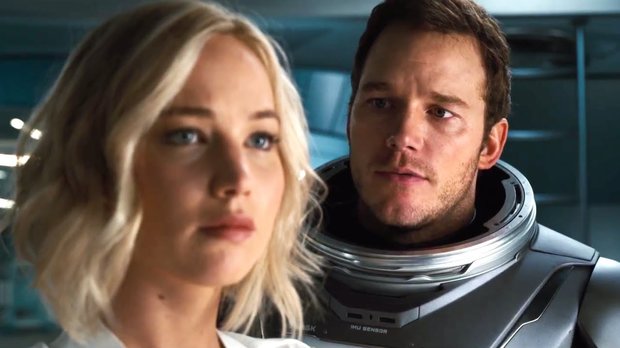
Cast: Chris Pratt, Jennifer Lawrence, Michael Sheen
Director: Morten Tyldum
Duration: 116 mins
Passengers is set is the very distant future, with Chris Pratt as Jim Preston, a space migrant who has decided to jettison his earth-life and head off on a 120-year star trek to a privatised colony named Homestead II. He is just one of 5,000 individuals suspended in hibernation on the starship Avalon, which is apparently Homestead the company’s premier interstellar airliner. Earth, we’re told, is at this time hugely overpopulated, overpriced, and overrated, and these snoozing travellers are off to a new world, a fresh start, with room to grow. The intention is that they’ll all yawn and stretch back into consciousness in the final few months of the trip, whereupon the Avalon will be turned into a groovy space cruise with bars, restaurants, pools, gyms, and plenty of opportunities for in-house dating. Unfortunately, our Jim has woken up just under a hundred years too early, and there’s no way for him to resume his 40 winks’+ session. When he questions the ship’s computers, they respond with corporate jargon and platitudes. They can’t help him with his problem, because, well, you see – this wasn’t supposed to happen – and, sorry, but there’s no fail-safe mechanism on board should such an unlikely occurrence take place. So off a glum Jim trots, wandering the desolate spaces of the Avalon, with a variety of pleasant-voiced holograms, electronic food servers, and a robot bartender named Arthur (a top nod to The Shining from Michael Sheen) to keep him company till he grows old and dies. Also, dammit, as he’s not a Gold Star Customer, Jim is bombed out from having any fancy-dan coffees such as those mocha/cappuccinos/latte things.)
Following nearly a year of playing basketball and video games on his tod, and wandering the halls naked and with a year-old beard, (how come his 90-years' beard in hibernation was a mere 10 day stubble and not substituting as a hairy kingsize duvet? Not to mention his neat haircut on wakening up? Eh? Just asking…) Jim briefly considers suicide by throwing himself out into space. Of course this is a failure. Before long, he finds himself beside the hibernation pod of Aurora Lane (Jennifer Lawrence), and sees her beautiful slumbering face through the glass. He becomes obsessed with Aurora, a young writer from New York, and starts to think the unthinkable: he is an engineer who’s spent the last year alone - and now he has the power to waken Aurora – thereby saving himself from loneliness, but ensuring she’ll go bananas if she ever finds out. That’s an astonishing and horrific decision, and if the director had any real guts, he might have pursued the idea into some genuinely uncomfortable places. A guy wakes up in space and is facing an eternity of loneliness; what does he do? That remains a captivating idea, and one worth exploring. But in order for a premise to become a film, something more needs to happen. Unfortunately for Passengers, it turns out to be a muddy mess of familiar elements and clichés, strung together for no apparent reason other than to get us to feature length and give both actors something to do.
