Cast: Rachel Weisz, Timothy Spall, Tom Wilkinson, Andrew Scott, Jack Lowden, Caren Pistorius, Alex Jennings, Harriet Walter, Mark Gatiss, John Sessions, Nikki Amuka-Bird, Pip Carter
Director: Mick Jackson
Duration: 110 mins
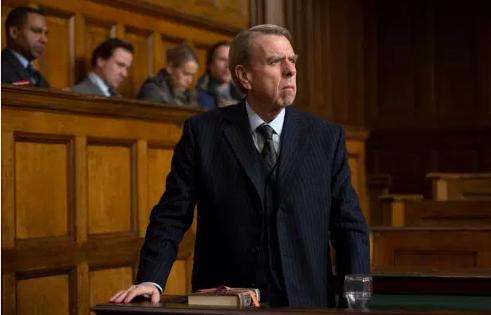
Mick Jackson’s film Denial, based on the book by noted Holocaust historian Deborah Lipstadt, dramatises her infamous legal battle with the English Holocaust denier David Irving, a once reputable historian who sued Lipstadt for libel following the denigration of his work in one of her books. The film chronicles the case, questioned the very fidelity of the Holocaust. The verdict from the trial destroyed Irving's professional reputation and served as an important precedent in the legal history of the genocide in which Adolf Hitler's Nazi Germany and its collaborators killed about six million Jews. Acclaimed playwright David Hare wrote the screenplay which offers a vindication of logic and reason against those offering fallacious conspiracy theories to advance racist agendas, reflecting the undercurrent of anti-Semitism which to this day continues within elements of the contemporary world. Denial humanises Irving, but maintains a constant attack upon his abhorrent ideals, categorically destroying them one by one until he is finally stripped of all dignity and credibility. The brilliant Timothy Spall plays Irving as a delusional social climber whose talents as a historian were increasingly perverted by his growing passion for the ideas espoused by Adolf Hitler and the Third Reich. Spall, who has lost a considerable amount of weight, functions his sneering jowels in a manner which superbly captures the facial demeanour of both Irving's insecurity and arrogance, showing him to be a repellent racist whose hatred was so deeply ingrained that he was incapable of seeing it. He is a classic example of a pathological bigot whose racist view of the world leads him to see himself as a victim of some vast conspiracy out to get him.
With an almost entirely British cast, Rachel Weisz's performance as Lipstadt brings a complement to and the counterpart of Spall's Irving. As an American and the one being tried, Lipstadt is horrified by the British legal position that an individual is, in effect, guilty until proven innocent, the reverse of her native tradition. Striving to be accepted into the upper crust of British society, Irving lives in a beautiful home with a staff of housekeepers. What this film has to say about revisionist history and extreme beliefs is darkly profound, especially as it explores the self-denial people have about their own prejudices, forcing us to explore our unspoken thoughts.

Cast: Matthew McConaughey, Edgar Ramirez, Bryce Dallas Howard, Toby Kebbell
Director: Stephen Gaghan
Duration: 121 mins
Director Stephen Gaghan adopts the use of a combination of hyperactive camera movements and a predominantly post-punk/alternative-rock soundtrack to exult in the thrill of the chase, bask in Kenny's newfound privilege as a result of his discovery, and just generally swim in a sea of amorality towards the outright corruption the film depicts. Sadly, his film Gold never finds an identity of its own, but the problems with it run deeper than stylistic derivativeness. As in his earlier Syriana, this film's screenplay, by Patrick Massett and John Zinman, exhibits a lack of interest in characters as three-dimensional people beyond their function in making larger thematic points. This failing is made even worse in the case of Gold because the story of Kenny Wells and, to a lesser extent, his South American second-in-command, geologist Michael Acosta (Édgar Ramírez), isn't jostling for attention with four or five other different storylines. The filmmakers seem less interested in exploring these two main characters than in simply chronicling a process narrative while striking a consistently flip attitude toward their material.
Gold is just another standard rise-and-fall account of the American dream, one in which down-in-the-dumps characters believe in little more than making a lot of money in order to be successful, a notion that's eventually disproved in brutal fashion after a temporary period of raging success. Unlike the character Belfort in Scorsese’s exemplary The Wolf of Wall Street, who at least actively participated in the stockbroking he did, Kenny Wells isn't even an honest beneficiary of his own success, only coming up with the idea to venture out into Indonesia to dig for gold, leaving Acosta and plenty of Indonesian natives to do all the hard work while he, at one point, is waylaid by malaria. Perhaps that's meant to be the subversive joke of Gaghan's film: daring us to celebrate the exploits of a man who barely did anything to achieve the meteoric success he temporarily gains. But McConaughey (who plays the lead as a vile, unsavoury, obnoxious slob) brings so much of his usual fast-talking energy to the role that the damning irony carries less of a sting than it should. Gold is as much about a man's macho self-deception as it is about the corrupting effects of capitalism, especially as the revelations about the truth of the gold Wells and Acosta discovered in Indonesia begin to surface. This is the closest the filmmakers come to finding an interesting angle on this well-worn material. Even then, it leads to the most banal resolution possible: a be-good-to-your-loved-ones conclusion which is as hackneyed as it gets. But then, that's just par for the course for a film which finds no treasure of gleaming originality in its energetically told but crushingly clichéd anti-capitalist parable.
