The Master
Cast:
Joaquin Phoenix as Freddie Quell; Philip Seymour Hoffman as Lancaster Dodd; Amy
Adams as Peggy Dodd; Jesse Plemons as Val Dodd; Rami Malek as Clark; Laura Dern
as Helen Sullivan
Director: Paul Thomas Anderson
Running time: 137 mins.
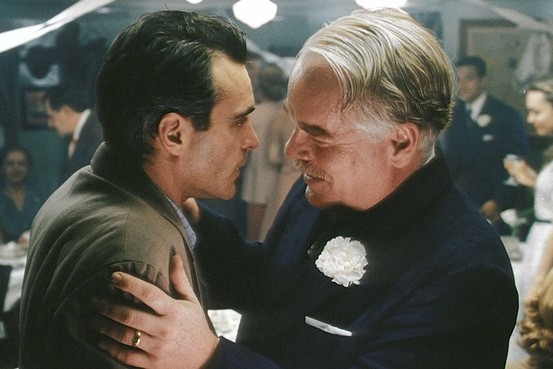
Pain, anger, confusion. drink, sex and sleep form just about everything in Freddie Quell's world, which seems to be without meaning or direction. He’s a one-month psychologist’s seminar in himself – a strange ego, a beast without spirit. He is a half-tamed wolf of a man, slumped and loping and always hungry—feeding, biting, whimpering, running. Once he had dreams and goals. Freddie is a World War II veteran, a photographer, a cabbage picker, an amateur alcohol cocktail enthusiast. He may well have been in love once. But his future and past have been devoured by his present. His passions and fears and neuroses dominate him in every conceivable way. He quite literally fights his way free from one promising career, destroying another in the process and is forced to flee from both. It is Freddie's way, to bite and run. However one night he stows away on a small ship.When he's discovered, he's led, meekly, to meet Lancaster Dodd, a man they call the Master. "You've wandered from the proper path, haven't you?" the Master asks him, before beginning to talk about dragons—how his own dragon was fearsome and uncontrollable until he learned how to tame the beast—teaching it to sit and stay. Perhaps tomorrow, he says, he'll get it to roll over. Freddie smiles knowingly. But we’re left wondering … what is this dragon really? Is it inside Freddie, something the Master can help tame? Or is Freddie himself the dragon, to be domesticated and brought to heel? Or could the real dragon stand before Freddie, smiling, preaching, charming—a cult leader breathing fire as he talks, devouring souls as he teaches?
Because of the themes at play in The Master—most of which take place in the framework of an emerging cult - it's hard to place much of what we see into "normal" categories. For instance, we know that Freddie desperately could use some help. And Lancaster seems to want to help him, even when most of the Master's family would rather he told this bloke to get lost. Therefore it’s never quite clear whether Lancaster believes in his own methods, or whether (as his son insists early on) he's making this stuff up as he goes along. We're left to wonder whether Lancaster's more concerned with Freddie's health or his servitude—moulding the man into an unquestioning pet to do his bidding.
It's a theme returned to again and again. Is Lancaster being kind or manipulative? Is Freddie staying sober, or has he transferred his addictive mania from the booze to the bamboozler? When we see flashes of love or concern, are they sincere? Or are they simply manifestations of, or covers for, more craven impulses? Power? Fear? Jealousy? The fact that this film forces us to think about such things is perhaps a positive in its own right. This gives witness to the seductive and coercive power of cult and tells us, quite clearly, to be wary of those who ask for our undivided devotion. Lancaster is steadily building a religion in his own image. He might argue that he's teaching more of a science (though one not recognised by any actual scientists) than religion, as he plumbs people's past experiences with something resembling hypnotherapy.
But we learn it's not just past experiences
Lancaster is tapping into; he's also trying to pin down past lives. His adherents believe the world is trillions of years old and most of us have
occupied countless past bodies on our way to countless future ones. "Our
spirits live on in the whole of time," Lancaster says. Believers and
followers are taught that It's through painful experiences in either this or
other lives that cause pain and the goal appears to be to rid ourselves of the
reactive emotions associated with those experiences. The process, Lancaster
tells us, can cure a variety of diseases, too—including dementia and some forms
of leukemia. It shouldn't surprise anyone, then, that one critic suggests to
Lancaster's face that he's creating a cult.
There is no God or even gods in this spiritual concoction. The ultimate deity, we're told, is humanity itself. "The source of all creation, good and evil, the source of all is you," Lancaster claims, and advises his herd to find their way back to an "inherent state of perfect."Lancaster's proclamations yield striking similarities to Scientology—similarities that the film's writer and director, Paul Thomas Anderson, has both admitted and tried to downplay. He's called Scientology a "backdrop," and said he was more interested in exploring how and why movements like that get going than performing an overt observation on Scientology itself. But there's no question that Lancaster bears more than a passing resemblance to L. Ron Hubbard, Scientology's founder. Indeed, Lancaster's movement (called The Cause) shares Hubbard's belief in past lives and time travel and trillion years of existence. And The Cause's "processing" sessions sound very much like Scientology's "audits." Thus, despite Thomas Anderson's protestations, it seems fair to view The Master as being, at least on some level, a critique of a real-world cult. During one of those processing sessions, Lancaster asks Freddie if he believes God will save him. Freddie says no. We hear President Franklin Roosevelt offer a prayer on the radio and the Irving Berlin song "Get Thee Behind Me Satan" in a department store.
There is no God or even gods in this spiritual concoction. The ultimate deity, we're told, is humanity itself. "The source of all creation, good and evil, the source of all is you," Lancaster claims, and advises his herd to find their way back to an "inherent state of perfect."Lancaster's proclamations yield striking similarities to Scientology—similarities that the film's writer and director, Paul Thomas Anderson, has both admitted and tried to downplay. He's called Scientology a "backdrop," and said he was more interested in exploring how and why movements like that get going than performing an overt observation on Scientology itself. But there's no question that Lancaster bears more than a passing resemblance to L. Ron Hubbard, Scientology's founder. Indeed, Lancaster's movement (called The Cause) shares Hubbard's belief in past lives and time travel and trillion years of existence. And The Cause's "processing" sessions sound very much like Scientology's "audits." Thus, despite Thomas Anderson's protestations, it seems fair to view The Master as being, at least on some level, a critique of a real-world cult. During one of those processing sessions, Lancaster asks Freddie if he believes God will save him. Freddie says no. We hear President Franklin Roosevelt offer a prayer on the radio and the Irving Berlin song "Get Thee Behind Me Satan" in a department store.
As part of his therapy routine, Lancaster forces Freddie to walk back and forth across a room, touching a wall on one side, then a window on the other side. For hours, perhaps days, Freddie paces that room like a wolf in a cage—full of anger and confusion and a desperate need to please. The film itself feels a little like that. Its overall execution is a great achievement, artistically, but perhaps desperately so. It pushes all the critic-friendly buttons while losing any connection it might've had with a paying audience. There is no resolution here. The characters neither change for the better or worse. The Master curries favour with its breathtaking, and it has to be said, quite brilliant lead performances (mumble, mumble, Oscar, mumble), then bashes you on the head with its disturbing and grotesque vision. It's both confusing and confused, feeling positively unhinged at times. Freddie paces between two imperfect paths. One, laid out by the Master, offers a semblance of hope and self-improvement. But it's a false hope, based on a ludicrous pseudo-science and a horribly flawed man. The other is to go back to the life he knew before Lancaster —one filled with sex and drink and violence. The life of a wild animal. One is a wall impossible to breach. The other is a closed window … the promise of freedom of sorts beyond, but filled with broken glass and blood. But Freddie is given no third choice. All he has is the wall and the window, a cult's claustrophobia and the world's wild futility. None of this really matters though, because nothing is condemned and nothing is championed by the film’s end. There’s no satisfactory conclusion - you’ll leave marvelling at the performances and shoulder-shrugging the rest, making this an endorsement out of respect rather than heartfelt enthusiasm.
