BLUE IS THE WARMEST COLOUR
Writer/Director: Abdellatif Kechiche (179 mins)   
Cast: Adèle Exarchopoulos, Léa Seydoux, Jérémie Laheurte

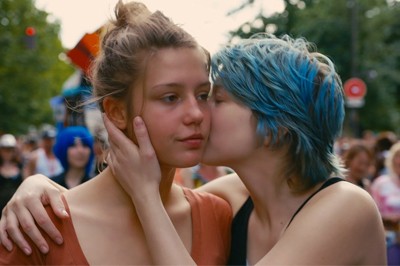
One look - a wordless exchange of glances is all it takes for French teenager Adèle (Adèle Exarchopoulos) to realize that she prefers the company of women. Or one woman in particular - blue-haired bohemian artist Emma (Léa Seydoux), whose seductive sidelong stare stirs in Adèle an overwhelming tempest of desire, at once liberating and terrifying. The beauty of Blue Is The Warmest Colour, a sprawling three-hour chronicle of first love and sexual awakening, is the way it entices the viewer into the emotional wavelength of its heroine, inviting them to witness, and subsequently share, every palpitation of her heart and every high and low she experiences. The film completely belongs to Exarchopoulos, its remarkably expressive starlet, who is rarely off-screen throughout, and whose countenance—frequently framed in close-up, which greatly improves the story, as each minute shift in feeling becomes a grand canvas for director Abdellatif Kechiche. Of course, it’s not the actress’ face, but her bared body that’s created all the fuss around this intimate epic, which has proved surprisingly divisive since the Cannes jury handed both Kechiche and, in an unprecedented move, his two lead actresses the Palme D’Or.

Explicit lesbian lovemaking aside, Blue is, at heart, a coming-of-age romance. Three hours may seem excessive for such a modest plot (adapted from the French graphic novel Blue Angel), but Kechiche wastes little of his mammoth running time. In place of corner-cutting clichés, there’s a wealth of character and environment building. Nearly an hour passes before Adèle tracks down Emma, the stranger she encountered on the street, at a lesbian bar. During that prelude to courtship, she dates and then dumps a relatively dull boy, nurses a very brief infatuation with a female friend, confides in a gay classmate, quells her sadness with food, sings protest songs in the street, and copes with the cruelty and general mundane nature of her high school education. Seydoux, whom audiences may best know as the near-mute assassin in Mission: Impossible—Ghost Protocol, eventually injects a little electricity into the proceedings. Her first real scene with Exarchopoulos, a long and flirtatious conversation, pulses with mutual attraction. But even after a love connection has sparked, the film takes its time, allowing a vision of late adolescence—and, eventually, of a fledgling relationship—to slowly and organically take shape. The fact that the romance is between two women is and isn’t important, as while the director takes care to show how Adèle struggles with social pressure, hiding her sexuality from her friends and parents, that aspect never hijacks the narrative.

This is a drama of self-discovery, not a social-issues film. As for the sex scenes, they are erotic, but it’s not just their frankness and duration that counts, but their emotional intensity too. While so many films make sex look either sleazy or almost pantomime in nature, this is a film that depicts it honestly—as a messy, sometimes ungraceful act of connection. For some, it may be impossible to separate these prolonged simulations, but only a hopeless tedious prude could confuse any of it for pornography. There’s too much raw emotion, too much fierceness and beauty, in the way Exarchopoulos and Seydoux embrace. How, in this day and age, could two women making love inspire such hysteria, especially among otherwise enlightened film enthusiasts? The heavy stuff comes afterwards, when the passions cool and two people, once united in amorous appetite, have to figure out how to keep what they have alive. Although it will no doubt be labelled a gay flick by many asinine observers, its heedfulness regarding love, passion and heartache are of the sort that can be readily understood and embraced by audiences of all orientations. Blue is the Warmest Colour is one of the very best films of 2013, a work so stirring and powerful that it will leave most viewers enthralled and devastated in equal measure.


THE HUNGER GAMES:
CATCHING FIRE
Directed by Francis Lawrence  (146 mins)

Cast: Jennifer Lawrence, Josh Hutcherson, Liam Hemsworth, Donald Sutherland, Stanley Tucci,  Woody Harelson, Phillip Seymour Hoffman

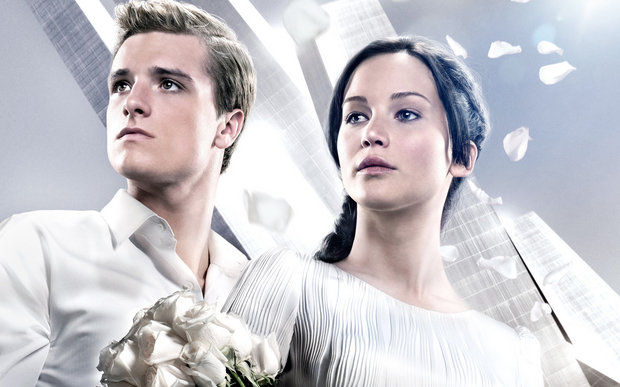
Trilogies and Quadrilogies assign roles to each episode. The first introduces us to the characters, and the situation. The finale answers all the questions, rights all the wrongs and ultimately sorts everything out. Then, as in this, we have the central section - and with that comes the 'sequel' before the third, 'Hunger Games: Catching Fire' a prelude to the conclusion which will cover the source material's parts three and four - but this outing, quite frankly, and despite the obviously huge fan-base, is grandiloquently puffed-up to the point of tedium. Based upon Suzanne Collins' tome,  written in the voice of the 16-year old Katniss Everdeen, and set in the post-apocalyptic dystopian nation of Peneen, this ambiguous flick clearly has the story underway, but as a cynical marketing ploy, does similar things - all over it again – providing the heroes with death-defying challenges to overcome — and then, not unsurprisingly, it just .... ends. This is just one of several reasons why this film fails – the main one being that it is so far up itself, it re-appears through its own gaping mouth. It opens with our heroine Katniss (the stilted, one-dimensional, over-rated Jennifer Lawrence, or - with all the fawning about her apparent 'brilliance' - perhaps I've missed the boat somewhere along the way) suffering from a smidgeon of post-traumatic stress disorder having survived the murderous government competition that sets young persons against their peers in a catalogue of derring-dos concluding with their demise, as in the last film. It explains that the regime now views her as a threat, because of her personal example of co-operation and self-sacrifice. Katniss changes the personal attitude into something resembling political, as she notices how the downtrodden of the Districts respond to her, and wonders if there isn't a way to turn the Hunger Games on their head, and bring the real fight to the Capitol itself. But then — being the second dollop of an interminable serial of bombastic euphuistic twaddle — it simply stops and the credits begin to roll — with Katniss personally resolved, but with all the real struggles still to come (your messiah of choice help us). Most of the Part-One cast returns - but this time out we are treated to a new director, Francis Lawrence, apparently no relation to the 'star', but with a similar lacklustre, apathetic approach to the proceedings. (For the record – he is responsible for "I Am Legend," "Constantine" and "Water for Elephants.") Say no more. If your inner nerd got your anorak off to the first outing, you'll most likely be appeased by this one. But if, like me, you had severe problems last time around — then I’m sad to report, prepare yourself for similar grief on the follow-up. 

The scenes in the impoverished Districts are wholly unimaginative, relying on anachronistic "Grapes of Wrath" style poverty; the CGI is mercilessly poor, the costumes and set decoration in the lush Capitol are fatuous and Stanley Tucci should have his ridiculous ponytail pulled until he squeals - and whoever cast cardboard nonentity Josh Hutcherson as a lead needs a severe talking to. No, I am not being harsh - this is me being kind. 
There's also a major romantic failing. Katniss is supposed to be full of trauma and confusion; does she love hunky Gale back home, or the pathetic Peeta, the one-expressioned baker's boy who has followed her on this adventure? Her lack of emotion conveys nothing. However, like her - do we really care?