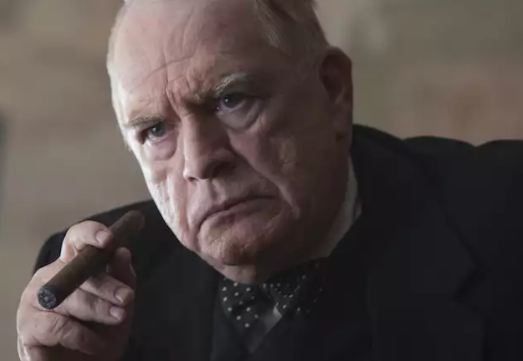
Cast: Brian Cox, Miranda Richardson, John Slattery, Ella Purnell, Julian Wadham, Richard Durden, James Purefoy
Director: Jonathan Teplitzky
Duration: 105 mins
During the days preceding Operation Overlord on June 6, 1944, the US President Dwight Eisenhower received considerable expressions of uncertainty for the invasion plan from British Prime Minister Winston Churchill. This is the time frame covered in Jonathan Teplitzky’s Churchill, as shown from the PM’s perspective, with Eisenhower reduced to a secondary role. With Churchill (Brian Cox), haunted by the memories of the disastrous Gallipoli campaign on the Anatolian coast he’d been instrumental in crafting back in 1915, he frantically argues that Overlord is far too dangerous and must be called off, while Eisenhower (John Slattery) and Field Marshal Montgomery (Julian Wadham) contend that it has to go forward as planned—and overrule him. Churchill was written by historian Alex von Tunzelmann, but this is a highly speculative example of historical revisionism, as it presents the 69-year old PM as a man unable to accept the fact that his time is passing and his glory days fading from memory.
Even as he is tortured by his past mistakes, the crisis of confidence Churchill suffers here is pure invention, and innumerable other aspects of Tunzelmann’s script are also fashioned for dramatic effect, often very crudely. The worst is the introduction of Helen Garrett (Ella Purnell), a fictitious young secretary who becomes the object of the PM’s wrath. The plot thread reaches its nadir in a maudlin moment in the last act regarding her fiancé, who is part of the invasion force. Despite some well-framed long distance shots of sole figures and excellent cinematography by David Higgs, this is actually a small film despite the huge historical context. Confined largely to interiors which are often clouded by a cigar and cigarette smoke-filled fue, the scale is modest even when Churchill visits Montgomery’s troops before the invasion. Given the limitations, however, there is much to admire in Brian Cox’s performance as a driven Churchill approaching the point of a complete breakdown. With the help of make-up, the physical resemblance is striking, but it’s the actor’s voice and demeanour that truly impresses. Miranda Richardson is the very image of stiff-upper-lip propriety as Clementine, Winston’s long-suffering but supportive wife, who barely misses a beat when he husband suddenly trashes their dining room. James Purefoy tries hard with his two scenes as King George VI, but he struggles with the then monarch’s well-documented speech impediment. Tunzelmann has contrived a provocative portrait of Churchill, less based on history than imagination, but showcasing a virtuoso performance by Cox.

Cast: Sam Worthington, Radha Mitchell, Octavia Spencer, Avraham Aviv Alush, Tim McGraw, Graham Greene
Director: Stuart Hazeldine
Duration: 132 mins
Dragging on for a seemingly interminable 132 minutes, The Shack is an offensive, simple-minded, pseudo-religious shambolic pile of drivel, reliant on kitsch imagery to transmit an inane message about the power of forgiveness. It begins its endless marathon of guff with a bland narration by lead character Mack Phillips (the quite hopeless Sam Worthington who struggles even to reach the categorisation of being one dimensional). In an infuriating constant whispering tone which he maintains throughout the film, he warns that this will be “on the fantastic side” and that we might be “sceptical” about what he is about to tell us. This is followed by some brief scenes where we see the young Mack being physically abused by his alcoholic father. As he strolls off, bruised and upset, he is further miffed by the appearance of a woman (the ridiculously over-rated Octavia Spencer) who offers the boy some apple pie. “Talk to God,” she tells him. “He’s always listening.” (This despite a later reappearance by Spencer as a female deity). Ignoring her advice, young Mack decides to pour some handily available strychnine into his father’s booze bottles - but there this sequence ends, with no follow-up. There is worse, much worse, to come. Mack’s adult life suddenly arrives in such an over-paced, lacklustre way, and like most of the subsequent sequences in the film, this jump is utterly unconvincing. Particularly irksome is a very confusing sequence where Mack saves one of his children from drowning, only to simultaneously lose another to an unseen abductor. Mack then gets a letter from someone called “Papa” in which are typed the words, “I’ve missed you … I’ll be at the shack next weekend if you want to get together.” You may think the protagonist is engaged in an illicit affair with a man in a love shack, but no, as “Papa,” it turns out, is what his wife Nan (Radha Mitchell) calls God. “It’s too familiar for my taste, but the kids love it,” says pompous, 0.5 dimensional Worthington as Mack.
Another line in this tragic script actually comes up with, “it’s in the Bible, so it must be true” in such a serious way it beggars belief, and a woman (played by Alice Braga) calmly announces, “I am Wisdom,” with a straight face. Mack goes to the eponymous shack, and once he is there, the whole thing deteriorates into a series of plodding, soft-spoken conversations between Mack and a trio of deities - ticking all the boxes in the PC accord with an Eastern Jesus and an Asian Holy Ghost - but led by Spencer’s “Papa” God. Why did they chose an overweight African American woman to play God the Father? All fingers point to the director of this tosh. Worthington is so hopelessly inexpressive that his lengthy scenes with Spencer play out like acting classes where she appears to be attempting to get him to display any sort of recognisable human emotion. He asks why God doesn’t have a “long white beard,” which makes fat woman/God/Papa laugh: “I think that’s Santa,” she says. Oh, be still my aching sides. This patronising, sycophantically annoying character bangs on about being “especially fond” of Mack, and the joke is supposed to be that this God is “especially fond” of everyone.
The natural evolution of these ‘conversations’ with fat woman/God/Papa is completely ignored - such as - for example - is f.w./God/Papa also especially fond of Hitler? Isis? The London/Manchester terrorists? Myra Hindley? “I’m in the middle of everything you perceive to be a mess!” she proclaims to Mack at one point, and her words apply equally to this execrable lump of a film she is part of. The relentless triteness of The Shack reaches an insulting climax when Braga’s 'Wisdom' tells Mack that his abusive father had an abusive father of his own, and that the man who killed Mack’s daughter had an abusive father too – so, naturally, he must be forgiven, which he duly is. Unlike this unholy chaos of a film, when towards the finale, it offers a gratuitously awful scene where the dead girl’s body is found and a burial ensues within a Wizard of Oz migraine-inducing set - dragging tastlessness into a new nadir of objectionable unpleasantness.
