ARGO
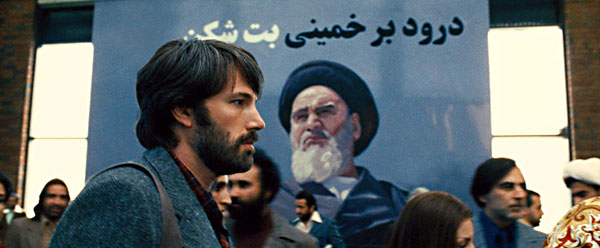
Cast: Ben Affleck, Bryan Cranston, Alan Arkin, John Goodman, Victor Garber, Tate Donovan, Clea Duvall,
Scoot McNairy, Rory Cochrane, Christopher Denham, Kerry
Bishé, Kyle Chandler, Chris Messina
Director: Ben Affleck
Screenplay: Chris Terrio, from the Wired magazine article Escape from Tehran by Joshuah Bearman
Director: Ben Affleck
Screenplay: Chris Terrio, from the Wired magazine article Escape from Tehran by Joshuah Bearman
and the book Master of Disguise by Antonio Mendez
Producers: Grant Heslov, Ben Affleck, George Clooney
Running time: 120 minutes
Ben Affleck, he previously of the tarnished acting
reputation, has managed to reinvent himself over the last five years as one of
America’s top new directors. Following the outstanding reception Affleck
received for writing and directing Gone Baby Gone and The Town, this third feature
confirms that the filmmaker knows precisely what he is doing and that the
previous two films were no lucky flukes. In fact, Argo, in which Affleck stars as Latino CIA operative Tony Mendez, may
finally reveal that his talents are best expressed behind the camera rather
than in front of it. Affleck’s performance here, though solid, lacks just a little
in shading and dramatic weight but nevertheless he is still a more than
acceptable presence in the main role of this outstanding film. Producers: Grant Heslov, Ben Affleck, George Clooney
Running time: 120 minutes
Argo is a hugely entertaining thriller that’s based on a true incident that occurred in 1980 at the height of the American hostage crisis in Iran. There’s no question that Affleck and screenwriter Chris Terrio have modified certain aspects of the tale for dramatic effect, particularly in regard to the film’s climactic, knuckle-biting moments. Tony Mendez is a CIA exfiltration expert with expertise in Iran. Now Mendez has been called in to help six American embassy employees who managed to sneak out a back door and find safety within the Canadian embassy when the American compound was taken over by Islamic fundamentalists on Nov. 4, 1979. After 10 weeks holed up, the escapees’ identities remain unknown to the Iranians who hold the other American diplomats captive in the American embassy, so the CIA contemplates an extraction plan. The U.S. government’s idea is to sneak in bicycles and have the six Americans ride 300 miles to the border. Mendez, while watching Return to the Planet of the Apes, hatches another crazy plan and is given the go-ahead to enact this “best bad idea”: creating the cover of a location-scouting expedition for a naff science fiction film called Argo. To help him make this notion concrete, Mendez enlists a couple of Hollywood pros: John Chambers (Goodman, firing on all cylinders), a real-life makeup specialist who invented Mr. Spock’s ears for Star Trek (among other distinctions), and Lester Siegel (Arkin, razor sharp, bone dry and brilliant), a venerable and no-nonsense producer.
We’re privy to every step of this mission and the characters involved: the U.S. government’s push-pull, the captives’ fears and tensions, the absurdities of creating the myth of the film’s existence, and even the Taliban’s intelligence procedures. Much care is devoted to establishing the Seventies look in wardrobe and hairstyles, and the film's insiders’ sense of Hollywood is coy and amusing. A sequence that cross-cuts between the horror of the torture experienced by the captives held in the American embassy and the absurdity of an in-costume, Hollywood table read for the extraterrestrial Argo shows off Affleck’s deft craftsmanship. His greatest talent, however, may lie in his casting instincts. In addition to the above-mentioned turns by Arkin and Goodman, stand-out performances are also on view by Bryan Cranston as Mendez’s boss and Victor Garber as the morally heroic Canadian ambassador to Iran.
Still to come however, is Affleck’s multiple-pronged coda to the movie. As the credits roll, we hear the voice of President Jimmy Carter verifying the truth of the mission and why it remained classified for so long. We also are presented with side-by-side photographs of the historical figures and their film representations; the resemblances again reveal the filmmakers’ attention to detail, although the display seems more self-congratulatory than necessary. A brief scene reunites Mendez with his estranged wife, which also seems a slight Hollywoodism. And if all those endings weren’t enough, we are treated to some text onscreen that moralises about how this event is a great achievement in international cooperation between the Americans and Canadians. I expect for some snooty critics, it may have just too many endings for one film and in their eyes they may moan that it slackens the film’s earlier pace.
As for me, my only response to those types, has to be an echo of the film’s running joke, “Arrr, go fuck yourself!”
