EDGE OF TOMORROW
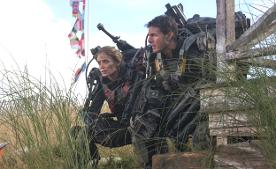
Dragomir Mrsic, Charlotte Riley
Director: Doug Liman
113 mins
Sadly his initial foray in the battlefield hits quite a snag: he dies. However at this point some of the alien’s blood manages to inveigle its way into his system, causing him to keep waking up before the slaughter has even happened. In a Groundhog Day-type repetition scenario, he regains life, snuffs it again, resumes existence, pops his clogs once more, and so on ad nauseum. Just for the sake of comfortable coincidence, Cage discovers he has a fellow-sufferer of this demise/resurrection stuff – and – as you’ve most probably guessed – it’s Rita Vrataski. She decides to harness this power, and declares that, as a result, she will bring this pesky war to a satisfactory conclusion.
The rapidly-growing tone-setting cliché of using talking heads on recognisable network news bulletins plus Cruise and Gleeson in charge of exposition is slightly dreary, but there are some amusing incidents as Cruise’s Major William Cage engages in humorous asides to avoid fighting with the troops, all alas to no avail. He plays up Cage’s cowardice whenever he gets the chance, to both comedic and dramatic effect using his fear to make Cage’s reluctance sympathetically understandable.
The initial battle sequence is, it has to be said - a superb set piece. When Cage falls from a damaged plane, the shot is captured in a expertly achieved long take with a clear sense of setting, space, and personal geography, and this clarity remains throughout the film. Further combat and destruction spectacle is not entirely at a premium elsewhere, especially towards the film’s conclusion where the famous glass pyramid in Paris is shattered to astonishing effect.
Jimmy's Hall
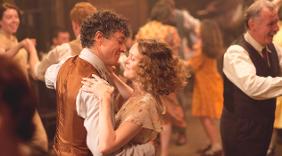
Andrew Scott, Jim Norton, Brian F. O’Byrne
Director: Ken Loach
106 mins
Tenuously continuing a link from a previous work "The Wind That Shook The Barley” Loach here tackles another especially loathesome aspect from Ireland’s notorious past, where the titular Jimmy Gralton was unceremoniously deported from his home country without trial. Set ten years on from the war of independence featured as a backdrop to the aforementioned ‘...Barley’, “Jimmy’s Hall” shows that the animosity and divisions through religion, politics and bureaucracy were as potent as ever.
Prior to the conflict Jimmy, (a wonderfully understated Barry Ward) alongside his fellow townsfolk in Leitrim, had created the Pearse-Connolly community hall to offer to the local people an array of community dancing, art courses and studies in literature. This aroused the ire and subsequent intervention of the Catholic clergy who despised this apparent bohemian debauchery – seeing themselves as the rightful purveyors of learning for the people in the parishes and beyond. Feeling this intensifying pressure grinding him down, Jimmy Gralton decided to set off to New York.
By 1932 his ageing but warm and benevolent mother (a wonderful portrayal of bemused dignity from Aileen Henry) requires help in the home following the death of her other son – so Jimmy returns. Inevitably support and constant pressure from his friends and neighbours forces his hand, and following some initial reluctance, Jimmy decides to rebuild and re-open the forsaken and decaying Hall. Father Sheridan (Jim Norton) appears as the feathers-spitting nemesis to counter the town’s joy at this new focal point for their recreation, and in church he lambasts the erring Jimmy and his cohorts for their disgraceful efforts which do nothing more than heinously bringing about the “Los Angelisation of our culture”! Wonderfully scripted as always, by the sublime Paul Laverty, this beautifully shot, performed and directed film vividly illustrates the haunted past of a country ravaged by personal vendettas, ignorance and intolerance and of the huge sacrifices suffered by so many in the then seemingly endless torment. It is another masterful piece from the one of the most outstanding filmmakers of our time.
Grace Of Monaco
Milo Ventimiglia, Paz Vega,
Geraldine Somerville,
Derek Jacobi, Robert Lindsay,
Parker Posey
Director: Olivier Dahan
103 mins
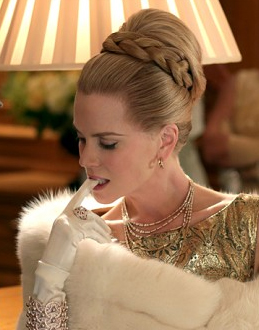
Nicole Kidman's bland interpretation of (Princess) Grace Kelly certainly has her well-cast in the looks department, but the whole project is an unmitigated disaster from conception to conclusion. On the matter of the film’s ending – it just suddenly ceases mid-way through Kelly’s married life with no coherent denouement. Perhaps they all just felt a collective ‘sod this’ reaction to the entire proceedings and decided enough was more than enough.
The real tragedy is that Kidman is a hugely talented actress and the arc of Grace Kelly’s life from film star to Princess of Monaco was potentially a very interesting tale. However this risible attempt at a biopic fails on every conceivable level. I wouldn’t say I was enduring the whole film in the hope of witnessing a re-creation of the fatal car crash, but there is no real substance, dramatic power nor coherent narrative whatsoever, and it offers nothing of any worth towards covering her early career and ultimately tragic demise.
Director Olivier Dahan helms this insipid dilution with a sanctimonious sense of withering worthiness that moves it closer to send-up than a dramatised documentation of a deceased darling. There is also a detectable aura of knowing pantomime within the wretched performances, with previous screen alumni such as Tim Roth and Derek Jacobi up there giving it less than their all, plus prime ham merchant Robert Lindsay acting the goat and extracting the proverbial, all of this probably due to their bemused involvement in such unmitigated drivel.
