Take Shelter
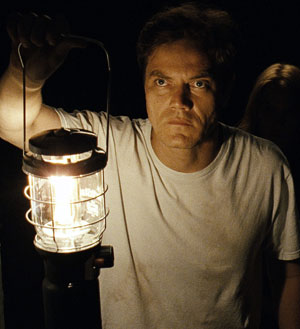
Cast: Michael Shannon, Jessica Chastain, Kathy Baker
Director: Jeff Nichols
Running Time: 120 mins
Director: Jeff Nichols
Running Time: 120 mins
These days there's no lack of
apocalyptic visions on the big screen. Take Shelter presents
the end of a world on a smaller scale. Michael Shannon plays Curtis, a
hard-working family man trying to provide for his wife Samantha and his
hearing-impaired daughter Hannah. In another instalment of recession cinema,
times are tough and Curtis is caught in a squeeze. He's juggling bills,
including expensive medical treatment for his daughter, while Samantha pines
for a holiday. Curtis is a simple
honest man. He's tall, strong and stoic. Each day he works at a sand and gravel
company, but he's haunted, his hollow eyes plagued by visions of ‘The End’.
Nightmares are constant. He sees visions of murderous neighbours stealing his
child. Standing in his backyard he looks to the sky which is heavy with storm
clouds. In his visions, the rain comes down as a thick oily liquid, perhaps the
source of the spreading madness.
In reality, Curtis's sleepless nights
are taking their toll. He's wetting the bed, increasing his medicine intake to
avoid the night terrors, but they keep coming. The family dog goes mad. The sky
is filled with another dark cloud, this time a shifting ink blot of a murder of crows which is extremely eerie and unsettling. And so this modern-day Noah starts building his ark: in
his case, an expanded storm shelter built into his backyard. Curtis comes from
a family with a heavy history. His mother was diagnosed as a paranoid
schizophrenic. Curtis even pays her a visit, digging around on when she first
felt things change. Even through her own cloud of confusion, the mother can
sense her son is struggling. But when she asks if he's ok, the only response is
"Yeah I'm fine."
The tension in Take Shelter is twofold, Curtis can feel the storm approaching, but whether it's an omen or sign of his own psychosis, no one can say. The film never quite answers the question and this adds to the atmosphere. As the delusions increase, we're never quite sure what's real. This type of high-wire act wouldn't be possible without a grounded performance and that's where Michael Shannon comes in. His craggy face is distinctive and memorable. Often we witness him in a quiet struggle, fighting the demons inside. Forced to confront his fears, his voice cracks, squeaking out a pitiful "I can't." Although the final (needless) scene unravels the story, Take Shelter remains quite a rewarding look at disasters both external and internal.
The Guard
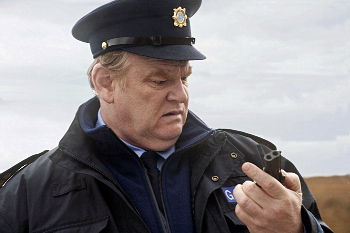
Cast: Brendan Gleeson, Don Cheadle, Liam Cunningham, David Wilmot,
Rory Keenan, Mark Strong
Directed by: John Michael McDonagh
Producer
Joel Silver once devised a simple formula for success: you take a white guy and
a black guy with completely different backgrounds, give them a mystery to solve
together, have them take part in a few action sequences, say a couple of funny
lines, and the box office cash rolls in. This method worked for years, as films
like Lethal Weapon, 48 Hours, and more went on to have
incredible box office success. Now writer/director John Michael McDonagh has
taken that formula, given it an Irish twist, and created one of the best
comedies of the year.
Featuring terrific turns by its stars, tremendous chemistry between its leads and an unorthodox approach to a familiar set-up, The Guard is a screamingly hilarious comedy with a great deal of heart. Taking an equal-opportunity-offender approach, the film is a dark comedy in every sense of the word, but everyone will be too busy laughing to care about the boundaries being pushed.
The story centres on Sergeant Gerry Boyle (Brendan Gleeson), a police officer who serves in the west of Ireland. Upon learning that a team of three international drug smugglers (Mark Strong, Liam Cunningham, David Wilmot, all brilliant) are in town, Boyle is forced to team up with an FBI agent named Wendell Everett (Don Cheadle) in order to bring them to justice. Though they resist working with each other at first, Boyle and Everett are unified after witnessing a wave of corruption, bribery and blackmail and refuse to back down until the job is done.
The main reason for the film’s success is the pairing and dynamic between Gleeson and Cheadle. Because their characters are so deftly written and layered, all aspects of Boyle and Everett’s personalities bounce off each other perfectly. From Boyle’s casual racism to Everett’s wealthy upbringing; Boyle’s lack of worldliness to Everett’s fish-out-of-water situation, everything about the two is crafted with purpose and makes the film all the funnier.
Beyond the script, however, The Guard’s entire cast also gives amazing performances. As Boyle, Gleeson is required not only to be incredibly laid back - but thanks to scenes with his dying mother, is also a good and responsible man. The range shown in each actor’s performance is amazing. The film’s real scene stealer, though, is Mark Strong as a criminal who has become bored by what he does. Strong has been frequently typecast as a stereotypical baddie in the last few years but here he shows that he can play deep and complex characters when given the right material, as he had in BBC’s memorable and seriously underrated “The Long Firm”.
Because of John Michael McDonagh’s relationship to Martin McDonagh – they’re brothers – and the fact that both films star Brendan Gleeson, The Guard is likely to earn a lot of comparisons to In Bruges, which isn’t entirely unfair. Both pictures aim for the same audience, have similar senses of humour and adroitly mix darker character and story elements with hysterical ones. There are, of course, some sections of the audience which may not take too kindly to McDonagh’s brazen and unabashed approach to comedy, but those that appreciate irreverent humour when they need a laugh are going to adore The Guard.
Unmissable.
Featuring terrific turns by its stars, tremendous chemistry between its leads and an unorthodox approach to a familiar set-up, The Guard is a screamingly hilarious comedy with a great deal of heart. Taking an equal-opportunity-offender approach, the film is a dark comedy in every sense of the word, but everyone will be too busy laughing to care about the boundaries being pushed.
The story centres on Sergeant Gerry Boyle (Brendan Gleeson), a police officer who serves in the west of Ireland. Upon learning that a team of three international drug smugglers (Mark Strong, Liam Cunningham, David Wilmot, all brilliant) are in town, Boyle is forced to team up with an FBI agent named Wendell Everett (Don Cheadle) in order to bring them to justice. Though they resist working with each other at first, Boyle and Everett are unified after witnessing a wave of corruption, bribery and blackmail and refuse to back down until the job is done.
The main reason for the film’s success is the pairing and dynamic between Gleeson and Cheadle. Because their characters are so deftly written and layered, all aspects of Boyle and Everett’s personalities bounce off each other perfectly. From Boyle’s casual racism to Everett’s wealthy upbringing; Boyle’s lack of worldliness to Everett’s fish-out-of-water situation, everything about the two is crafted with purpose and makes the film all the funnier.
Beyond the script, however, The Guard’s entire cast also gives amazing performances. As Boyle, Gleeson is required not only to be incredibly laid back - but thanks to scenes with his dying mother, is also a good and responsible man. The range shown in each actor’s performance is amazing. The film’s real scene stealer, though, is Mark Strong as a criminal who has become bored by what he does. Strong has been frequently typecast as a stereotypical baddie in the last few years but here he shows that he can play deep and complex characters when given the right material, as he had in BBC’s memorable and seriously underrated “The Long Firm”.
Because of John Michael McDonagh’s relationship to Martin McDonagh – they’re brothers – and the fact that both films star Brendan Gleeson, The Guard is likely to earn a lot of comparisons to In Bruges, which isn’t entirely unfair. Both pictures aim for the same audience, have similar senses of humour and adroitly mix darker character and story elements with hysterical ones. There are, of course, some sections of the audience which may not take too kindly to McDonagh’s brazen and unabashed approach to comedy, but those that appreciate irreverent humour when they need a laugh are going to adore The Guard.
Unmissable.
Oslo 31st August
Produced by Hans-Jorgen Osnes, Yngve Saether, Sigve
Endresen
Directed by Joachim Trier
Screenplay, Eskil Vogt, Trier, freely adapted from the novel "The Fire Within" by Pierre Drieu La Rochelle
Cast: Anders Danielsen Lie, Malin Crepin, Aksel M. Thanke, Hans Olav Brenner, Ingrid Olava, Oystein Roger, Tone B. Mostraum, Kjaersti Odden Skjeldal.
Running Time: 1hr 31min (Subtitled)
Directed by Joachim Trier
Screenplay, Eskil Vogt, Trier, freely adapted from the novel "The Fire Within" by Pierre Drieu La Rochelle
Cast: Anders Danielsen Lie, Malin Crepin, Aksel M. Thanke, Hans Olav Brenner, Ingrid Olava, Oystein Roger, Tone B. Mostraum, Kjaersti Odden Skjeldal.
Running Time: 1hr 31min (Subtitled)
Joachim Trier's Oslo, 31. August, is a well-crafted character study about a 34-year-old man's life evaporating over the course of a single day. Released from a state-run home for recovering drug addicts, Anders (Anders Danielsen Lie) journeys to his hometown of Oslo for a job interview and to give vent to his planned suicide.
Although he's at the end of his recovery process, Anders is still deeply tormented by the consequences of his devastating drug addiction.
His eyes are deep pools of regret and guilt, his mouth slightly quivering during moments of extreme disappointment. This journey through the streets of Oslo rekindles memories about his parents, childhood, and older sister, all incomplete fragments of a completely alien life.
The film shows Anders meeting up with old friends, some supportive and others hurtful, catching up together at Oslo's park benches, cafes, swimming pools, and balconies, all emotional platforms for a young man grasping at redemption. The film opens up the entire city to a plethora of possibilities, including Anders's yearnings and those of the immediate strangers living around him.
Trier follows behind Anders with a steady and unassuming camera, as if the viewer were just another friend following him into the deep end. The observational focus makes the joyous and saddening moments all the more affecting. It shows an obviously charismatic and talented man overwhelmed by his own assumptions.
This process is a slow disintegration and for Anders, his emotional downfall becomes a whisper, not a bang.
