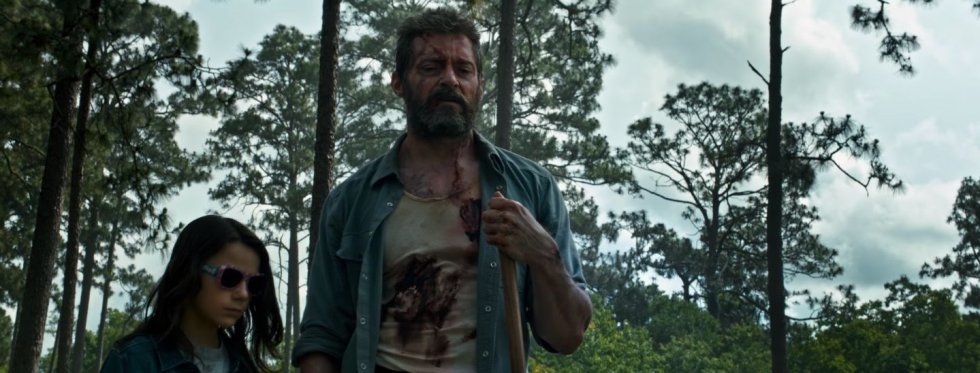
Cast: Hugh Jackman, Patrick Stewart, Dafne Keen, Stephen Merchant, Richard E. Grant
Director: James Mangold
Duration: 135 mins
Within a group utilised by metaphor for marginalised people everywhere, Wolverine (Hugh Jackman) became the breakout character. Committed to the principle of co-operation, Logan (as Wolverine is also known) is a man who has apparently lived multiple lifetimes - yet only has one story to tell. This titular film recognises that the thinly veiled secret of Logan's solo existence is that he's always been a cog of some kind, whether within an industrial complex or through Charles Xavier (Patrick Stewart). Logan is set in the not too distant future where Wolverine, one of the last of his kind, is in deep trauma following the loss of all his friends and colleagues, so much so that he spends his days quietly chauffeuring and/or knocking back the booze. The one remaining connection to Logan's old life is Xavier, grimly hanging on, as dementia renders him susceptible to powerful, uncontrolled waves of psychic energy. Xavier functions as a frail but optimistic foil for Logan's survival instinct – as we are introduced to Laura (Dafne Keen), a child mutant who has been bred and experimented upon - and who possesses Wolverine's adamantium-enhanced powers. Unlike him however, she is replete with programmed ruthlessness.
Logan's feral savagery conversely seems a
little bland when set against the real mccoy of Laura's inarticulate but
howling rage. The gloss of the X-Men franchise is pared down in this
outing, as the action provides the grisliest representation yet of Wolverine's
claw-fighting. The film is abundant in images of Logan and Laura's metal claws
ripping open veins and decapitating heads, sending up geysers of blood in the
process, and the soundtrack heightens the gruesomeness of this savagery. For
the first time on screen, Logan appears to be profoundly scary and traumatised, as he should well be, even as he finally reaches the limits of his body's
capacity to heal. In breaking free of CGI extremes, Mangold offers up an excellent film with a surprisingly haunting,
poignant quality.
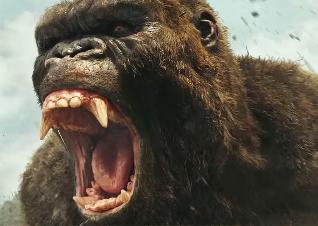
Cast: Tom Hiddleston, Samuel L. Jackson, Brie Larson, John Goodman, John C. Reilly, Toby Kebbell
Director: Jordan Vogt-Roberts
Duration: 118 mins
King Kong first thundered his way on to cinema screens in 1933 as a symbol both embodying and criticising white America’s fear of the savage unknown. In Kong: Skull Island, he’s a great deal bigger - so much so that he could stand eye-to-antenna with the Empire State Building, without any requirement to clamber up the famous structure. Set at the tail-end of the Vietnam War and inspired to the point of plagiarism by Apocalypse Now, it’s a cautionary tale about humanity’s war-like ways, and especially America's penchant for guns and bombs when approaching complicated situations, being their primary response. Amongst its overpopulated cast of inept characters, most of whom have absolutely hee-haw purpose other than to hang around the edges of the frame until they get eaten by monsters - is an Army officer (Samuel L. Jackson) who reaches for the holster when Kong attacks the squadron of helicopters that have invaded the ape’s personal space - and becomes consumed with the need to exact vengeance from his titanic foe. But it’s also a film that gives Jackson a line that references Jurassic Park so clumsily that it’s more likely to induce groans than cheers.
Apart from the fact that an ape the height of a suburban house is no longer quite as impressive as it once was, the main reason this Kong seems to have been ultra-sized is so that he can one day step into the ring with Godzilla himself. In case he’s still not big enough, the film makes a point of telling us that he’s not fully-grown. That gives this Kong more than a few years to pump iron before his inevitable big bout. The clumsily titled Kong: Skull Island takes place in 1973 and helpfully reminds you of the time frame by blasting inevitable Creedence Clearwater Revival or Jefferson Airplane tracks (yes, bloody "White Rabbit" - again!) at you every so often, lest you’ve forgotten. With the war in Vietnam all but lost—or, as Jackson’s character would have it, abandoned—the U.S.A. is in search of new frontiers to conquer and an uncharted island hundreds of miles from civilisation seems to be just the ticket. The expedition’s ostensible purpose is mapping the caverns underneath the island’s surface—which is why the group is mainly composed of scientists, with Tom Hiddleston as a tough-guy tracker and Brie Larson poncing about as a photojournalist to guide and document. But once the soldiers start dropping bombs, it’s clear the purpose is to flush something out rather than simply take notes on the terrain, and that thing isn’t happy about these people-pests arriving to irritate his relative calm.
After losing most of their number to Kong’s initial wrath, the expedition happens upon a village in the centre of the island, inhabited by colourfully painted but mostly mute natives and a bearded, manic John C. Reilly, who’s been stranded there since his World War II fighter crashed nearly 30 years earlier. He warns the group that they are, in effect “fighting the last war” - going after Kong - whom, he informs them, “is king around here”, without taking account of the bigger, meaner creatures Kong keeps in check. Those other monsters are, to be fair, quite impressive. There will always be more poetry in Willis O’Brien’s original Kong; no matter how duff the stop-motion effects of 1933 may look to some modern eyes, they’re transfixing in a way neither Vogt-Roberts’ nor Peter Jackson's 2005 creations can manage. But a lot of care and craft has gone into these creepy-crawlies—far more, in fact, than is evident in their flesh-and-blood counterparts. Then again, that’s only fitting. It’s clear who the real stars are here and who are the disposable plot contrivances on legs. You can’t have a King Kong flick without King Kong - and everything and everyone else is an afterthought.
