The Rewrite
Cast:
Hugh Grant, Marisa Tomei, Bella Heathcote, J. K.
Simmons, Allison Janney, Chris Elliot
Director: Marc Lawrence
106 mins
Hugh Grant sets off doing a lightweight self-parody - even to the extent of viewing a contrived YouTube clip of his 'Four Weddings and a Funeral' award speech back in his fop with the flop heyday – in this latest soft-romcom from his old ally writer-director Marc Lawrence. It’s a not-unpleasant outing as he returns to more familiar territory from his 'Cloud Atlas' diversion and Grant’s well-worn but still affable screen persona charms serve both the actor and the story well.
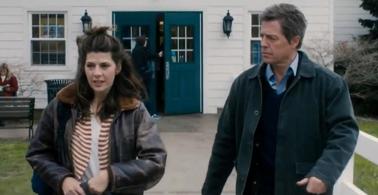
Award-winning (once) Hollywood screenwriter Keith Michaels (Grant) still basks in the fan worship engendered by his one moment in the spotlight, but the industry which once revered him is now crossing the street in droves when he appears. Short on money and having lost his wife to the director of the film that won him an Oscar, and despite his sexist womanising attitude betraying his age, he takes up a mundane teaching job in the backwater town of Binghamton, N.Y. There he reckons he can summon up a sequel to his big hit and at the same time learn the value of teaching his adoring class of post-pubescent Glee-stereotypes.
His foil is single mum Holly Carpenter (Marisa Tomei), who is the counterpoint to a bespectacled, sexy pupil whom Keith beds almost on arrival from the airport. As Keith gets to discussing script structure with his class, he could probably teach this one, it’s so by the book.
Mary Weldon (Allison Janney) is the head of an ethics committee and a raging pathologically addicted Jane Austen fan. In contrast to the oversexed girl trying desperately to achieve fully matured woman status, Tomei’s character is sadly and badly under-outlined but she is still worth watching. In essence, not an entirely uncomfortable session in a cinema chair.
Director: Marc Lawrence
106 mins
Hugh Grant sets off doing a lightweight self-parody - even to the extent of viewing a contrived YouTube clip of his 'Four Weddings and a Funeral' award speech back in his fop with the flop heyday – in this latest soft-romcom from his old ally writer-director Marc Lawrence. It’s a not-unpleasant outing as he returns to more familiar territory from his 'Cloud Atlas' diversion and Grant’s well-worn but still affable screen persona charms serve both the actor and the story well.
Award-winning (once) Hollywood screenwriter Keith Michaels (Grant) still basks in the fan worship engendered by his one moment in the spotlight, but the industry which once revered him is now crossing the street in droves when he appears. Short on money and having lost his wife to the director of the film that won him an Oscar, and despite his sexist womanising attitude betraying his age, he takes up a mundane teaching job in the backwater town of Binghamton, N.Y. There he reckons he can summon up a sequel to his big hit and at the same time learn the value of teaching his adoring class of post-pubescent Glee-stereotypes.
His foil is single mum Holly Carpenter (Marisa Tomei), who is the counterpoint to a bespectacled, sexy pupil whom Keith beds almost on arrival from the airport. As Keith gets to discussing script structure with his class, he could probably teach this one, it’s so by the book.
Mary Weldon (Allison Janney) is the head of an ethics committee and a raging pathologically addicted Jane Austen fan. In contrast to the oversexed girl trying desperately to achieve fully matured woman status, Tomei’s character is sadly and badly under-outlined but she is still worth watching. In essence, not an entirely uncomfortable session in a cinema chair.
The Judge
Cast: Robert Downey Jr, Robert Duvall, Vera Farmiga, Leighton Meester, Billy Bob Thornton, Vincent D'Onforio, Dax Shepard, David Krumholtz, Sarah Lancaster, Ian Nelson
Director: David Dobkin
141 mins
American law is a complex beast, as indeed is the father son relationship, in this aspirational drama which lurches through some narrative wobbles towards a murder trial. Heavily reliant on the talents of Robert Downey Jnr and Robert Duval respectively as the smart-ass son who defends the rich and guilty, and the distant, seemingly dysfunctional father who believes in the truth, appropriately enough.
The demons of their past arrive with fury during a weather storm and erupt at a force-nine gale pace, revealing all that had remained unsaid. Unfortunately the film itself feels like a three month trial at just on 141 minutes but there are moments to savour with great performances from Downey Jnr and Duval. My own deep personal hatred of cheap exposition was heavily fuelled however in the opening scenes – with some diabolically poor writing requiring immediate deletion on sight in the cutting room – and which would have offered no loss whatsoever to the ensuing remainder.
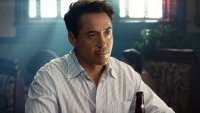
The catalyst for change in Hank’s (Downey Jr) rapid lifestyle is the death of his mother. He heads home to Indiana following a lengthy gap, only to open a painful Pandora's box of family secrets and long hidden memories. Here his ridiculously written glib lines and sharp tactics offer no shield and his vulnerability is quickly exposed. His father Judge Joseph (Duval) has a hostility towards his son that is palpable in its ferocity and this, with his deteriorating health, offers some intensely vulnerable and confronting moments including an unforgettably poignant bathroom scene. Vincent D'Onofrio (rarely seen on screen since Full Metal Jacket) is effective as Hank's older brother Glenn, as is Jeremy Strong portraying the younger, retarded brother Dale, whose focus is home movies. Vera Farmiga excels as Hank’s ex - the girl who owns the local bar and still carries a hefty torch for her former young love. There’s also a glorified cameo for Billy Bob Thornton as the focussed prosecuting lawyer. The highlights however are the verbal and emotional joustings between father and son, as Hank gets drawn into defending his dad - when the latter is accused of murder late at night on a wet road. From an early disappointment, the film increases in stature and concludes with a gripping finale.
Annabelle
Cast: Annabelle Wallis, Ward Horton, Alfre Woodard, Brian Howe
Director: John R. Leonetti
98 mins
Horror films need only have an interesting premise, a few solid jump scares, and acting that is, at the very least serviceable. That's all it will really take to satisfy the thrill-seeking, gorehound lurking in the untidier parts of most cinemagoers’ psyche. After all, horror films often function less as bold explorations of fear, and more like spookily exciting rides that you can enjoy with a group of strangers.
However, this nonsense, Annabelle, a Manson-era prequel of sorts to the 2013 hit The Conjuring, doesn't even get past those admittedly lax standards. Dim-witted, stiff, and predictable, Annabelle provides no decent scares, no palpable atmosphere, a decidedly ridiculous monster, and a pair of personality-bypass protagonists. It's a bad sign when your main characters spend a scene watching a first-run episode of the 1960s US tv comedy series Rowan and Martin's Laugh-In, and you end up feeling you’d rather be watching that instead of the guff on the silver screen.
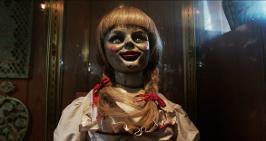
The title character is a doll last seen in a prologue to The Conjuring. Annabelle is a conduit for demonic chicanery, and while she doesn't move around and kill people herself (which is a cop-out), her various owners do tend to end up as forensic evidence. In the late 1960s, Annabelle wound up in the home of John and Mia (Ward Horton and Annabelle Wallis), an uptight and upright married pair of bores. Mia is pregnant with the couple's first child. In case the thought is about to drift in and out of your brain - any other similarities to Rosemary's Baby end there. When John and Mia's home is invaded by a team of Satanic cult neighbours, the horror clichés kick off in earnest. Blood drips on to the doll. Weird things begin happening around their home: doors swing shut, machines turn themselves on, crap albums on K-Tel play without a human hand’s involvement - and mysterious banging noises manifest inside the walls. It's all old-hat haunted house imagery. When the baby is born and our heroes move to Pasadena, Annabelle calls out the demonic big guns. From there, priests and mystics become involved.
I could forgive the banality, had Annabelle provided a few trashy scares, or at least dimmed into something vaguely spooky. Sadly, it evokes nothing but an obnoxiously bland sense of boredom. Annabelle's most grievous mistake, however, lies with the titular monster itself. As spooky dolls go, Annabelle is just not scary. She looks utterly ridiculous, ugly and crass. Old porcelain dolls are spooky enough as is. Their clean white cheeks and intense dead eyes could drive anyone nuts with fear. You don't need to cover their faces with dirt and give them angry eyebrows to make them look scarier. Enough? I think so.
