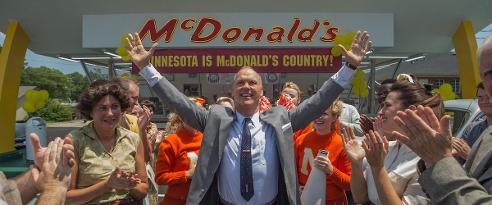
Cast: Michael Keaton, Nick Offerman, John Carroll Lynch
Director: John Lee Hancock
Duration: 115 mins
The Founder focuses on Ray Kroc, chronicling the evolution of the fast food restaurant industry, mainly the global domination of the ubiquitous cultural basic grub outlet McDonald’s. Ironically, although the makers chose the title, it should not be inferred upon the aforementioned protagonist – as in essence he nicked the entire concept. The film opens with a close-up of Ray Kroc (Michael Keaton - his features operating in immediately identifiable full facial effect Keaton mode). He’s trying to convince the owner of a drive-in outlet that he needs to buy a six-spindle milk shake mixer. But the owner doesn’t fall for the well-worn speil, leaving Kroc to lug the heavy mixer back to its place in the trunk of his well-travelled sedan car. The year is 1954, and this knackered 52 year-old hustler can’t even get the correct food he’s ordered from a similar eatery. Later that night in a motel, he sets off to bed listening to a motivational record, before heading back on the road the following morning. Next day, when checking in by phone with his office in Chicago, he is astonished to be told that an outlet in California wants six mixers - and based upon his lack of success so far, he naturally assumes that this must be a mistake – only to be informed when phoning the client that in fact they now require eight. Ray zooms off to meet these people, and before long, he pulls into the parking lot of McDonald’s. He’s amazed to encounter a huge queue of hungry, anticipatory patrons all of whom arrive at a window and order food.
Ray cannot fathom that his order is handed to him just a few seconds after ordering – and it’s hot and exactly what he’d ordered. Later, seated on a nearby bench and about to demolish his lunch, he meets a man sweeping the area who turns out to be one of the co-owners, ‘Mac’ McDonald (John Carroll Lynch). That evening over dinner (in a restaurant) both owners (brothers) are delighted to expand on their business tale and USP. Before long, Ray is in cahoots with the pair, eventually taking over the entire concern through massive expansion via a franchise model, much to the chagrin of the original owners who feel the purity of their concept has been brutally debased. The title role is a showcase for the talents of the always-brilliant Keaton. It’s an engaging roller coaster, as he shows us the weary, downtrodden Kroc at the start, the happy twinkle in his eyes as he wraps up his sales pitch, only to have his spirits crushed and casually swept aside. He is then utterly revitalised, as the thought of McDonald’s enormous potential courses through his corroded psyche. This is another triumph in Keaton’s career following his performances in the sublime Birdman and outstanding Spotlight. Unfortunately The Founder itself encounters some difficulties, particularly in its pacing. There are far too many montages and long-distance phone call sequences and these do not bear repetition. The sudden dismissal of Laura Dern’s character as Ray’s wife is bewildering, as is the apparent ease with which the legal entanglements are resolved regarding his takeover process of the intellectual property of the brand. Still, those quibbles aside, with Keaton’s work, this is still a highly engaging cultural insight.
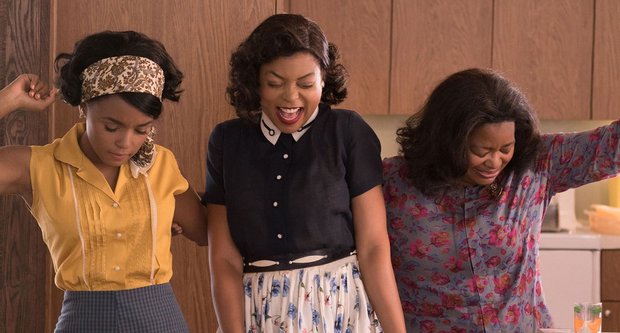
Cast: Taraji P. Henson, Octavia Spencer, Janelle Mona, Kevin Costner
Director: Theodore Melfi
Duration: 128 mins
Hidden Figures is based on the true story of three women who didn't accept offensive racism and appalling bigotry disguised within polite dismissals such as ‘policy’. They kept pushing themselves forward in the knowledge that such a stance could only result in advancement towards equality. This is the previously little-known story of NASA's pre-IBM mathematicians who, themselves, were known as "computers." Their job, and it was mostly seen as women's work, was to triple-check the calculations of all their male bosses. This wasn’t regarded as a particularly glamorous profession, and even less so was the work of the "coloured computers" - because even NASA was segregated, and African-Americans, despite helping to promote American power, still had to use a separate ladies' toilet. However, these three women clearly felt that this equation simply didn’t work, and they resolutely decided to recalculate it. Thankfully, the story provided three solid roles for African-American actresses, at a time when most major films struggle to find even one. Janelle Monae's character cannot attend the ‘white’ college, the services of which are essential for her further education in her chosen field. Spencer's can't get the promotion she's fully qualified for, and Taraji P. Henson's, despite working twice as hard as her white male colleagues, only gains half the respect.
Whilst some of the individual moments are exceptional - with Spencer being given some great lines, and Henson taking ownership of one particularly powerful scene where she suddenly relieves herself of her previous resolve and lets rip, the women never emerge as complete human beings who have lived a full life. Where, for example, have Spencer and Henson's characters been for the previous twenty or so years? And all of the men around them are equally vague. For example, we have Maherhala Ali, the National Guardsman who delicately begins courting Henson. What is his back story and what is his take on the women’s respective positions? All three female leads are excellent, but the direction by Theodore Melfi adds nothing substantial to the piece. There is absolutely no real sense of time and place, apart from some old newsreel footage. He cannot seem to manage a way in which to make physics or mathematics visual (unlike The Theory of Everything for example), and the editing provides nothing in the way of dramatic tension. Worst of all - we are left with the ludicrous sense, according to this film, that prejudice and bigotry has now ended and was merely a short-lived phenomenon - a naïve symptom of society that took place a long time ago.
