One Direction: This Is Us

Cast: Harry Styles, Niall Horan, Zayn Malik,
Louis Tomlinson, Liam Payne
Director: Morgan Spurlock
A staple of rock documentaries, we’ve seen this kind of behind-the-scenes, world-tour format many times before. All teens when the tour started (the oldest among them is now 21), there’s not a lot of life experience these five can offer to a filmmaker. Nevertheless they drive the young girls wild, and all one has to do is remove a shirt (one of the film’s frequent refrains) to ignite an earsplitting megaton scream. Of course, none gets any closer to a girl than signing an autograph, and drugs and booze are nowhere to be seen. They’re just your average teenage lads who got lucky. The film’s actually a genuinely enjoyable piece of work, and you’d need to be a deadhead cynic not to appreciate the enjoyment on show. No harm done, and you’ll be surprised at how well it’s been put together.
Director: Morgan Spurlock
This is
the Morgan Spurlock-directed documentary about the boy-band phenomenon. 1-D, a
five-man outfit which has became a worldwide sensation here have their origin
story mixed with live concert inserts. The five singers – all teenage boys –
tried out individually to become contestants on Simon Cowell’s The X Factor. All five failed to win a spot on the show, but Cowell,
demonstrating his astute music business industry acumen, saw fit to merge the
five singers into a group.
Despite the group failing to actually win the TV competition (which stats now show is the kiss of death to the winner/s), they acquired a devoted fanbase of tweeting t(w)eenage girls whose enthusiasm quickly grew worldwide. Massive sales of records soon followed, and of course a world tour, which provides the backdrop for this film.
Despite the group failing to actually win the TV competition (which stats now show is the kiss of death to the winner/s), they acquired a devoted fanbase of tweeting t(w)eenage girls whose enthusiasm quickly grew worldwide. Massive sales of records soon followed, and of course a world tour, which provides the backdrop for this film.
A staple of rock documentaries, we’ve seen this kind of behind-the-scenes, world-tour format many times before. All teens when the tour started (the oldest among them is now 21), there’s not a lot of life experience these five can offer to a filmmaker. Nevertheless they drive the young girls wild, and all one has to do is remove a shirt (one of the film’s frequent refrains) to ignite an earsplitting megaton scream. Of course, none gets any closer to a girl than signing an autograph, and drugs and booze are nowhere to be seen. They’re just your average teenage lads who got lucky. The film’s actually a genuinely enjoyable piece of work, and you’d need to be a deadhead cynic not to appreciate the enjoyment on show. No harm done, and you’ll be surprised at how well it’s been put together.
ELYSIUM

Cast: Matt Damon, Jodie Foster, Alica Braga, William Fichtner
Directed by Neill Blomkamp
Elysium is the second feature from writer-director Neill Blomkamp (District 9) Three ships illegally attempt to flee the wrecked, poverty-ravaged Earth of 2154 for the abundant riches of Elysium, a paradisiacal, medically advanced space station that’s home to the privileged few. First one ship, then another, falls to a missile, an event Blomkamp shoots from a distance before cutting to a control panel indicating a successful strike.
Over a few seconds, the film conveys just how little the deaths matter to the people with money. They draw minimal notice from the rich, who not only distance themselves from the little people, but literally look down upon them. Elysium uses its 22nd-century setting to comment on the inequality that currently divide the 1 percent from the 99 percent, citizens from non-citizens, and those with health insurance from those required to pay their own way. One of the film’s smarter touches is how un-futuristic its futurism feels. Los Angeles lies in rubble, but it’s the rubble of sustained neglect, reminiscent of the creeping disrepair of many urban cities right now, in seemingly irreversible decline. Blomkamp widens the allegorical net while telling a story of one man reluctantly drawn into an attempt to overthrow an unfair system, a journey that unfolds over a series of increasingly bone-rattling action scenes. Matt Damon steps into the protagonist role as Max DeCosta, a child of the 22nd-century slums who, in a series of flashbacks, is seen dreaming of moving to Elysium and taking along his young love Frey (played as an adult by Alice Braga).
Paradise hangs over their heads, just out of reach. As an adult, Max mostly dreams of making it through the day. An ex-con covered in tattoos and trying to distance himself from a past as a car thief, he plods away at an assembly line making robots for the police and other clients, droids of the same sort that, in one early scene, harass him on his way to work. But forces work to shake him out of his routine. While being treated for injuries inflicted by police robots, Max reconnects with Frey, now a nurse trying to care for her ailing child. Then he’s injured again, this time on the job, when he’s exposed to toxic amounts of radiation and given five days to live. With nothing to lose, he joins his friend Julio (Diego Luna) in a scheme to steal the memories, and confidential information, of Max’s boss Carlyle (a sneering William Fichtner). What they don’t realize however is that Carlyle has plans of his own, having fallen into cahoots with Elysium’s Secretary Of Defence (Jodie Foster), who’s plotting a coup. To pull it off, she leans on a band of Earth-based mercenaries led by Kruger (District 9 star Sharlto Copley), a man with no real beliefs, and who takes barbaric pleasure in inflicting pain.
For all its simple politics, clanging dialogue, and underwritten roles—only Damon’s natural, and deepening, ability to suggest unspoken disappointment gives his character dimension—Elysium just about works, although never as well as it should. There are visceral action scenes that feature the technology of tomorrow but have the immediacy of powder burns or a scraped knuckle. The film also keeps its world vivid, from Max’s hovel to the sterile interiors of Elysium. While Blomkamp’s creation never reflects our world as effectively as it wants to, it still feels like a real place, one where the promise of a better life hangs tauntingly in the sky, inspiring the sort of dreams that could lead a child, grown bitter with time, to try dragging it down to Earth.
LOVELACE
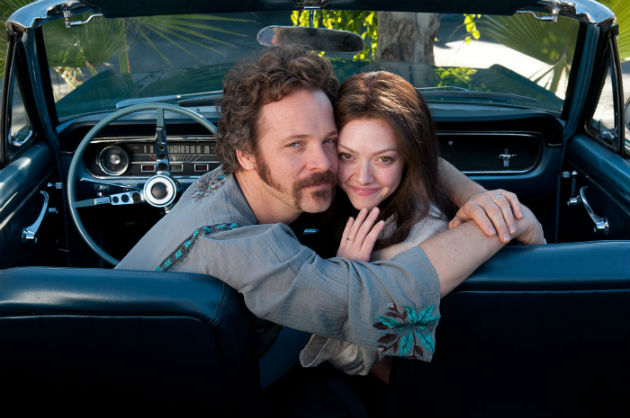
Cast: Amanda Seyfried, Sharon Stone, Peter Saskaard, Robert Patrick
Directed by Rob Epstein and Jeffrey Friedman
Directed by Rob Epstein and Jeffrey Friedman
Hot on the heels of the sexual revolution, 1972's pornographic smash-hit Deep Throat turned its lead actress, Linda Lovelace, into a quite a star. In Lovelace, actress Amanda Seyfried does an admirable job of portraying Linda Susan Boreman (her pre-Lovelace name), a clenched and repressed young woman, barely functioning in the shadow of a religious mother and ineffective father (a superb performance from a barely recognisable Sharon Stone and Robert Patrick). As fate would have it, Chuck Traynor (Peter Sarsgaard) chats her up, and quickly becomes her full-time all consuming partner. Soon Chuck is coming over to the house for dinner and charming her parents, while engaging intimately with Linda in the kitchen between dinner and desert. To all intents and purposes, Chuck seems to be a sensitive lover and an understanding confidant, so wedding bells are soon on the way. Traynor then turns into an abusive beast and serious physical and emotional violence replaces the initial sensitivity and love.
Later, after being busted, Traynor coerces Linda into entering the sex industry, to raise funds for his legal fees. In the offices of porn-film director Jerry Damiano (another superb turn from the brilliant Hank Azaria), what emerges is the media sensation that was Deep Throat, a porno film that is a mix of screwball comedy and contrived sex between her and co-star Harry Reems. The film becomes an unexpected hit, and enters pop culture history – with the result that Linda and Chuck are soon chums with Hugh Hefner and Hollywood figures like Sammy Davis Jr.
The difficulty I faced with Lovelace as a biopic is the incredible amount of historical inaccuracy. On one hand, she (Lovelace) professes to want to tell it how it really was, whilst on the other, shying away from mentioning the famous names she intimately associated with during her heyday, many of them icons, who are still around today. Personally I can recall seeing her (I was in the audience and in close proximity) when she appeared in "Lust" the first of the only two ill-fated editions of BBC Scotland's "Seven Deadly Sins" series, where she came across as an insincere, smug, self-perpetuating pseudo-born-again God botherer.
Equally remiss, is within the closing title sequence, where viewers are shown a “where-are-they-now” series of updates. Crucially, they conveniently leave out the fact that Miss Lovelace returned to making pornography after the release of her best-selling autobiography, on which the film is based. It's sad when certain facets of the truth are omitted. Personally, I feel it is a disservice to the overall cautionary message.
FOR THOSE IN PERIL
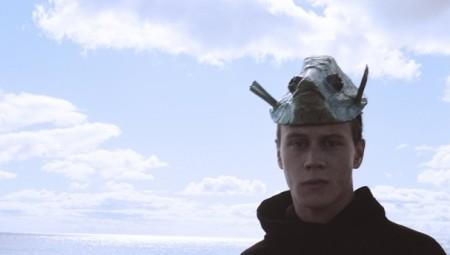
Cast: George MacKay, Kate Dickie, Michael Smiley, Brian McCardle, Nichola Burley
Writer/Director: Paul Wright
Aaron
is a young man whose existence doesn't sit quite well in a remote
Scottish fishing community. Following a tragic incident at sea, he
somehow managed to be the only one left alive from the fatal event that
claimed the lives
of five others including his beloved older brother. Obsessed
by superstition and his solitude, he embarks upon a mission to return
to the scene of the accident in the forlorn hope that his brother will
somehow emerge unscathed from the depths. The
locals turn on Aaron as their blame culture demands a scapegoat for the
tragedy, and he's the obvious choice, making him an outcast as he
pursues his demented intention.A beautifully underplayed low-budget independent piece, this film although intense - and at times one shade too deep in impassivity, nevertheless showcases excellent performances from both George MacKay in the lead role, and from the wonderful Kate Dickie as his distraught mother Cathy.
