Sing Street
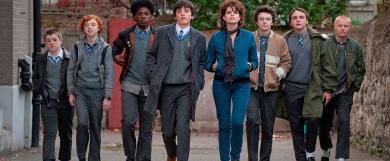
Cast: Ferdia Walsh-Peelo, Lucy Boynton, Jack Reynor, Aidan Gillen, Maria Doyle Kennedy, Mark McKenna, Kelly Thornton, Ian Kenny, Ben Carolan, Percy Chamburuka, Karl Rice, Conor Hamilton
Writer/Director: John Carney
106 mins
It’s a hackneyed cliché, but on occasion it's true - that music has the power to alter and improve people’s lives. Following his previous two outings “Once” and “Begin Again,” John Carney goes for the hat trick with “Sing Street.” We’re in Dublin, back in the 1980s, as young schoolboy Conor (Ferdia Walsh-Peelo), tries to deal with a collapsing parental background, bullying at school and his growing need for individualistic expression. To add to the piling dismay, he is sent to a new, harsher regime within an educational establishment run by a bunch of priests known as the Christian Brothers.
Conor decides that the only way out of this distress would be to form a band, so he hooks up with a bunch of pals including his co-songwriter Darren (Ben Carolan), all the while throwing his growing advances at the spellbinding Raphina (Lucy Boynton) – his one-year older desired damsel. She harbours ambitions of skeedaddling to London to fulfil her ambitions as a model, but Conor steps in by informing her that he’s the lead singer in a band and suggests that she feature in their next video. Conor has only been dabbling around with his guitar – so, to impress Raphina, forming a band is essential, as will creating music to record in advance of her agreement to help with the promo filming. Thereafter, in steps the bold Darren – a slight, short curly-haired teethbrace-sporting, aspiring promoter, who also enlists his chum Eamon (Mark McKenna), who when not obsessing over rabbits, is a multi-instrumentalist. Added to the ensemble is Ngig (Percy Chamburuka) on keyboards, the enthusiastic Larry (Conor Hamilton) and Garry (Karl Rice) on drum and bass. Next stop is the music, so Conor calls on his older brother Brendan (Jack Reynor), a long-haired dropout layabout, but the owner of a fair-sized collection of LPs, an encyclopaedic knowledge of rock – and vitally – a supporter of the lads’ cause.
And so is formed the group—named Sing Street after the address of their school on Synge Street. Kicking off as a covers band, Brendan insists that moving to original material is vital, so Conor and Eamon bang their collective musical noggins together and come up with a catchy piece called “The Riddle of the Model,” which impresses Raphina enough to feature in their hilariously ramshackle video of it. Even better songs later emerge.
It’s fairly clear how the rest of the film will pan out – and so it does. Conor’s feelings towards Raphina will intensify despite her London plans being an ominous threat. Alongside this, the band’s repertoire increases with some nifty tracks (written by Carney and musician from actual 1980s outfit Danny Wilson, Gary Clark) with the performance culmination being their gig at a school dance.
Walsh-Peelo offers up a fine performance as the likeable young protagonist Conor, and Boynton is a delight as Raphina. In fact, the entire cast is full of excellent crowd-pleasing turns. Whilst the production is relatively meagre in resources, the entire film offers a refreshingly cheerful outlook - with engaging acting, and for once, a soundtrack of original music that actually counts.
WHISKEY TANGO FOXTROT
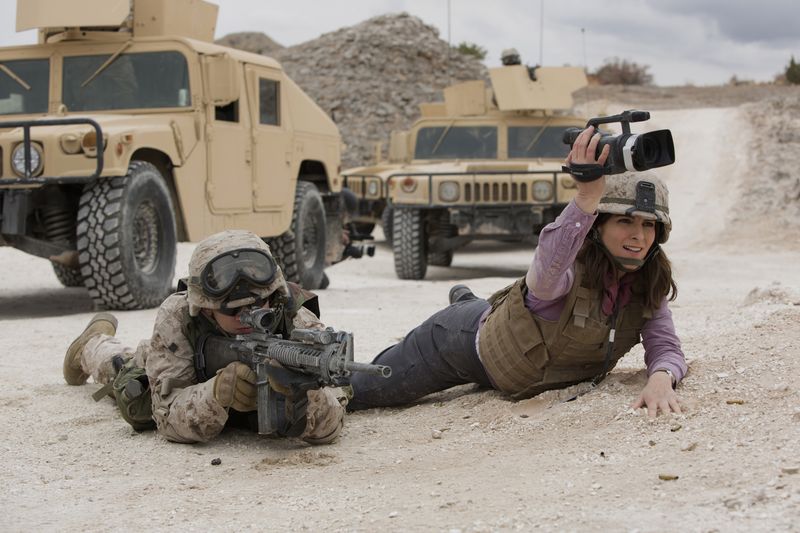
Cast:
Tina Fey, Christopher Abbott, Margot Robbie,
Martin Freeman, Billy
Bob Thornton
Directors: Glenn Ficarra, John Requa
1hr 51 mins
Whiskey Tango Foxtrot is a film about how the war in Afghanistan affects one middle-class
white American. Based on the memoir The Taliban Shuffle, by Kim Barker, who
spent years writing about Afghanistan and Pakistan, reporting from the ground.
But rather than offering a focussed, journalistic analysis of the era's
politics, the film is a great deal lighter and more personal in context,
focussing on how a life-or-death struggle helps one woman sort out who she is
and what she wants from life. Fey stars as Barker, becoming Kim "Baker" - a dissatisfied TV news
writer who accepts a posting to Afghanistan in 2003 because it will offer her
an on-screen position with more responsibility and freedom. The film also
implies that she has nothing else worthwhile in her life, being unmarried and
childless, and her attachments to home seem to consist merely of a casual
boyfriend and a handful of house plants. Set in 2006, Kim is seen as an competent and confident war journalist, capable of robustly swearing at a local in his own
language, and being relatively immune to the constant explosions and gunfire.
Then it reverts to 2003, to show her coming to the war-torn country as a naïve
newcomer, so much so that her first endeavour on the ground is to pull out a
big wad of cash, then instantly lose it to the raging winds tearing through the
city. Fellow journalist Tanya Vanderpoel (Margot Robbie) encourages Kim to see
the artificial environment of the incestuous ex-pat community as a non-stop
party, with booze and sex endlessly on tap. "Can I fuck your security
guys?" Tanya yelps on their first meeting, implying that she's already
worked her way through the largely male press corps in Kabul, and is on the
hunt for new prey. Kim also learns a few things from a bunch of marines
commanded by a sharp but world-weary general played by Billy Bob Thornton.
Directors Glenn Ficarra and John Requa (I Love You Phillip Morris, Crazy, Stupid, Love, Focus) offer a lot of off-colour banter which makes good use of Fey's comic timing, but the apparently constant need to keep the quick-stepping humour in play undermines a film that already seems uncertain about which elements of Kim Baker's life are important. The script offers no real sense of who she is before she leaves for Afghanistan, which makes it difficult to fully engage with her character on a personal level. Her boyfriend is barely established at all as a character, so her raging response at him (when she has not been back in the USA for an extended period) during a Skype call, as a half-naked woman scurries across in the background, seems relatively excessive. WTF does however offer up some seriously contemporary relevance in Kim's relationship to her tv network, which increasingly fails to use her stories because apparently Americans don't want to hear depressing reports on death and setbacks, as in when one young Marine casually tells Kim that Afghanistan has become a forgotten war. It's never clear what is changing in Afghanistan politically over the course of the film, or whether Kim feels an actual personal attachment to the people around her, or if it’s just ambition to prove herself and gain more screen time. The latter motive provokes some of the film's best drama, as Kim pushes in vain for a meaningful scoop. The film is caustic about the situation in Afghanistan, but not necessarily despairing or dismissive, although it takes some cringe-inducingly wrong-footed steps, as in the ludicrous casting of Martin Freeman as a Celtic supporting Glaswegian photographer and when Kim talks about leaving Kabul and returning to "the real world," as if Afghanistan was just a piece of film scenery, all set to be folded up and stored once she no longer needs it. But it never tries to make her into the hero of the story. At most — as in an entirely invented and frankly unbelievable climax involving the kidnapping of the Glasgow lensman and a subsequent blackmail scheme — it shows her as having learned her way around a country, regardless of how little she belongs there. The film frequently feels like a lost opportunity, as there is the potential for a great story about what it takes for a journalist to make sense of a chaotic situation, and package it in a palpable way while still serving the truth - but it winds up feeling like half a story, and not always the more meaningful or satisfying half.
