The Deep Blue Sea
Cast: Rachel Weisz, Tom Hiddleston, Simon Russell Beale, Ann Mitchell, Harry Hadden-Paton
Director: Terence Davies
Running Time: 98 min.
Director: Terence Davies
Running Time: 98 min.
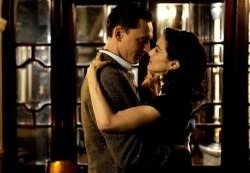
Following an 11-year absence from fiction filmmaking, during which he produced only the love/hate celluloid letter to his home town of Liverpool, Of Time and the City, Terence Davies has returned to narrative storytelling in the fluid, memorial style of his initial work. Faithfully adapting Terence Rattigan's overheated romance, the effect of this mixture of high theatricality in the performances and dialogue and pure cinema in the mise-en-scène turns out to be curiously similar to Davies's blunt, distilled presentation of his own past in Distant Voices, Still Lives and The Long Day Closes. The story, set as we’re advised at the outset "sometime around 1950," concerns a woman with a proclivity for suicide attempts (Rachel Weisz) who leaves her boring, wealthy husband (Simon Russell Beale) for a hotshot pilot (Tom Hiddleston), who's everything her husband isn't—a list that includes well-off, caring, or in love with her.
Davies collapses the entire first act of Rattigan's play into a tedious and wordless 10-minute sequence that sets into motion all of the personal dynamics without any expository slogging, and while the rest of the film isn't so radical, it nonetheless manages to achieve the rare feat of maintaining an unmistakably theatrical tone without ever playing as stagey in the least. Rattigan's dialogue veers between clever and scunnersomely boring — a fight in a museum is hilariously stymied by Hiddleston's storming off with a shout of "I'm going to the impressionists!"; Rattigan follows this up in a reconciliation scene by having Hiddleston quip, "I only did it for the Monet"—and Weisz, Hiddleston, and Beale, all three accomplished stage actors, all bring off a balance between the small gestures of cinema and the bold ones of theatre.
The ghost of WWII haunts the film, materialising at two moments that prove to be its finest: a memory of community in the London Underground during an air raid that continues Davies's use of song as a key social unifier (the 1952 classic “You Belong To Me”), and the final shot, a crane movement that connects Weisz, who in the circular structure has progressed from total resignation to something like hope, to a stark post-war image—an ambiguous, moving moment that could only have been achieved in cinema.
Resistance

Director: Amit Gupta
Cast: Andrea Riseborough, Tom Wlaschiha, Sharon Morgan, Michael Sheen, Iwan Rheon, Stanislav Ianevski, Alexander Doetsch, Anatole Taubman, Kimberley Nixon, Mossie Smith, Nia Gwynne, Tomos Eames
Running time: 92 mins
Cast: Andrea Riseborough, Tom Wlaschiha, Sharon Morgan, Michael Sheen, Iwan Rheon, Stanislav Ianevski, Alexander Doetsch, Anatole Taubman, Kimberley Nixon, Mossie Smith, Nia Gwynne, Tomos Eames
Running time: 92 mins
This has an interesting premise – what would life be like in the UK immediately after the failure of D-Day as Germany invaded Britain? “Resistance” is set in an isolated Welsh valley in the immediate aftermath. It's an intriguing idea, and the filmmaking is relatively sensitive and complex, but frankly, it’s an incredibly tedious piece of work and a real stretch at 92 minutes.
After their men sneak off in the night to join the resistance, farm wives Sarah (Riseborough) and Maggie (Morgan) are left to do the work themselves. Soon a group of German soldiers arrives, led by Captain Albrecht (Wlaschiha), who takes an unusual approach to his role as an occupying force. He decides to hide from the Gestapo in this valley, hopefully to see out the war while keeping his young officers (Ianevski, Doestch and Taubman) well away from any conflict, and in the process developing an uneasy friendship with Sarah.
The potential exists for suspense, but director-cowriter Gupta fails to generate even the slightest tension. Superficially everyone seems to get along, and both the Germans and the wives are complicit in hiding the truth from the officials. But dangers lurk everywhere, and it's odd that this is never exploited. There’s no development either of a potential subplot involving a resistance leader (a wasted turn from Michael Sheen) training the young local postman (Rheon) in how to deal with both the enemy and local collaborators.
This stilted and muted approach results in all the performances being subdued and cagey, as everyone hides their true feelings. The stoic British sensibility struggles through, but with only Morgan being allowed to convey anything resembling emotion. The other actors never look much more than strained or emotionally stunned, although Riseborough and Wlaschiha are engaging figures at the story's centre. But it feels utterly out of balance that the Nazi officers are more generous and open-minded than the British rebels.
The central underlying fact is that these women are much more resilient than the men who are determining their destinies. But the filmmakers take such an evasive, oblique approach to a story that, for a film in which life and death hang in the delicate balance, never gets hugely involving, let alone thrilling.
DRIVE
Driver: Ryan Gosling
Irene: Carey Mulligan
Shannon: Bryan Cranston
Bernie: Albert Brooks
Nino: Ron Perlman
Standard: Oscar Isaac
Directed by Nicolas Winding Refn
Written by Hossein Amini, based on the novel by James Sallis
Running time: 100 minutes.
Shannon: Bryan Cranston
Bernie: Albert Brooks
Nino: Ron Perlman
Standard: Oscar Isaac
Directed by Nicolas Winding Refn
Written by Hossein Amini, based on the novel by James Sallis
Running time: 100 minutes.
A getaway driver (Ryan Gosling) waits as his temporary partners in crime pile in with their unspecified haul, and as the police close in behind them the driver does what he does best. Straight-faced, resolutely calm, and in absolute control, he eludes capture through precision and restraint, and when the job’s over he walks away. But what happens when walking away is no longer an option? Driver (as he’s listed in the credits) meets, befriends, and falls for a young woman (Carey Mulligan) and her son who may just be the only real innocents left in Los Angeles. When her husband is released from jail and forcibly asked to commit one last robbery to pay off a debt, Driver steps in to assist and spare mother and son any further anguish.
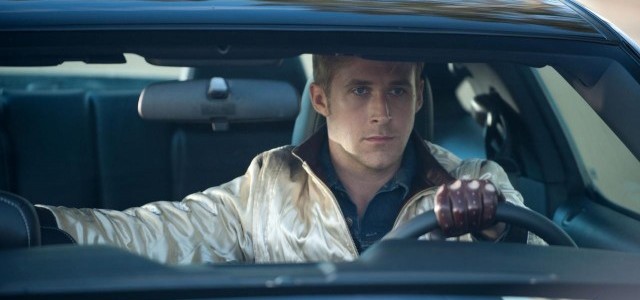
However, things do not go as planned. If the bare mechanics of Drive's plot seem overly familiar it’s because they are. The character of Driver could easily be imagined in any number of westerns, samurai epics, or Clint Eastwood films as the nameless stranger who appears to skirt both sides of the law but who shows his true colours when it comes to protecting or avenging the innocent. His past is unclear but we know those gaps are most likely filled with violence, loss and more violence. Despite the idea of “one last job that goes wrong” having become so ubiquitous – this is a truly original piece of work. 'Drive' is genius in a white satin jacket.
Director Nicolas Winding Refn and writer Hossein Amini (adapted from the book by James Sallis) have taken the incredibly familiar and turned it into one of the freshest and most electrifying films of the year. From an opening that sees credits scrawled in dated brush script mt italic neon, across the landscape and streets of LA. to a pace that resembles a tension-filled calm, punctuated with a handful of fiercely violent storms, Drive is a film that fits perfectly over a film-lover’s soul like the main-man's leather driving gloves. It envelops with atmosphere and style and engages through long stretches of dialogue-free action and inaction, all of it captivating and intense.
This is Refn’s most commercial film yet, but that’s saying very little for the director of such eclectic fare as the supreme Bronson and Valhalla Rising. Recognisable faces including Ron Perlman and the awesome Albert Brooks as mid-level mobsters and Brian Cranston as Driver’s only apparent friend in the city help add a familiarity that alongside some terrifically filmed action sequences tease mainstream appeal… that’s just as quickly abolished through atypical pacing and scenes of graphic violence and brutality.
Gosling embodies the role of Driver with a deceptive serenity that’s constantly threatening to crack from within, and he delivers his sparse dialogue in a quiet and measured manner. Seemingly half of his performance is accomplished with his eyes as they shift from focused to hopeful to sad resignation, and it’s more than enough to tell his story and highlight his conflicted motivations. Supporting performances are universally strong, but the standout is Brooks’ reluctant but resigned mobster who would love nothing more than to trade his life of necessary violence in for one that finds satisfaction in sponsoring race car drivers. He may stab you in the back, but he’ll be sincerely apologetic as he does it.
Refn and cinematographer Newton Thomas Sigel provide an immersive vision of Los Angeles that mixes noir with eighties neon and long stretches of beautifully shot calm with sudden shifts into slow-motion violence. It’s unsettling and visceral, and it’s impossible to look away. Just as important and effective is the evocative score by Cliff Martinez and a soundtrack dotted with class electronica that creates a mood and an atmosphere all of its own. The sound design in general works equally hard, as every rev of an engine and creak of Driver’s leather gloves adds to the experience.
However, things do not go as planned. If the bare mechanics of Drive's plot seem overly familiar it’s because they are. The character of Driver could easily be imagined in any number of westerns, samurai epics, or Clint Eastwood films as the nameless stranger who appears to skirt both sides of the law but who shows his true colours when it comes to protecting or avenging the innocent. His past is unclear but we know those gaps are most likely filled with violence, loss and more violence. Despite the idea of “one last job that goes wrong” having become so ubiquitous – this is a truly original piece of work. 'Drive' is genius in a white satin jacket.
Director Nicolas Winding Refn and writer Hossein Amini (adapted from the book by James Sallis) have taken the incredibly familiar and turned it into one of the freshest and most electrifying films of the year. From an opening that sees credits scrawled in dated brush script mt italic neon, across the landscape and streets of LA. to a pace that resembles a tension-filled calm, punctuated with a handful of fiercely violent storms, Drive is a film that fits perfectly over a film-lover’s soul like the main-man's leather driving gloves. It envelops with atmosphere and style and engages through long stretches of dialogue-free action and inaction, all of it captivating and intense.
This is Refn’s most commercial film yet, but that’s saying very little for the director of such eclectic fare as the supreme Bronson and Valhalla Rising. Recognisable faces including Ron Perlman and the awesome Albert Brooks as mid-level mobsters and Brian Cranston as Driver’s only apparent friend in the city help add a familiarity that alongside some terrifically filmed action sequences tease mainstream appeal… that’s just as quickly abolished through atypical pacing and scenes of graphic violence and brutality.
Gosling embodies the role of Driver with a deceptive serenity that’s constantly threatening to crack from within, and he delivers his sparse dialogue in a quiet and measured manner. Seemingly half of his performance is accomplished with his eyes as they shift from focused to hopeful to sad resignation, and it’s more than enough to tell his story and highlight his conflicted motivations. Supporting performances are universally strong, but the standout is Brooks’ reluctant but resigned mobster who would love nothing more than to trade his life of necessary violence in for one that finds satisfaction in sponsoring race car drivers. He may stab you in the back, but he’ll be sincerely apologetic as he does it.
Refn and cinematographer Newton Thomas Sigel provide an immersive vision of Los Angeles that mixes noir with eighties neon and long stretches of beautifully shot calm with sudden shifts into slow-motion violence. It’s unsettling and visceral, and it’s impossible to look away. Just as important and effective is the evocative score by Cliff Martinez and a soundtrack dotted with class electronica that creates a mood and an atmosphere all of its own. The sound design in general works equally hard, as every rev of an engine and creak of Driver’s leather gloves adds to the experience.
