ONLY LOVERS LEFT ALIVE
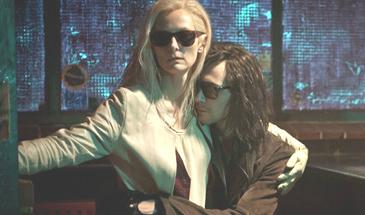
Cast: Tom Hiddelston, Tilda Swinton, Mia Wasikowska, John Hurt, Anton Yelchin, Jeffrey Wright
Director: Jim Jarmusch
123 minutes
A nocturnal (Detroit) Pennsylvania is the new Transylvania in Jim Jarmusch’s delightfully detached and quirkily deranged vampire-muso outing Only Lovers Left Alive. The film manages to successfully grab and bite back the genre from its more recent heavily teen-oriented focus and in so doing achieves a modern-Gothic romanticism evoking the people exodus and urban decay of Motor City. It does so in a calmly-measured and transcendent style. Without doubt this is the white-haired helmer Jarmusch firing on all cylinders even though he’s not in too much of a hurry to drive any sort of plot. The patience in pacing the piece echoes the lifestyles of the quasi-immortals caught up in the arts of popular culture.I viewed the film at a public preview screening in Glasgow and there was a palpable dismissal of it by many in the cinema with several leaving less than halfway through. This may have been due to the feature’s complete lack of concern for plotting, but any film which allows the viewer to breathe in so deeply, to revel in its dark spaces and eclectic moods is anything but sub-standard. Only Lovers Left Alive is comparable to listening to an exceptionally good album from beginning to end. The film even visually suggests this in the opening shot with the camera spinning and fading into a vinyl single giving it 45rpm on the turntable. Jarmusch’s own band, Sqürl provides a droning, but warm and fuzzy score that is quite wonderful in itself.
The increasingly superb Tom Hiddleston plays an old vampire named Adam, whose current existence in early 21st century Detroit is as a reclusive lengthy-tonsorialised musician with an ever growing collection of vintage guitars, Revox tape decks and mixing equipment in amongst various other instruments in his dilapidated home. Adam has a recurring penchant for writing dense deep music - ideal stuff for those in possession of taste and sophistication should they wish to avail themselves of it as ambience for suicide. Adam himself might be on the verge of self-topping as his connections to the outside world are few. He disguises himself as ‘Dr. Faust’ creeping stealthily in surgical clobber within a hospital to cut a deal for top-notch contraband blood supplies, where he hands over a substantial wedge of readies to an only-too-willing medic therein (a droll performance from Jeffrey Wright). His other supplier, a shaggy rock-head (Anton Yelchin) is a purveyor of exotic guitars and supplier of a hand-made wooden bullet, who occasionally drops in to ask of Adam, “Anything else weird or interesting you might require?” Later in his apparent misery, our anemic hero skypes an intervention-plea to his ex-lover in Tangier.
Jarmusch has some previous with Tilda Swinton (Broken Flowers, The Limits of Control) and he seems enamoured with her walking and sashaying style, so she shows up here giving it those very movements as Adam’s Eve. Her travel from North Africa to America (night flights but of course) is a sensual visual experience in itself. It’s a strange but undeniable pleasure to see her speed-read then throw copies of Dostoyevsky and David Foster Wallace into her metal suitcase. Existing both as a kind of mother and lover to Adam, Swinton’s Eve is more engaged in living and as such she is obliged to risk international travel to revitalise her former lover even if there is the risk of any one of her flights being delayed on the tarmac in daylight. For she, naturally, is also of the vampiric persuasion. Blood doesn’t go through customs too well, so vampire travel is a serious business.
Both Hiddelston and Swinton are sublime as the couple. The age difference matters not at all here, but their acting chemistry certainly does – and these two smoulder together beautifully. A lingering still shot of them naked asleep is aesthetically wonderful. They knock back blood shorts together, then drive off for a night-time tour of the formerly famous Michigan Theatre, with its imposing architecture - but tragically now an obscenely insulting car park. They talk about art, science and music and speculate on the future and dance to Denise La Salle's magnificently sassy 1972 single "Trapped By This Thing Called Love" as Eve professes her preference for Stax over Motown. Then, suddenly storming in from LA, is Mia Wasikowska, as Eve’s younger impulsive vampire sister - to provide some conflict and mess up the mating. John Hurt also shows up in a deliciously irascible role, debasing Shakespeare whilst grunting along in what is a marvellous cameo. Adam soothes Eve by recounting Einstein’s theory of ‘Spooky Entanglement.’ This offers (if I can recall correctly) that particles can influence each other’s state, even if they are a universe apart. So there, star-crossed lover film fans. In conclusion - I’d warmly recommend Jarmusch’s latest confection to those who feel the need for something more idiosyncratic than the usual mundane fare.
NT LIVE:
CORIOLANUS
(Donmar Warehouse Production)
CORIOLANUS
(Donmar Warehouse Production)
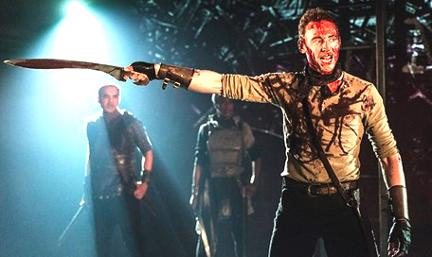
Tom Hiddleston as
Caius Martius Coriolanus
Mark Gatiss as Menenius
Brigitte Hjort Sorenson as Virgillia
Jacqueline Botswain as Valeria
Peter De Jersey as Cominius
Alfred Enoch as Titus Lartius
Deborah Findlay as Volumnia
Hadley Fraser as Aufidius
Elliot Levey as Brutus
Rochetta Sandall as Ensemble
Helen Schlesinger as Sicinia
Directed by Josie Rourke
Mark Gatiss as Menenius
Brigitte Hjort Sorenson as Virgillia
Jacqueline Botswain as Valeria
Peter De Jersey as Cominius
Alfred Enoch as Titus Lartius
Deborah Findlay as Volumnia
Hadley Fraser as Aufidius
Elliot Levey as Brutus
Rochetta Sandall as Ensemble
Helen Schlesinger as Sicinia
Directed by Josie Rourke
Not strictly a ‘feature film’ as such, but this was
broadcast to cinemas via NT (National Theatre) Live at Glasgow Film Theatre so it is more than
worthy of an appraisal.
Although Shakespeare’s Coriolanus isn’t amongst the most revered nor often performed of his plays, in 2011 Ralph Fiennes took on the director’s chair for a lavish film version - so clearly he too felt it merited revisiting. Here at the converted Warehouse, the Donmar production returns it to a more natural home on stage. Famine is threatening Rome’s destruction while the city’s common people (referred to here as ‘plebs’) face a constant violent reaction towards our hero Martius, later to be renamed Coriolanus when lauded for his immense solo endeavours in taking the city of Corioles.
Tom Hiddleston takes the leading role and offers a visceral powerhouse performance of vitriolic, bloodthirsty rage and esoteric bombast in Josie Rourke’s outstandingly sparse but lasceratingly relentless production.
Hiddleston is spellbinding as the eponymous Coriolanus. Winner of best newcomer only a year ago at the South Bank Sky Arts awards – he is now towering above a plateau of excellence - delivering a performance of soaring rage, subtlety and unyielding power. Caius Martius Coriolanus lacks Hamlet or Macbeth’s grand soliloquies, but then, as he is primarily a soldier, we can spare him that. The actual siege on Corioles is magnificent - as Hiddleston intones his men to “Put your shields before your hearts, and fight …. with hearts more proof than shields,” as he soars up the tall vertical metal ladder which stands ominously dominating centre stage.
Hiddleston’s Coriolanus is chameleonic – at once bold brave and battling – but also deeply unpleasant – as when he insultingly implores the people to elect him to the Senate, before denouncing them with offensive insults. Hiddleston throughout this, is immense, in both acting skill and physical bravura - being capable of effortlessly engaging his cohorts and enemies alike through comedy, fury and sadness in a matter of a few short moments. He successfully wins over the hearts of both those close to him and of strangers with consummate ease.
Gender politics is embraced and dealt with too in this play, especially through the central figure of Volumnia, Coriolanus’ mother. Outstandingly played by the exceptional Deborah Findlay - she is a tough, manipulative and forceful woman. Coriolanus is clearly in awe of her, she kicks and screams him into contention for the Senate, whilst expressing considerable delight upon discovering her son has been wounded in battle (this she revels in, as she feels assured it will attract increased public sympathy). Findlay’s performance is a standout in this production – portraying the cunning Volumnia as quite a shrewd political animal.
The production alas is not without some flaws and faults. Another integral female character - Coriolanus’ wife, Virgilia, is played by Birgitte Hjort Sørensen. Disappointingly, she of the superb Scandinavian political drama Borgen, has an extremely thin role –offering clear evidence of several deleted script pages. Another quibble is with the contradiction of costume design. At times I felt we the audience had accidentally strolled in to an advanced rehearsal session, as several characters were in contemporary attire, clashing ludicrously with others in period clothing.
Physical mannerisms too have not been held in sufficient check. High-fiving and 'man-embraces' which are now replacing familiarity handshakes, look completely out of place and damage a sense of authenticity. There are modern cynicism facial tics abound, which should have been noted and dealt with, not countenanced. Vernacular, verbal pace and clarity of diction are essential aural delivery idiom disciplines within Shakespearian performance and too many cast members are and were simply not sufficiently proficient. All of this clearly became evident when contrasting the work of, for example, an extremely poor attempt by Elliot Levey as Brutus, when compared with the exemplary work from Findlay, Gatiss and Hiddleston.
And to the ubiquitous but brilliant Mark Gatiss – here playing a Senator and Coriolanus’ closest friend Menenius – he just feels slightly underused. His Menenius is a witty figure, clad in a long scarf and waistcoat, brightening up proceedings with warmth and humour and veering from camp to fury, especially in his verbal sparring with the manipulative Tribunes. However, apart from an incredibly moving scene in which he fails in his plea to Coriolanus to abandon vengeance, he too is under-used.
Loud electronic music sequences bizarrely announce each scene change. But all the aforementioned aside - the staging is brilliant, considering the very limited space at their disposal. Having directed plays too on a limited stage area, I can fully appreciate their talent with logistical frugality. The scene where Coriolanus washes away the blood and gore of battle in a shower of water is wonderfully lit and adds triumph to some outstanding stage crew achievements.
Although Shakespeare’s Coriolanus isn’t amongst the most revered nor often performed of his plays, in 2011 Ralph Fiennes took on the director’s chair for a lavish film version - so clearly he too felt it merited revisiting. Here at the converted Warehouse, the Donmar production returns it to a more natural home on stage. Famine is threatening Rome’s destruction while the city’s common people (referred to here as ‘plebs’) face a constant violent reaction towards our hero Martius, later to be renamed Coriolanus when lauded for his immense solo endeavours in taking the city of Corioles.
Tom Hiddleston takes the leading role and offers a visceral powerhouse performance of vitriolic, bloodthirsty rage and esoteric bombast in Josie Rourke’s outstandingly sparse but lasceratingly relentless production.
Hiddleston is spellbinding as the eponymous Coriolanus. Winner of best newcomer only a year ago at the South Bank Sky Arts awards – he is now towering above a plateau of excellence - delivering a performance of soaring rage, subtlety and unyielding power. Caius Martius Coriolanus lacks Hamlet or Macbeth’s grand soliloquies, but then, as he is primarily a soldier, we can spare him that. The actual siege on Corioles is magnificent - as Hiddleston intones his men to “Put your shields before your hearts, and fight …. with hearts more proof than shields,” as he soars up the tall vertical metal ladder which stands ominously dominating centre stage.
Hiddleston’s Coriolanus is chameleonic – at once bold brave and battling – but also deeply unpleasant – as when he insultingly implores the people to elect him to the Senate, before denouncing them with offensive insults. Hiddleston throughout this, is immense, in both acting skill and physical bravura - being capable of effortlessly engaging his cohorts and enemies alike through comedy, fury and sadness in a matter of a few short moments. He successfully wins over the hearts of both those close to him and of strangers with consummate ease.
Gender politics is embraced and dealt with too in this play, especially through the central figure of Volumnia, Coriolanus’ mother. Outstandingly played by the exceptional Deborah Findlay - she is a tough, manipulative and forceful woman. Coriolanus is clearly in awe of her, she kicks and screams him into contention for the Senate, whilst expressing considerable delight upon discovering her son has been wounded in battle (this she revels in, as she feels assured it will attract increased public sympathy). Findlay’s performance is a standout in this production – portraying the cunning Volumnia as quite a shrewd political animal.
The production alas is not without some flaws and faults. Another integral female character - Coriolanus’ wife, Virgilia, is played by Birgitte Hjort Sørensen. Disappointingly, she of the superb Scandinavian political drama Borgen, has an extremely thin role –offering clear evidence of several deleted script pages. Another quibble is with the contradiction of costume design. At times I felt we the audience had accidentally strolled in to an advanced rehearsal session, as several characters were in contemporary attire, clashing ludicrously with others in period clothing.
Physical mannerisms too have not been held in sufficient check. High-fiving and 'man-embraces' which are now replacing familiarity handshakes, look completely out of place and damage a sense of authenticity. There are modern cynicism facial tics abound, which should have been noted and dealt with, not countenanced. Vernacular, verbal pace and clarity of diction are essential aural delivery idiom disciplines within Shakespearian performance and too many cast members are and were simply not sufficiently proficient. All of this clearly became evident when contrasting the work of, for example, an extremely poor attempt by Elliot Levey as Brutus, when compared with the exemplary work from Findlay, Gatiss and Hiddleston.
And to the ubiquitous but brilliant Mark Gatiss – here playing a Senator and Coriolanus’ closest friend Menenius – he just feels slightly underused. His Menenius is a witty figure, clad in a long scarf and waistcoat, brightening up proceedings with warmth and humour and veering from camp to fury, especially in his verbal sparring with the manipulative Tribunes. However, apart from an incredibly moving scene in which he fails in his plea to Coriolanus to abandon vengeance, he too is under-used.
Loud electronic music sequences bizarrely announce each scene change. But all the aforementioned aside - the staging is brilliant, considering the very limited space at their disposal. Having directed plays too on a limited stage area, I can fully appreciate their talent with logistical frugality. The scene where Coriolanus washes away the blood and gore of battle in a shower of water is wonderfully lit and adds triumph to some outstanding stage crew achievements.
