
Writer/Director: Paul Thomas Anderson
149 mins
Inherent Vice is heavily over-burdened with plot threads, characters and confusing motivations. It’s partly a dialogue-dense detective story, partly a comedy and is easily the funniest thing writer/director Paul Thomas Anderson has yet come up with, being a dope-hazed travelogue of Los Angeles’ youthful hippy-ideology optimism of the late 1960s. It feels, in short, like three or four films projected directly on top of each other.
The tone of the novel Inherent Vice serves the film adaptation brilliantly well, with "Doc" Sportello, a perpetually stoned private investigator who is throughout at the core of the narrative, sets out to solve the mystery surrounding his one-that-got-away ex-girlfriend, Shasta Fay Hepworth, a conspiracy that may or may not link to a pulp-novel criminal syndicate called the Golden Fang. This offers Anderson ample opportunity for all manner of weird and wonderful characters who dip in and out like a shoal of red herrings throughout the film’s 149 minutes.
Joaquin Phoenix packs every scene full of physical comedy with every imaginable facial twitch. However, Josh Brolin's performance as Sportello's sometimes-partner/sometimes-antagonist Lt. Detective "Bigfoot" Bjornsen is the real attention-grabber. Bjornsen seems as solid and straitlaced as Brolin's razor haircut at first, but his little peculiarities paint a portrait of a man who can match Sportello dysfunction for dysfunction. As the drop-out and the sell-out orbit around each other, the friction escalates until each starts to recognise his own characteristics hidden beneath the other's surface.
Anderson's 1970s Los Angeles is an unloved shabby seaside village where characters scurry around in tight little circles and occasionally collide. Inherent Vice has the willfully obtuse appearance and pacing of what is in effect a Hash Noir drama – and good luck as you try to unfankle the plot. However, the mystery itself is the least of Inherent Vice's real concerns. Everybody's missing somebody. But for all the neediness and heartache, the film's tone is totally zany. Much of the friendly energy probably comes from Radiohead’s brilliant tunesmith Johnny Greenwood's score, and the rest of the soundtrack distributes evocative period tunes - including a brace of Neil Young ‘Harvest’-era tracks, plus the Tornados' "Dreamin' on a Cloud," and Minnie Riperton's "Les Fleur".
The cast is packed full of actors who seem to be doing their own thing. Joanna Newsom is excellent as the plaintive narrator. Martin Short's thankfully short outing as a dentist maximizes his energy while simultaneously minimizing his tendency to mount your mammary glands. Katherine Waterston brings an alluring sadness to the role of Shasta with her deep melancholy becoming a siren call for Sportello’s tiny part of his brain he hasn't numbed into submission with whatever chemical product he can scrounge.
Even as its central mystery unravels, Inherent Vice jealously guards some of its secrets. What's at the heart of Detective Bjornsen's broken pride? Is it his domineering faceless wife? What, if anything, does Sportello want? Do any of these characters actually exist? Is there really a Thomas Pynchon cameo in the film, as has been insinuated? Maybe multiple viewings will solve some of Inherent Vice's myriad of puzzles.
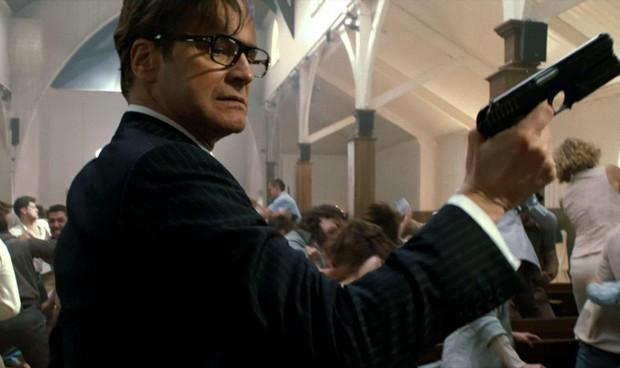
Cast: Colin Firth, Taron Egerton, Mark Strong, Samuel L. Jackson, Michael Caine
Director: Matthew Vaughn
128 mins
The last time Matthew Vaughn directed a film based on a comic book written by Mark Millar, the result was Kick-Ass, a lewd, crude superhero genre outing featuring an 11-year-old girl who swore like a drain and had more violence than an Old Firm game with free Special Brew. After that, Vaughn made X-Men: First Class, an actual superhero film wisely set in the Swinging 60s for some retro superspy grooves. With Kingsman: The Secret Service, Vaughn teams with Millar (and regular co-screenwriter Jane Goldman) again for something that’s a little of both: the over-the-top energy and hyper violence of Kick-Ass combined with the colourful fun and wit offered up by the best British and American spy thrillers/ spoofs of the 1960s and 1970s. And it works. Kingsman may not be Vaughn’s best film but it’s his biggest, his most confident, and his most outlandishly entertaining. Kingsman is top-notch enjoyment from the off, despite sagging a bit in the middle before wrapping up with a ridiculously huge finale. He’s aided well by Colin Firth as his lead spy, a combination of Roger Moore’s Bond, Patrick Macnee’s John Steed (The Avengers) and Michael Caine’s Harry Palmer (it’s no coincidence surely, that Caine is in the film too). Firth is all proper British mannerisms and composure until he lets loose with everything from lethal umbrellas and hidden throwing knives to his own fists; he then appropriately straightens his tie and combs back his hair, slightly sighing once whatever melee he’s faced is over.
The tale opens with Firth’s Harry Hart leading a team of fellow spies from the clandestine Kingsman organisation into a mission somewhere in the Middle East. It goes tits-up and as one agent is killed, Harry takes it upon himself to visit the man’s wife and young son, and offer to help them if they’re ever in a tough jam. Some years later and Harry gets the call to bail the now-grown son, Eggsy (Taron Egerton), out of jail for jacking a local gangster’s car. But Harry also offers Eggsy something else: a chance to become a recruit for Kingsman and, if he succeeds at getting through his training, taking his father’s place at Harry’s side. Eggsy does go through some familiar paces as he teeters on the edge of washing out of the programme. He’s joined there by several other cadets, including the resourceful Roxy (Sophie Cookson) and as they endure a trial by fire presided over by no-nonsense drill sergeant Merlin (Mark Strong with an hilarious Scottish accent), Harry and Kingsman head Arthur (Caine) are also consumed by other matters: a string of celebrity abductions somehow tied to the sinister mogul Richmond Valentine (Samuel L. Jackson), who you won’t be surprised to learn is hatching some sort of plan that involves something terrible happening on a global scale. Jackson’s Valentine, who speaks with a pronounced lisp and cannot stand the sight of blood, puts a quirky spin on the typical supervillain that’s on a par with the rest of this film’s tweaks of the genre’s nose. Another one of those is his henchwoman, Gazelle (Sofia Boutella), a super-efficient female take on the Oddjobs of the Bond films: she has blades for feet and a sharp wit as well. They both join Firth and Strong in selling the story and their characters even as they walk the thin line between self-awareness and self-parody – landing firmly on the self-aware side pretty much throughout the entire length of the film.
Egerton’s transformation from street hooligan to gentleman spy – the film references My Fair Lady directly – is believable although the extended training sequences tend to slow the middle portion of the film down. But it’s quickly revived by a stunning action scene in a church (set to the strains of “Freebird”), in which Firth takes on an entire congregation. It's a sequence that revels in its own bold gratuitousness, paving the way for an equally bravura finale. Kingsman: The Secret Service does exactly what it’s required to do, with panache and even a touch of elegance – much like the fictional spies that its makers unreservedly love and pay tribute to.
